Inflation Rate and CPI in Canada Today

The inflation rate is the rate at which the prices of goods and services in the Canadian economy increase over time. The Consumer Price Index (CPI) measures changes in the prices of a basket of goods and services over time.
Canada’s inflation rate held at 3.1% in October 2026, matching September, as higher prices for gasoline, natural gas, groceries and clothing offset lower cell phone plan prices and slower rent growth. The Bank of Canada (BoC) adjusts its policy interest rate to bring inflation back to its 2% target, and its core measures were mixed in October.
The next CPI release, covering November, is scheduled for December 14, 2026, and the BoC’s next rate announcement is December 9, 2026.
Key Takeaways
- Canada’s headline CPI held at 3.1% in October 2026, unchanged from September, with gasoline prices up 30.9% year-on-year.
- Excluding gasoline, CPI rose 2.2%, unchanged from September, and the Bank of Canada’s core measures were mixed: CPI-trim eased to 1.8%, CPI-median held at 2%, and CPI-common rose to 2.5%.
- Grocery price growth picked up to 2%, after 4 months of slowing, but stayed below headline inflation for a third straight month.
- The next CPI release is December 14, 2026, and the Bank of Canada announces its next interest rate decision on December 9, 2026.
Best Mortgage Rates
Current Inflation Rate in Canada: 3.1%
Canada’s inflation rate was 3.1% year over year in October 2026, unchanged from September, according to Statistics Canada. Gasoline again drove the headline: prices rose 30.9% year over year, compared with 27.8% in September. The CPI rose 0.2% month over month.
Higher prices for natural gas, groceries and clothing added to the pressure. Excluding gasoline, the CPI rose 2.2%, unchanged from September. Excluding energy altogether, inflation was 2%, down from 2.1%.
Part of the gasoline gain is a base-year effect: gasoline fell 4.8% in October 2025, and that drop no longer counts in the 12-month change. Gasoline fell 2.5% month over month in October 2026 but stayed elevated amid uncertainty about the geopolitical conflicts in the Middle East and Ukraine.
Transportation (+8.9%) again led the 8 major components. Four accelerated from September, while 3 slowed and 1 was unchanged.
Inflation by CPI Category, October 2026
| CPI Category | CPI |
|---|---|
| Transportation | 8.9% |
| Recreation, Education and Reading | 4.2% |
| Clothing and Footwear | 2.7% |
| Food | 2.4% |
| Health and Personal Care | 2.1% |
| Alcoholic Beverages, Tobacco Products, and Recreational Cannabis | 1.6% |
| Shelter | 1.4% |
| Household Operations, Furnishings and Equipment | 0.1% |
Inflation Rates by Province, October 2026
| Province | Inflation Rate |
|---|---|
| Nova Scotia | 5.9% |
| Prince Edward Island | 5.2% |
| Newfoundland and Labrador | 4.9% |
| New Brunswick | 4.8% |
| Manitoba | 4.2% |
| Saskatchewan | 3.7% |
| Quebec | 3.4% |
| Alberta | 3.3% |
| British Columbia | 2.5% |
| Ontario | 2.5% |
Fuel oil and other fuels rose 61.1% year over year, and Atlantic Canada uses fuel oil for home heating more than any other region. Excluding energy, inflation was 3.4% in Nova Scotia, 2.7% in New Brunswick and Newfoundland and Labrador, and 2.2% in Prince Edward Island, versus 2% nationally. Ontario and British Columbia (both 2.5%) were the only provinces below the national rate.
Grocery Price Growth Picks Up to 2% but Stays Below Headline Inflation
Prices for food purchased from stores rose 2% year over year in October, up from 1.7% in September, according to Statistics Canada. It followed four consecutive months of slower price growth and was the third consecutive month grocery price growth ran slower than the all-items CPI.
Higher prices for fresh vegetables (+1.4%, after -2.9% in September), sugar and confectionery (+0.4%) and condiments, spices and vinegars (+2.6%) drove the acceleration.
Slower grocery inflation is not relief at the till. Inflation measures the pace of change, not the level, so grocery prices remain 31.9% higher than in October 2020.
Shelter Cost Growth Slows to 1.4% as Rent and Insurance Ease
Shelter cost growth slowed to 1.4% year over year in October from 1.8% in September. Slower rent price growth (+1.7%, down from +2.8%) and slower growth in homeowners’ home and mortgage insurance (+3.8%, down from +4.9%) pulled it down, according to Statistics Canada data. Property taxes and other special charges, priced once a year in October, rose 3.8% nationally, compared with 5.6% in October 2025.
Statistics Canada said a slowdown in rent prices was the main reason inflation eased in British Columbia. The mortgage interest cost (MIC) index was flat year over year (0%), and homeowners’ replacement cost fell 2.1%. The mortgage interest cost index tracks interest costs on outstanding mortgages, so it does not show mortgage rates falling.
Asking rents, the prices landlords list for vacant units, can fall while the CPI rent component, the rent tenants actually pay, still rises. Our Canadian housing market outlook tracks the national housing picture each month.
What Is Inflation and How Is It Measured
Inflation measures the increase in the cost of goods and services over time. Inflation reduces purchasing power over time, so as it rises, your dollar buys less than it used to.
The Consumer Price Index (CPI) measures inflation by tracking the retail prices of a basket of goods and services over time. The CPI is the index, while the inflation rate is the percentage change in that index. CPI is divided into 8 major categories, each weighted by how much consumers spend on that good or service. Basket weights are typically updated annually.
CPI Basket Weights
| Category | CPI Basket Weight |
|---|---|
| Shelter | 28.30% |
| Transportation | 18.54% |
| Food | 16.93% |
| Household Operations, Furnishings and Equipment | 12.80% |
| Recreation, Education and Reading | 9.81% |
| Health and Personal Care | 5.40% |
| Clothing and Footwear | 4.50% |
| Alcoholic Beverages, Tobacco Products and Recreational Cannabis | 3.73% |
Statistics Canada calculates the inflation rate as the percentage change in the CPI from the same month one year earlier. October 2026’s 3.1% rate means the CPI was 3.1% higher than in October 2025. CPI data are measured in each province and territory and weighted by each province’s share of Canada’s consumer spending.
CPI Basket Weights by Province
| Geography | Weight |
|---|---|
| Canada | 100% |
| Newfoundland and Labrador | 1.32% |
| Prince Edward Island | 0.36% |
| Nova Scotia | 2.50% |
| New Brunswick | 1.92% |
| Quebec | 20.74% |
| Ontario | 39.76% |
| Manitoba | 3.18% |
| Saskatchewan | 2.85% |
| Alberta | 12.56% |
| British Columbia | 14.63% |
| Whitehorse, Yukon | 0.08% |
| Yellowknife, Northwest Territories | 0.07% |
| Iqaluit, Nunavut | 0.03% |
The Bank of Canada’s Preferred Measures of Core Inflation
The Bank of Canada’s preferred measures of core inflation are CPI-trim, CPI-median and CPI-common. Since January 2017, the Bank has used them as an operational guide to the underlying inflation trend, according to the Bank of Canada, because they help it look through temporary swings in total CPI.
CPI-trim
This measure excludes CPI components with extreme monthly price movements, so conditions that affect only one component, such as a drought that lifts food prices, do not distort it. CPI-trim removes the highest and lowest 20% of weighted monthly price changes, which make up 40% of the basket. CPI-trim was 1.8% in October 2026, down from 1.9% in September.
CPI-median
This measurement also filters out volatile price movements in components, similar to CPI-trim. However, this measure uses the middle point, or median, price change within a component’s range. CPI-median was 2% in October 2026, unchanged from September.
CPI-common
This measure follows price changes common across basket categories. A statistical model known as the factor model identifies common variations and filters out component-specific price movements. CPI-common was 2.5% in October 2026, up from 2.4% in September.
Headline Inflation vs. Core Inflation
Headline inflation can run above core inflation when a few volatile prices, such as gasoline, rise quickly. Core measures strip out or discount extreme price changes, so they show whether price pressure is broad or concentrated, which is why the BoC watches them alongside the headline.
| Measure | October 2026 | September 2026 | What it shows |
|---|---|---|---|
| Headline CPI | 3.1% | 3.1% | The overall change in consumer prices used for the BoC’s 2% inflation target. |
| CPI excluding gasoline | 2.2% | 2.2% | Inflation with gasoline removed, a quick test of whether energy is driving the headline CPI. |
| CPI excluding food and energy | 1.8% | 2.1% | Inflation without two volatile groups; this is not one of the Bank’s core measures. |
| CPI-trim | 1.8% | 1.9% | Inflation after removing the components with the most extreme monthly price changes. |
| CPI-median | 2% | 2% | The middle price change across the entire CPI basket. |
| CPI-common | 2.5% | 2.4% | Price changes shared across CPI categories. |
| Shelter | 1.4% | 1.8% | Rent, mortgage interest cost (MIC), owned accommodation and related housing costs, with the largest CPI basket weight at 28.30% |
Where Is the Bank of Canada’s Policy Rate Headed Next?
The Bank of Canada raised its policy rate by 25 basis points to 2.50% on October 28, 2026. It was the Bank’s first increase since July 2023 after seven consecutive holds, and it will next announce its rate on December 9, 2026.
Governing Council said it raised the rate “to reduce the risk that continuing high energy prices spread broadly to the prices of other goods and services.”
The Big Six banks split on December 9: RBC, Scotiabank and National Bank expect another increase by year-end, while BMO, CIBC and TD expect the Bank to wait until 2027. See each bank’s view in our Mortgage Rates Forecast.
For the full breakdown, see our Bank of Canada Announcement article and the Bank of Canada interest rate schedule; for a longer-range view, see our Mortgage Rates Forecast.
On October 28, the Bank of Canada raised its target for the overnight rate by 25 basis points to 2.50%, its first increase since July 2023 after seven consecutive holds. The big banks raised prime by the same amount, to 4.70%, effective October 29. The Bank said growth picked up through the middle of the year, with GDP up 3.3% in the second quarter and about 2% in the third. Statistics Canada’s October 30 data came in softer: real GDP was essentially unchanged in August, and industry figures point to 0.3% third-quarter growth, about 1.3% annualised. The unemployment rate rose to 6.7% in October, after holding around 6.5% for several months. CPI inflation was 3.1% in October, unchanged from September; excluding energy, it was 2%, and core inflation remains close to 2%. The Bank now expects inflation to rise to about 3.5% by the end of the year, average 3% in 2027 and fall to 2% by mid-2028. Governor Tiff Macklem explained the decision:
In September, the Bank held while weighing two risks pulling in opposite directions. This time it acted on the first: energy prices expected to stay higher for longer and building cost pressures. It left the door open to more: “There could be a need to increase the policy rate further, but given uncertainties, Governing Council agreed to proceed carefully.” History points the same way: no Bank of Canada tightening cycle since 1997 has ended after a single increase. Bond markets put the odds of a 25-basis-point hike on December 9 at 66%, against 34% for a hold, and imply 99% for a hike by January 27. Read the full Opening Statement, the October Monetary Policy Report and our post-announcement mortgage strategy breakdown to understand what this means for Canada’s mortgage rate forecast.
How Does Inflation Affect Mortgage Rates?
Higher inflation can push mortgage rates up, but a single CPI release won’t move them. Variable rates follow lenders’ prime rates, and prime rates follow the Bank’s policy rate. Fixed rates follow Government of Canada (GoC) bond yields.
Fixed-rate borrowers feel inflation when their mortgages are up for renewal, while variable and adjustable-rate borrowers feel it when lenders’ prime rates follow the BoC’s changes to the policy interest rate. See what affects mortgage rates in Canada and our mortgage rates forecast for how the pieces fit.
What a Higher Rate Does to a $500,000 Mortgage Payment
A quarter-point rate change moves the monthly payment on a $500,000 mortgage with 25 years remaining by about $70. The table shows what 3 illustrative rates mean for that monthly payment under each compounding convention.
| Illustrative rate | Variable (monthly compounding) | Change from 4.45% | Fixed (semi-annual compounding) | Change from 4.45% |
|---|---|---|---|---|
| 4.45% | $2,765 | Starting point | $2,753 | Starting point |
| 4.70% | $2,836 | +$71 | $2,823 | +$70 |
| 5.00% | $2,923 | +$158 | $2,908 | +$155 |
Test your own balance and renewal date with our mortgage renewal calculator or mortgage payment calculator, and compare today’s mortgage rates to see where pricing stands.
What to Watch Next for Inflation and Interest Rates
Four dates in the next 4 weeks matter most for inflation and for the Bank of Canada’s rate path.
| Date | Release | Why it matters |
|---|---|---|
| November 30, 2026 | Third-quarter GDP and September GDP by industry | A read on Canada’s economic growth and demand |
| December 4, 2026 | November Labour Force Survey | Employment and wage growth |
| December 9, 2026 | Bank of Canada rate decision | Final decision of the year, without a new Monetary Policy Report |
| December 14, 2026 | November CPI | Whether energy price increases are spreading to other categories |
Between those dates, watch whether CPI-trim, CPI-median and CPI-common keep moving toward 2%, wage growth, and the 5-year GoC bond yield. The Bank of Canada reported that yield closed at 3.52% on November 18.
Historical Inflation Rates in Canada
The table below shows a 10-year history of Canadian inflation rates from January 2016 to the present. For mortgage rates over the same period, see our mortgage rates history.
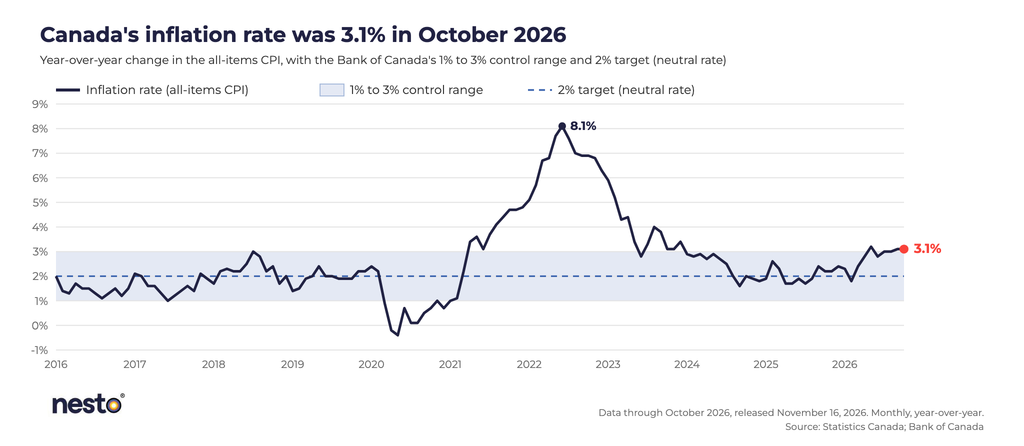
Chart methodology: monthly year-over-year change in the all-items Consumer Price Index, January 2016 to October 2026, as published by Statistics Canada and compiled by the Bank of Canada. The shaded band is the Bank’s 1% to 3% control range, and the dashed line is its 2% target (neutral rate). Data through October 2026. Source: Bank of Canada
| Year | Jan | Feb | Mar | Apr | May | Jun | Jul | Aug | Sep | Oct | Nov | Dec |
|---|---|---|---|---|---|---|---|---|---|---|---|---|
| 2016 | 2% | 1.4% | 1.3% | 1.7% | 1.5% | 1.5% | 1.3% | 1.1% | 1.3% | 1.5% | 1.2% | 1.5% |
| 2017 | 2.1% | 2% | 1.6% | 1.6% | 1.3% | 1% | 1.2% | 1.4% | 1.6% | 1.4% | 2.1% | 1.9% |
| 2018 | 1.7% | 2.2% | 2.3% | 2.2% | 2.2% | 2.5% | 3% | 2.8% | 2.2% | 2.4% | 1.7% | 2% |
| 2019 | 1.4% | 1.5% | 1.9% | 2% | 2.4% | 2% | 2% | 1.9% | 1.9% | 1.9% | 2.2% | 2.2% |
| 2020 | 2.4% | 2.2% | 0.9% | -0.2% | -0.4% | 0.7% | 0.1% | 0.1% | 0.5% | 0.7% | 1% | 0.7% |
| 2021 | 1% | 1.1% | 2.2% | 3.4% | 3.6% | 3.1% | 3.7% | 4.1% | 4.4% | 4.7% | 4.7% | 4.8% |
| 2022 | 5.1% | 5.7% | 6.7% | 6.8% | 7.7% | 8.1% | 7.6% | 7% | 6.9% | 6.9% | 6.8% | 6.3% |
| 2023 | 5.9% | 5.2% | 4.3% | 4.4% | 3.4% | 2.8% | 3.3% | 4% | 3.8% | 3.1% | 3.1% | 3.4% |
| 2024 | 2.9% | 2.8% | 2.9% | 2.7% | 2.9% | 2.7% | 2.5% | 2% | 1.6% | 2% | 1.9% | 1.8% |
| 2025 | 1.9% | 2.6% | 2.3% | 1.7% | 1.7% | 1.9% | 1.7% | 1.9% | 2.4% | 2.2% | 2.2% | 2.4% |
| 2026 | 2.3% | 1.8% | 2.4% | 2.8% | 3.2% | 2.8% | 3% | 3% | 3.1% | 3.1% |
What Drives Inflation?
Inflation comes from three channels: demand that exceeds supply (demand-pull inflation), higher production costs (cost-push inflation) and wage-price loops (built-in inflation).
The clearest current example is cost-push inflation. By September, the Middle East conflict had pushed crude oil prices to their highest level since May. Consumers felt inflation as gasoline prices rose 30.9% from a year earlier in October, while fuel oil and other fuels were up 61.1% over the same period.
Wage growth is the key indicator for the built-in inflation channel. Average hourly wages rose 2.2% year over year in October, down from 2.3% in September and still slower than headline inflation, according to Statistics Canada’s Labour Force Survey. Wages are the mechanism that would turn an energy shock into persistent inflation.
How to Calculate Inflation Rate
To calculate the inflation rate, divide the change in the price index by the previous index and multiply by 100.
Inflation Rate = (Current CPI – Previous CPI) / Previous CPI x 100
The all-items CPI stood at 170.4 in October 2026, up from 165.3 in October 2025, both on the 2002 = 100 base, so (170.4 – 165.3) / 165.3 x 100 = 3.1%.
Who Benefits From Inflation?
Corporations that can raise prices tend to benefit most from inflation, such as real estate and supermarkets. Borrowers with fixed mortgage rates also benefit, but only to a limited extent. Inflation erodes the real value of a fixed mortgage payment over time, but that benefit holds only while the rate is locked, so it disappears at renewal.
Who Does Inflation Hurt?
Inflation harms consumers, particularly those with low or fixed incomes, by eroding their purchasing power. They spend a larger share of their income on necessities such as rent and food, so they must cut other spending.
Inflation lands unevenly. In October, fuel oil and other fuels rose 61.1% nationally, with the largest effect in Atlantic Canada, where inflation was 5.9% in Nova Scotia and 5.2% in Prince Edward Island. An Ontario household faced provincial inflation of 2.5%, and renters across the country saw rent rise 1.7%. Our guide to sticky inflation covers what persistent price pressure means for homebuying.
We're curious…
Frequently Asked Questions (FAQ) About the Consumer Price Index (CPI)
What is Canada’s current inflation rate?
Canada’s inflation rate was 3.1% year over year in October 2026, unchanged from September, according to Statistics Canada. Excluding gasoline, the CPI rose 2.2%. The next CPI release, covering November, is scheduled for December 14, 2026.
Why did Canada’s inflation rate hold at 3.1% in October 2026?
Canada’s inflation rate held at 3.1% in October 2026 because gasoline prices climbed 30.9% year over year, up from 27.8% in September, partly because of a base-year effect. Fuel oil and other fuels rose 61.1%, and natural gas prices rose 4.9%. Lower cellular service prices and slower rent growth kept the all-items CPI rate from rising.
Which province has the highest inflation rate in Canada?
Nova Scotia had the highest provincial inflation rate in October 2026 at 5.9%, followed by Prince Edward Island at 5.2%, Newfoundland and Labrador at 4.9% and New Brunswick at 4.8%. Ontario and British Columbia were the lowest, both at 2.5%.
What is the Bank of Canada’s inflation target?
The Bank of Canada’s inflation target is 2% (neutral rate), the midpoint of a 1% to 3% control range, measured as the year-over-year change in total CPI. Total CPI can sit outside that range temporarily because of volatile items such as gasoline, and the Bank uses core measures to judge whether underlying inflation is returning to target.
Is CPI excluding gasoline the same as core inflation?
CPI excluding gasoline is not the same as core inflation. It removes one volatile item from the total, while the Bank of Canada’s core measures use statistical methods to filter out extreme price movements across components. In October, inflation excluding gasoline was 2.2%, CPI-trim was 1.8%, CPI-median was 2% and CPI-common was 2.5%.
What is deflation?
Deflation is the opposite of inflation: a sustained fall in the general price level. Falling prices can reduce business profits as consumers wait for prices to fall further, and if deflation persists, it can lead to job losses and wage cuts. Canada experienced prolonged deflation during the Great Depression.
What are negative real interest rates?
A real interest rate is the interest rate minus the headline inflation rate. A negative real interest rate results when inflation outpaces the nominal rate. In March 2022, the policy rate was 0.5%, and inflation was 6.7%, a negative real rate of 6.2%.
Will inflation come down in 2027?
The Bank of Canada expects inflation to stay elevated through 2027. Its October Monetary Policy Report projects CPI inflation of about 3.5% by the end of 2026, an average of 3% in 2027 and a return to 2% around the middle of 2028. Projections can change with energy prices.
Is 3.1% inflation high in Canada?
At 3.1%, October inflation is just above the top of the Bank of Canada’s 1% to 3% control range and above its 2% target (neutral rate). Excluding energy, inflation was 2%, and the trimmed-mean and median measures are at or near 2%, so the pressure is concentrated in energy.
How do higher interest rates bring inflation down?
Higher interest rates bring inflation down by making borrowing more expensive, which slows spending and demand and eases price pressure with a lag. The Bank of Canada raised its policy rate to 2.50% on October 28 to reduce the risk that high energy prices spread to other goods and services.
Final Thoughts
Canada’s inflation rate held at 3.1% in October 2026 as gasoline prices climbed 30.9% year over year. The Bank of Canada’s core measures were mixed, with CPI-trim at 1.8%, CPI-median at 2% and CPI-common at 2.5%. The Bank raised its policy rate on October 28 to reduce the risk that higher energy prices spread to other prices.
The next economic indicators are third-quarter GDP on November 30, the November jobs report on December 4, the Bank’s December 9 decision and the November CPI on December 14.
If your mortgage renews soon or you’re planning a purchase, speak with nesto mortgage experts. Our licensed mortgage professionals can help you test your payment at today’s rates, compare your options and review your mortgage strategy so your household can withstand the next rate cycle.
Why Choose nesto
At nesto, our commission-free mortgage experts are salaried and regulated, with most licensed in multiple provinces. They are evaluated on client satisfaction and the quality of their advice, and they help you compare mortgage options and understand rates and qualification requirements. Once you’re ready to move forward, they work with you on a mortgage strategy that fits your situation.
nesto pairs expert advice with a 100% digital, transparent and seamless process, and a dedicated mortgage professional supports you throughout your purchase, renewal or refinance.
nesto is on a mission to offer a positive, empowering and transparent property financing experience – simplified from start to finish.
Contact our knowledgeable mortgage experts to find your best mortgage rate in Canada.
Let’s get started!
About the contributors