

Bank of Canada Holds Rate at 2.25% | September 2026 Announcement
Bank of Canada Holds at 2.25% as Trade Uncertainty Narrows Its Options
The Bank of Canada held its target for the overnight rate at 2.25% today, a seventh consecutive hold. The policy rate hasn’t changed since October 2025.
For anyone shopping for a mortgage, the more consequential number this week wasn’t the one the Bank published. The 5-year Government of Canada (GoC) bond yield climbed through August, pulling fixed mortgage rates higher. Here’s what changed since the July 15 announcement, and what it means for your mortgage strategy.
Best Mortgage Rates
What the Bank of Canada Decided
The Bank’s decision leaves the policy rate at 2.25%, with the Bank Rate at 2.5% and the deposit rate at 2.20%, all unchanged since the last rate cut on October 29, 2025. September was not a Monetary Policy Report meeting, so Governor Tiff Macklem and Senior Deputy Governor Carolyn Rogers took questions without a fresh set of projections behind them. The next monetary policy forecast arrives on the October 28 announcement.
The framing the Bank carried into September came from its July decision, when it judged the current rate appropriate to support the recovery and bring inflation back to target. At that point the Bank projected growth of 0.7% for 2026, rising to 1.8% in both 2027 and 2028. Its inflation path had headline CPI easing to roughly 2.5% through the second half of this year, then returning to 2% in early 2027.
Inflation since then has been an awkward read. Headline CPI reached 3% in July, at the top of the Bank’s 1% to 3% target range, while its preferred core measures averaged 2%, with CPI-trim at 1.9% and CPI-median at 2%. Almost the whole gap was due to the surge in gasoline prices. Strip gasoline out and inflation was 2.2%. The Bank has said repeatedly that it will look through an energy shock as long as the shock stays contained, and core inflation has given it no reason to stop.
Why the Bank Held After Growth Came in at 3.3%
Last week, just days before the decision, Statistics Canada reported that real GDP grew 3.3% on an annualized basis in the second quarter, the fastest quarterly pace in more than 3 years. The print beat the Bank’s own July forecast of 2.5% for the quarter, and the same release revised Q1 growth up to 0.3% annualized from the flat reading first published. On a per-person basis, real GDP per capita rose 1% in the quarter, helped by a population that has now declined for 3 straight quarters.
A print that strong would normally argue against holding, and the gains were not narrow. Consumption posted solid gains and housing activity rebounded after several weak quarters. Some of that strength came from temporary factors, though, and the timing of the quarter matters more than its size. Business capital investment rose after five straight quarterly declines. Engineering structures (referred to as large-scale non-building infrastructure projects) rose 2.3%, and spending on computers and peripherals rose 16.7%, most of it imports of the processing units used in data centres. Residential investment rallied 2.5%, with resale activity leading the way in Ontario, Quebec, and British Columbia. The rest was exports, and exports are where the quarter gets complicated.
The two releases covering Q2 describe those exports differently. In the GDP accounts, export volumes rose 3.6%, the strongest quarterly gain since early 2023, led by passenger cars and light trucks at 27% as Canadian auto production recovered. The balance of payments, which measures value rather than volume, puts energy in front. Goods exports rose 13.1% to a record $232.1 billion, and energy products jumped 27.4%. Crude oil and bitumen alone reached a record $44.8 billion as the war with iran and the closure of the Strait of hormuz lifted prices. Canada’s goods balance swung from a $6.4 billion deficit in Q1 to a $12.2 billion surplus, its largest since 2008, and the current account posted its first surplus since 2022.
Then, if you look at the calendar, the reference period ended June 30. Trade talks between Ottawa and Washington broke down in August, and the United States imposed 50% tariffs on roughly $28 billion of Canadian exports on August 22. Canada answered dollar for dollar, with counter-tariffs on $27.6 billion of American goods taking effect September 8. Statistics Canada’s own advance estimate has July GDP flat. The quarter the Bank was handed and the economy it has to set policy for are not aligned with its current direction.
The tariffs and the growth engine only partly overlap. Energy has so far been carved out of the US measures, along with potash, critical minerals, and goods already under Section 232 tariffs, which shelters the largest single source of the quarter’s export value. Motor vehicles have no such protection, and they are what drove the volume gain. Even after the rebound, auto exports stayed below their 2023 and 2024 quarterly average. One price surge sits on both sides of the Bank’s problem. The crude oil that lifted Q2 export earnings becomes the gasoline holding inflation near 3%, and refinery margins have stayed wide enough to keep pump prices high on their own.
Leaving the policy rate unchanged is a reasonable response to that gap. The Bank also has its own read on what counter-tariffs do to prices. Its study of the 2025 round found they raised the cost of targeted goods by about 6% and added roughly 0.3% to headline CPI at the peak of the shock. CIBC puts the price-level effect of this round at about the same 0.3%, reasoning that Ottawa picked goods with ready substitutes and expects the drag on growth to outweigh the lift to inflation. Oxford Economics puts it higher, at up to 0.5 percentage points on consumer prices next year. The Bank got its August employment reading on September 4 and gets August inflation on September 14, both of which describe conditions after the tariffs landed. Moving in either direction on September 2 would have meant setting policy on a quarter that had already closed.
Why Fixed Mortgage Rates Rose in August While the Policy Rate Did Not
Fixed mortgage rates are priced off Government of Canada (GoC) bond yields, not off the overnight rate. Bond investors set those yields, and what they’re pricing in is global inflation risk, US Treasury supply, and the oil market, none of which the Bank of Canada controls. A stable policy rate alongside rising fixed rates isn’t a contradiction because the 2 rates answer to different markets.
August made the point twice. On August 17, lenders raised fixed rates by 5 to 20 basis points across 3-, 4-, and 5-year terms. The trigger was the 5-year GoC yield closing at 3.31%, in reaction to a July inflation print that ran slightly hot. Four days later, a global bond selloff carried yields toward a 12-month high near 3.36%, and lenders repriced again, mostly by 10 to 15 basis points and, in a few cases, by 20. Not every lender followed either move, and some trimmed selected terms. The GoC yield hasn’t run straight up since. It closed at 3.26% on August 26, according to the Bank’s own bond-yield table, roughly 10 basis points below its August 21 level.
It has since drifted back to around 3.35%, close to a 52-week high, and lenders have held their higher pricing rather than bringing it back down. Canada’s weak August jobs report barely touched it: the 4-year swap rate and the 5-year Canada Mortgage Bond rate, 2 of the funding benchmarks behind fixed pricing, slipped only 1 and 3 basis points on the day. That is the clearest evidence available that domestic data is not what is driving your fixed rate right now.
That climb was global, not Canadian. Long-term yields rose across major markets over the summer, and Canada’s moved with them, tightening financial conditions without a single policy change. The C.D. Howe Institute’s monetary policy council draws the practical conclusion that when bond markets tighten conditions on their own, the Bank has less need to do so itself. It may also have gone too far. Desjardins reads market pricing as taking the policy rate above 3.00% in 2027, against its own call of 2.75%, on the reasoning that permanently higher tariffs lower potential growth and therefore the neutral rate. If that view is right, bond yields can fall, and fixed pricing can ease without the Bank cutting at all.
For a borrower, the practical read is short. If you’re shopping a fixed term, the number that decides your pricing is the bond yield, and it can move daily without a word from the Bank. If you’re on a variable or adjustable rate, the Bank’s decisions are what matter, and the September announcement told you nothing changes for now.
What the Hold Means if You Have a Variable Mortgage
For borrowers holding an adjustable or variable mortgage, there is no change to your carrying costs or monthly payments over this statement cycle. Lenders set their prime rate off the Bank’s policy rate, so a hold leaves prime alone, and everything priced against prime remains unchanged.
If you hold a variable-rate mortgage (VRM), your payment was already fixed, and the split between principal and interest stays as it is. If you hold an adjustable-rate mortgage (ARM), your payment floats with the prime rate, so it remains unchanged.
The real change sits in what comes next. For most of 2024 and 2025, the case for a variable rate rested on cuts arriving and a borrower riding them down. That case is gone. Market pricing has flipped from asking when the Bank will cut to asking when it will hike. The consensus now runs to no move for the rest of 2026, with the first hike expected in the first half of 2027. In a Bloomberg survey, 63% of economists took that view, matching pricing in overnight swaps. Money markets have since gone further and are pricing in a partial increase for the December 9 decision. The timing implied by that pricing still swung noticeably within single weeks in August, and the soft August jobs report pushed it back again, so treat any specific probability you see quoted as a dated snapshot.
Anyone weighing a switch should run the math first. A payment shock calculator will show what a 25- or 50-basis-point increase does to your monthly obligation. Whether that number is tolerable is the real question beneath the fixed-versus-variable debate. Some borrowers take the opposite approach and start in a variable rate with the intention of converting to a fixed rate later, on the view that fixed pricing will ease. That is a real option, since most lenders allow a conversion mid-term, but it carries 2 risks worth naming: a variable rate rises if the Bank raises the policy rate, and a borrower who converts later receives whatever fixed rate their lender offers on that day, not today’s.
What the Hold Means if You Have a Fixed Rate or a Renewal Ahead
Nothing changes mid-term for fixed rate holders either. Your interest rate and monthly payment were locked in when you signed, and a policy decision doesn’t affect a fixed term.
Renewal is where the September decision actually lands. The rate on offer at renewal today is not the rate that was on offer in mid-July, with 2 rounds of lender increases having occurred in between. Anyone with a maturity date within the next 6 months has a reason to start comparing now. The Bank’s October meeting won’t set fixed pricing in any case.
The renewal picture is also less punishing than the coverage around it suggests. In its Q3 disclosure, BMO reported that roughly half the mortgages it renewed came off at a lower payment than the borrower had been making. Borrowers who signed at the peak of the last tightening cycle are still renewing into lower rates, even with fixed pricing drifting up from its spring lows.
A rate hold is the practical protection while you shop. It fixes today’s pricing for a defined window, so a repeat of August’s bond move doesn’t reprice you mid-search. At nesto, the 150-day hold applies to the 5-year fixed and 5-year variable, and all other terms carry holds of up to 120 days.
What Could Change the Bank’s Mind Before October’s Meeting
The calendar between the September and October decisions included four dates that matter, and two have now passed. Statistics Canada published August employment on September 4, and Canada’s counter-tariffs took effect September 8. August inflation follows on September 14, and the Bank releases its summary of deliberations on September 16, the closest public view of the Governing Council’s reasoning. September employment lands on October 9, the last labour reading before the decision.
The August jobs report came in soft. Employment fell by 42,000, missing forecasts for a gain of about 15,000; the unemployment rate held at 6.4% only because the labour force shrank with it; and average hourly wages slowed to 2.0% from 2.8% in July. That reverses part of a strong run, since employment had risen 181,000 between April and July. It does not turn the labour market into an argument for a cut, because the jobless rate is still more than half a percentage point below where it sat a year ago, but it does take some urgency out of the case for an increase. Manulife Investment Management read the report as evidence that any signal of imminent increases was premature.
Each remaining date pushes in a specific direction. Core inflation broadening beyond gasoline would strengthen the case for a hike, since the Bank’s tolerance for the energy shock has always been conditional on exactly that not happening. Slower wage growth pulls in the opposite direction, because wages are the main channel through which an energy shock becomes persistent. A tariff hit large enough to swamp the inflation picture would strengthen the case for a cut. RBC Economics puts the US measures now in force at about 5% of Canadian exports to the United States and about 0.4% of Canadian GDP and jobs. That is meaningfully real without being decisive, and Statistics Canada’s own numbers show where it bites: the layoff rate in industries dependent on US export demand averaged 0.9% over the 12 months to August, against 0.7% elsewhere.
RBC’s August 27 read allocates the risk in escalation rather than in the tariffs already applied. A significant escalation would damage growth enough to offset the inflation worry, and that is the path that would argue for cuts. On the measures as they stand, RBC expects the Bank to stay on hold for the rest of 2026.
The 2 risks are not weighted equally, though. Desjardins makes the point that the Bank had a plan for oil-driven inflation and a plan for trade escalation, but never set out what it would do when both occurred at once. Its inflation mandate obliges it to prioritise price pressures over growth when the two conflict, which pushes a cut further out than a balanced reading suggests.
Neither outcome is the base case today, though the balance has shifted. Upside inflation risk has grown while the tariffs have made growth prospects less certain, and the Bank has been careful not to pre-commit either way. The workable assumption for a borrower is that the policy rate stays at 2.25% into the fall, with any move treated as the exception. Our mortgage rate forecast tracks the same inputs over a longer horizon.
What nesto Borrowers Are Actually Doing
Forecasts are a dime a dozen. What distinguishes nesto’s vantage point is that we watch what Canadians are signing in close to real time, and the behaviour cuts through the noise.
Among nesto applicants in April 2026, 71% voiced an intent to go variable at the application stage, the strongest variable appetite in 17 months of nesto data. Yet by the time those same borrowers locked in a term, only 34% followed through on variable. The intent to float more than halved between the first conversation and the signature.
The destination was overwhelmingly fixed. Of every nesto borrower who committed to a term that month, roughly half chose the 5-year fixed, and more than three-quarters of those choosing a fixed rate took the 5-year. The quickest mover was the 3-year fixed, whose share of nesto commitments jumped from about 7.8% in February to 14.3% in April. Borrowers were gathering around certainty well before the market made the upward path official.
We're curious…
How to Read the Hold From Where You Stand
Today’s rate hold means something different depending on your mortgage situation. You can stress test any of these against your own numbers using nesto’s mortgage payment calculator.
Buyers
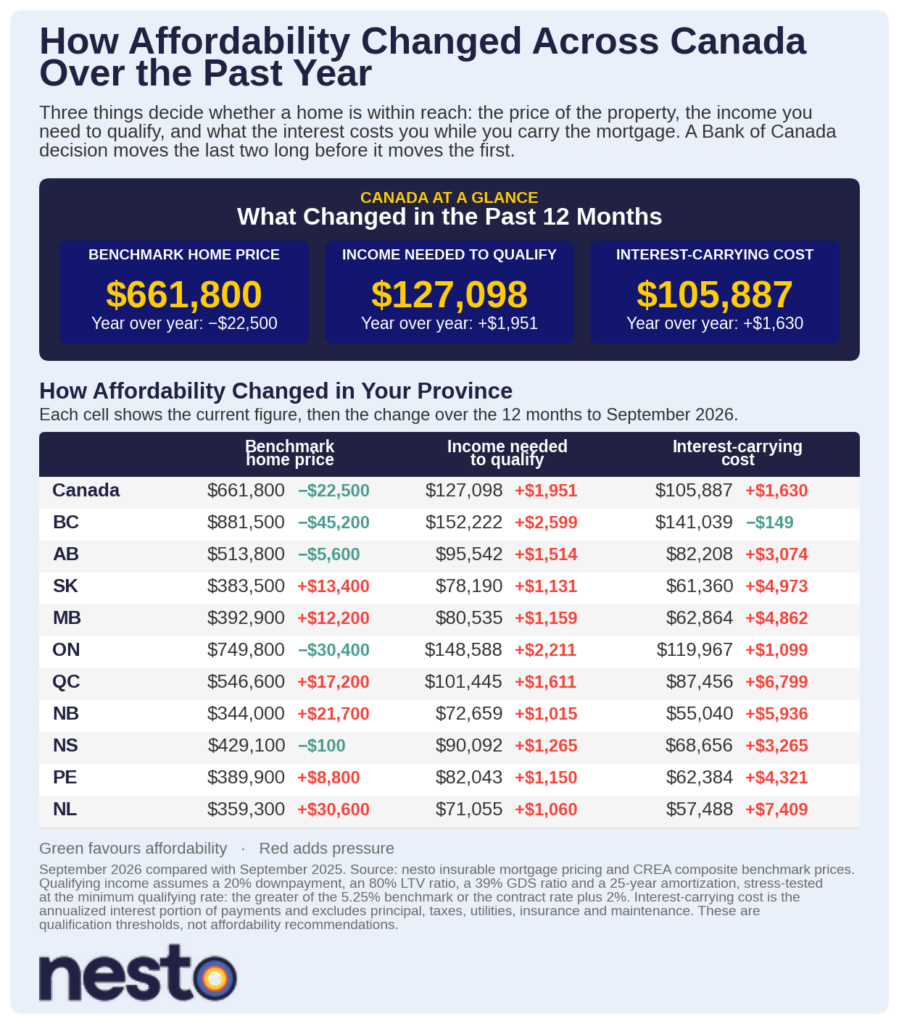
Negotiating power still sits with you across much of the country, yet financing costs are not coming down anytime soon. Getting pre-qualified tells you what you can borrow before you start shopping. A pre-qualification is not a rate hold offered with a pre-approval, so your discount is confirmed once you have an accepted offer to purchase, and from that point a rate hold protects you against bond swings that have moved 35 to 40 basis points on a single headline this year.
Renewers
The wait-for-cuts strategy has no more runway. With fixed rates firming, holding out for a lower renewal carries genuine downside. When certainty outweighs the pursuit of the bottom, a shorter fixed term, such as the 3-year term, is what a growing share of nesto borrowers are settling for.
Refinancers
The refinance window is closing on borrowers whose equity has thinned, and the qualifying math turns less forgiving if prices ease. When a refinance is on your radar, moving sooner is the safer play.
Variable and Adjustable Holders
Your monthly payment is on hold today, but budget for higher-for-longer rather than imminent relief. The next move the market expects is higher, so leave yourself a cushion rather than banking on a cut.
Where the Forecasters Disagree
With the rate itself a foregone conclusion, the weight of the September decision fell on the language rather than the numbers. There was no Monetary Policy Report to parse this time, so markets read the press release and the press conference for any echo of June’s talk of consecutive hikes, which had unsettled bond yields at the time. What they got instead was a shift in the balance of risks, with upside inflation risk described as having increased and growth prospects as less certain, and no guidance on what happens next.
The professional consensus is not unanimous. The C.D. Howe Institute’s Monetary Policy Council favours holding at 2.25% into late 2026 and stepping up to 2.5% by mid-2027. Oxford Economics sees growth of just 0.7% this year and unemployment drifting toward 7%, while TD looks for a sturdier rebound toward 1.7% by year-end. Scotiabank supplies the contrarian note on jobs, arguing that the headline unemployment rate flatters the slack in the market and that, measured on stricter US definitions, Canada would read closer to 5%, near full employment.
The sharper divide is between the 2 camps that set prices. Money markets carry a partial hike for December and price roughly 100 basis points of increases over the coming 12 months; most bank economists see the rate frozen at 2.25% through 2026, with the first increase in 2027. Capital Economics has moved its own first-hike call forward from June 2027 to as early as December 2026. That gap, not the September hold, is the number worth watching because bond yields follow market pricing rather than the consensus forecast, and bond yields set fixed mortgage rates.
The Bottom Line for Borrowers
A seventh straight hold at 2.25% looks placid on the surface and carries real weight underneath. The Bank is keeping its options open, yet the market has largely concluded that the next move points up, and fixed rates are already reflecting it. The next full forecast update arrives with the October 28 decision, and the August inflation release on September 14 is the most likely to move expectations before then.
The takeaway for borrowers is to stop planning around cuts that may never arrive and start planning around the rate landscape that actually exists. That is a conversation worth having with someone who lives in it daily, and nesto mortgage experts can weigh your options, secure a rate, hold it against bond swings, and match you to the term that fits your life rather than the headlines.
Final Thoughts
The policy rate has now sat at 2.25% for close to a year, and September 2 added another decision that changed nothing about the rate itself. The announcement still carried information. The Bank is comfortable waiting while the tariff picture develops, and that patience leaves the more active side of mortgage pricing untouched.
Anyone shopping or renewing this summer who watched only the headline decision missed 2 fixed mortgage rate increases within 5 days in August. If you’re renewing before the end of the year or making a purchase now, connect with nesto mortgage experts to see where fixed and variable rates actually land for your renewal date and budget.
Why Choose nesto
At nesto, our commission-free mortgage experts are salaried and regulated, with most licensed in multiple provinces. They are evaluated on client satisfaction and the quality of their advice, and they help you compare mortgage options and understand rates and qualification requirements. Once you’re ready to move forward, they work with you on a mortgage strategy that fits your situation.
nesto pairs expert advice with a 100% digital, transparent and seamless process, and a dedicated mortgage professional supports you throughout your purchase, renewal or refinance.
nesto is on a mission to offer a positive, empowering and transparent property financing experience – simplified from start to finish.
Contact our knowledgeable mortgage experts to find your best mortgage rate in Canada.
Mortgages giving you a headache?
Take a breather and work with nesto experts to make it easy for you.
About the contributors