
Will the Policy Interest Rate in Canada Go Down in 2026?

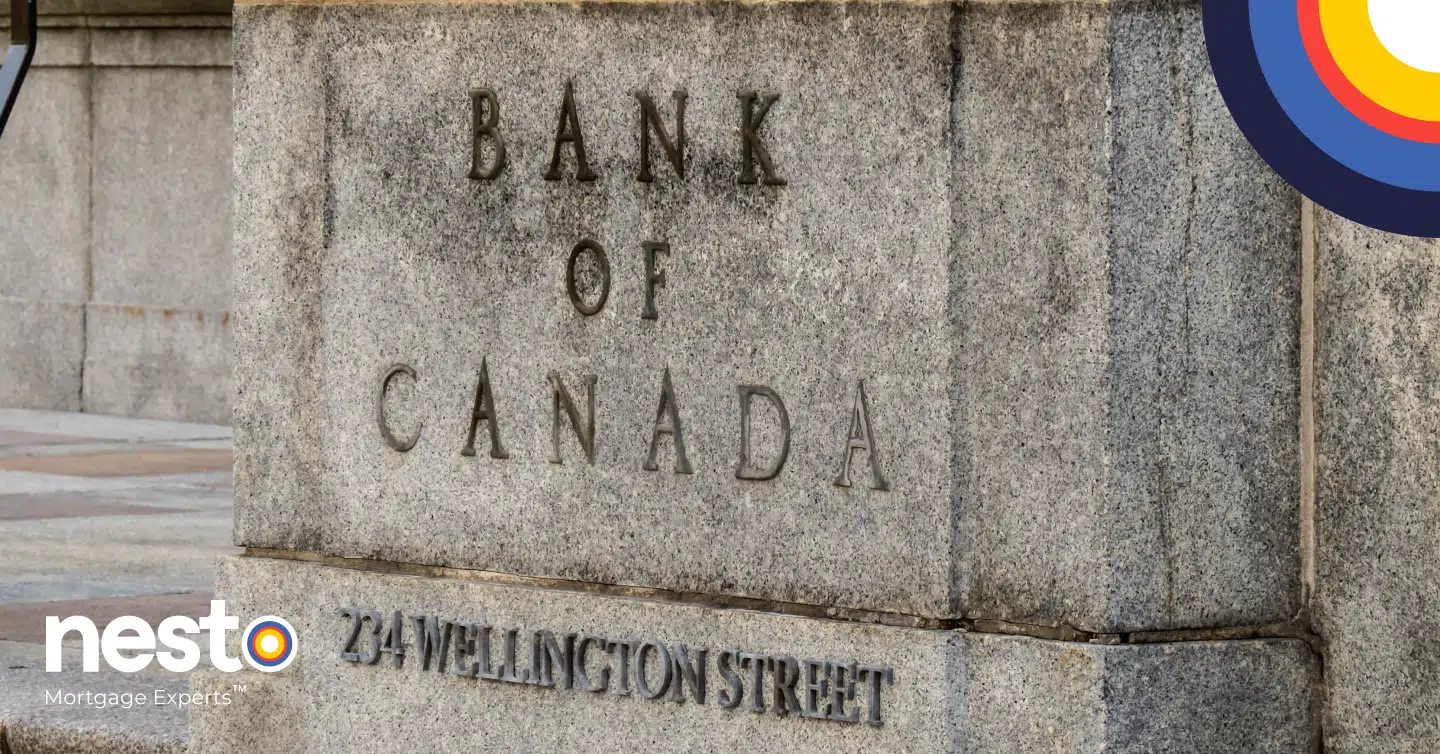
The Bank of Canada (BoC) benchmark policy rate is currently 2.25%.
The policy rate, also known as the overnight rate, serves as the foundation for borrowing costs across Canada. It influences lender prime rates, variable mortgage pricing, lines of credit, and business loans, and, indirectly, fixed mortgage rates through bond markets. Any shift in the policy rate can quickly ripple through the housing market, consumer spending, and impact overall economic activity.
Understanding how interest rates are influenced in Canada is vital for investors and borrowers alike. Factors such as the global economy, inflation expectations, Gross Domestic Product (GDP) and labour market conditions can influence interest rate decisions.
Predicting the exact path of interest rates in Canada is challenging, given the many factors that can affect economic conditions. Here, we examine the key drivers shaping Canada’s interest rate decisions and provide a forecast of where interest rates may be heading.
Key Takeaways
- Inflationary pressures mainly influence Canada’s interest rates.
- The Bank of Canada sets a 2% inflation target as a benchmark for price stability.
- BoC policy rate changes affect inflation through their impact on borrowing costs, consumer spending, and economic activity.
Best Mortgage Rates
How Interest Rates Are Influenced in Canada
Canada’s inflationary pressures are driven mainly by consumer spending, the housing and labour markets, and immigration. Since inflation is one of the most critical factors driving the BoC’s policy rate decisions, reaching its 2% target requires continually adjusting the policy interest rate to control and stabilize inflation.
When inflation remains well above the target, the Bank will continue to increase the benchmark rate to discourage borrowing and spending. Similarly, the Bank will decrease the benchmark rate when inflation falls below the target to encourage borrowing and spending and stimulate the economy.
The policy rate directly influences lenders’ prime rates, which are used to price variable interest rates. Fixed rates are set based on Government of Canada bond yields of corresponding maturities. The bond market and investors set these yields in response to inflation expectations, monetary policy decisions, and economic indicators.
In practice, this means fixed mortgage rates often move before an official monetary policy announcement. Financial markets anticipate future policy decisions based on inflation data, GDP growth, employment reports, and global economic developments. When markets expect tighter monetary policy, bond yields and fixed mortgage rates may rise in advance.
Will Interest Rates Climb to a New All-Time High?
Canada’s highest recorded BoC policy rate was 21.24% in August 1981, so we are far from reaching a new all-time high. In response, chartered banks changed their prime lending rates to 22.75%.
When comparing today’s Canadian interest rates to their all-time high, note that a 1:1 comparison may not be entirely accurate due to changes over time, including average home prices and the number of housing units per capita.
The real estate market has experienced notable growth, particularly in urban areas, leading to higher home prices. This increase in home prices has led to larger mortgage loans and higher debt levels among Canadian households.
As a result, today’s rate increases have a different impact than in past decades. Even smaller changes in interest rates can translate into materially higher monthly mortgage payments because loan balances are significantly larger. Household debt levels relative to income are also higher today than they were in the early 1980s, making rate sensitivity more pronounced.
Housing affordability has changed, and the impact of interest rate changes on monthly mortgage payments has become a more significant driver of mortgage interest cost (MIC) in the consumer price index (CPI).
- The number of housing units per capita has also changed over time.
- Demographic shifts, population growth, and changes in urbanization patterns have influenced the housing market’s supply and demand dynamics.
- In some regions, increased demand for housing due to population growth and supply shortages may tighten housing markets and drive prices higher.
Today’s Best Mortgage Rates as of September 25, 2026
Understanding the Path to Inflation & How Monetary Policy Impacts Rates
Understanding the path to inflation and how monetary policy affects interest rates in Canada requires recognizing how changes in the BoC policy interest rate influence borrowing costs, spending, and economic activity, which, in turn, can affect inflation.
The BoC has set a 2% inflation target as a benchmark for price stability. When inflation is too high, it can erode the purchasing power of money, as it takes more money to buy the same goods and services. On the other hand, when inflation is too low, it may signal weak economic demand and hinder economic growth.
- When the BoC wants to stimulate economic growth and increase inflation, it may lower the policy interest rate. Lower interest rates encourage borrowing and spending by reducing borrowing costs for businesses and individuals. This can increase consumer spending, business investments, and economic activity, contributing to higher inflation.
- When the BoC needs to slow economic growth and reduce inflation, it may raise the policy interest rate. Higher interest rates discourage borrowing and spending as borrowing costs rise. This can reduce consumer spending, business investment, and economic activity, bringing inflation back to its 2% target.
How Rate Decisions Ripple Through the Economy
Higher interest rates can make Canadian assets more attractive to global investors, which can push up the Canadian dollar and further tighten financial conditions. A stronger dollar and higher benchmark rates raise funding costs for lenders, which then get passed on to borrowers through higher interest rates on mortgages, loans, and lines of credit.
When interest rates move lower, the effects tend to work in the opposite direction. Lower rates ease financial conditions and can lessen upward pressure on the Canadian dollar, making exports more competitive and improving overall economic flexibility.
Policy rates feed directly into variable mortgage rates and influence fixed rates through bond markets, which is why inflation control remains the key gatekeeper to future rate decisions. Balancing inflation risks against economic growth is a delicate process, which makes forecasting the Bank of Canada’s next move challenging even for financial experts and interest rate analysts.
How Bank of Canada Rate Hikes Affect Mortgages in Canada
When the Bank of Canada raises its policy interest rate, it increases the cost of borrowing. The policy rate directly influences the prime rate set by Canadian lenders. Most banks adjust their prime rate within days of a Bank of Canada rate hike. That change has an immediate impact on variable-rate and adjustable-rate mortgages, and an indirect influence on fixed mortgage rates.
Variable Mortgages React Immediately
Variable mortgages in Canada are priced at a discount or premium to the lender’s prime rate. When the Bank of Canada raises its policy rate, lenders increase their prime rate, and variable mortgage rates rise accordingly. Monthly mortgage payments may increase immediately, depending on the type of variable mortgage.
For adjustable-rate mortgages (ARM), the payment increases immediately when the prime rate rises. For variable-rate mortgages (VRM) with fixed payments, more of the payment goes toward interest and less toward principal. If rates rise enough, borrowers can hit their trigger rate. This is why Bank of Canada rate hikes have the quickest impact on homeowners with variable mortgages.
Fixed Mortgage Rates Move Based on Bond Yields
Fixed mortgage rates are not directly tied to the policy interest rate. Instead, they are influenced by Government of Canada bond yields. However, bond markets move based on expectations about future Bank of Canada rate decisions.
When the Bank signals there may be more rate hikes ahead, bond yields often rise in advance, pushing fixed mortgage rates higher even before the rate announcement. This explains why fixed mortgage rates sometimes increase before the BoC officially hikes rates.
Best Mortgage Rates
Impact of Rate Hikes on Homeowners and Homebuyers
Rate hikes do not affect every borrower the same way. The impact depends on the mortgage type, the timing of your renewal, and whether you already have a mortgage or are actively looking for one.
Impact on Homeowners
Rate hikes can create renewal payment shock, especially for borrowers who locked in at historically low rates and face higher renewal rates.
Homeowners with variable-rate mortgages could face higher payments immediately with an ARM. With a VRM, they could face much higher payments at renewal, especially if they hit their trigger rate or trigger point, since they are no longer reducing the principal balance.
Homeowners with fixed-rate mortgages won’t see any changes to their payments because they have a locked-in rate for the entire term. However, if rates remain high and the mortgage is up for renewal, borrowers could face much higher mortgage payments at renewal.
Impact on Homebuyers
When the Bank of Canada raises rates, mortgage qualification becomes more difficult due to higher stress-tested mortgage rates. Purchasing power declines as rates increase, and the anticipated monthly mortgage payment increases for those looking to purchase. This can lead some borrowers to delay their purchase or exit the market until rates come down.
Given that the mortgage stress test requires borrowers to qualify at the higher of 5.25% or the contract rate plus 2%, rate hikes amplify affordability challenges. Even a modest increase in mortgage rates can significantly reduce how much a buyer can afford when lenders qualify at an even higher rate.
Will Interest Rates Go Down in 2026?
Based on current projections, interest rates are expected to remain stable in 2026. The BoC will likely adopt a more cautious, data-driven approach to any future policy rate changes, ensuring inflation remains close to the 2% target. The policy rate may increase slightly by the end of 2026, as early predictions suggest it could rise to 2.50% after remaining on hold for most of the year. This expectation would keep the policy rate within the lower end of the neutral range (2.25% to 3.25%).
Frequently Asked Questions (FAQ) About Where Canadian Interest Rates Are Headed in 2026
Will interest rates go down in Canada in 2026?
Current projections suggest that further interest rate cuts in 2026 are unlikely. Most forecasts indicate the Bank of Canada will keep the policy rate steady for much of the year, with some analysts expecting a modest increase to around 2.50%. That outcome would keep rates within the lower end of the neutral range rather than signal a new tightening cycle.
How does the US Federal Funds Rate influence inflation and interest rates in Canada?
The US Federal Funds Rate influences global financial conditions, which can affect inflation dynamics in Canada. Many globally traded goods are priced in US dollars, so that persistent US inflation can raise input costs worldwide. These pressures can spill into Canada through higher import prices and currency movements, which the Bank of Canada must consider when setting its own policy rate to maintain inflation near the 2% target.
How does the Canadian dollar affect inflation and borrowing costs in Canada?
Movements in the Canadian dollar directly influence inflation by changing the cost of imports and exports. A weaker Canadian dollar can raise the price of imported goods, adding inflationary pressure. A stronger dollar can ease import costs but may reduce export competitiveness. These currency effects influence overall inflation trends, which in turn shape Bank of Canada interest rate decisions and borrowing costs for households and businesses.
Why does Canada often have a different interest rate than the United States?
Canada and the United States operate under different economic conditions, inflation paths, and growth dynamics. The Bank of Canada sets interest rates based on domestic inflation, labour markets, and economic capacity, not simply to match US policy. Maintaining flexibility allows Canada to balance price stability with economic growth, even when US interest rates move in a different direction.
How do Bank of Canada rate decisions affect mortgage rates?
Bank of Canada policy rate decisions feed directly into variable mortgage rates through lenders’ prime rates. Fixed mortgage rates respond more to Government of Canada bond yields, which reflect inflation expectations and economic outlooks. As a result, fixed mortgage rates can move even when the policy rate remains unchanged, making inflation control the main factor influencing borrowing costs.
Final Thoughts
The Bank of Canada has set a 2% inflation target as a benchmark for price stability, and its interest rate decisions aim to promote economic growth while maintaining price stability. Due to constraints in Canadian housing supply, we expect continued pressure on shelter costs, including home prices, rents, and mortgage interest costs, for the foreseeable future.
The actual path of interest rates in Canada for 2026 remains to be determined. Overall, the BoC is expected to maintain the policy rate throughout the year. The exact timing and direction of interest rate changes remain uncertain and will depend on evolving global economic conditions.
Reach out to nesto mortgage experts to see how we can help you find your forever home.
Why Choose nesto
At nesto, our commission-free mortgage experts, certified in multiple provinces, provide exceptional advice and service that exceeds industry standards. Our mortgage experts are salaried employees who provide impartial guidance on mortgage options tailored to your needs and are evaluated based on client satisfaction and the quality of their advice. nesto aims to transform the mortgage industry by providing honest advice and competitive rates through a 100% digital, transparent, and seamless process.
nesto is on a mission to offer a positive, empowering and transparent property financing experience – simplified from start to finish.
Contact our licensed and knowledgeable mortgage experts to find your best mortgage rate in Canada.
Let’s get started!
About the contributors