
Income Needed to Buy a Home in Toronto
Thinking of buying a home in Toronto? You’re not alone, but mortgage affordability remains one of the biggest hurdles. Most households earn far less than what’s required to qualify for the average-priced property in the city. With home prices hovering near the million-dollar mark, a 20% down payment is no longer just a strategy; it’s often a necessity.
Let’s break down the gross income needed to qualify for a typical mortgage loan in Toronto based on current mortgage rules, today’s best mortgage rates in Canada, and amortization options. Whether you’re buying a condo, townhouse, or detached home, understanding the monthly payments and stress test implications is key to planning your purchase and protecting your budget.
Key Takeaways
- Toronto homebuyers face a steep affordability gap with the income required to qualify for an average home often reaching nearly three times the city’s median household income.
- Monthly mortgage payments are easing slightly compared to last month and last year, offering modest relief.
- Despite these small gains, affordability remains stretched, making strategic planning essential for your mortgage.
Best Mortgage Rates
Average Home Price in Toronto
The average home price in Toronto is currently $940,800. Prices have increased 5.4% year over year, keeping Toronto among the most expensive markets in Canada.
That means many buyers must rely on substantial down payments, currently averaging for a 20% down payment, just to meet uninsured lending criteria and qualify under Canada’s stress test rules. Affordability challenges persist, especially for first-time buyers without access to significant savings or co-purchasing arrangements.
Monthly Mortgage Payments in Toronto
For $657,500, the monthly mortgage payment for the average home in Toronto ranges between $3,501 and $4,675.
For a buyer taking an uninsured 5-year fixed mortgage with a 25-year amortization, monthly payments have eased slightly compared to last year and even last month, offering a bit of relief for those entering the market now. The current monthly payment to qualify for this type of mortgage sits at $4,906, reflecting how recent interest rate movements are beginning to shift affordability.
Here’s how it compares to actual monthly payment changes month over month and year over year:
- Current payment: $4,197
- Last month: $4,224
- Last year: $4,335
While this doesn’t erase the broader affordability challenge, it does signal a more favourable environment than homebuyers faced 12 months ago. Even a slight drop in monthly costs can make a meaningful difference when qualifying under today’s stress test rules.
This drop in monthly cost reflects some modest rate relief. Still, payments remain high due to large loan sizes and stricter uninsured qualification rules.
Best Mortgage Rates
How Much Income Is Needed to Afford a Home in Toronto
To pass the stress test for a new mortgage, your gross debt service (GDS) ratio generally must not exceed 35% of your gross household income for uninsured products. For the average home in Toronto, the income required to qualify ranges between $162,564 and $197,612 in $657,500 when using nesto’s lowest mortgage rates.
To qualify for the average home with a 20% down payment, on today’s fixed mortgage rates:
- Required household income: $197,612
- With a 30-year amortization: $186,595
- Last year’s income needed: $184,136 (30-year amortization)
Here’s how income needed to qualify changes against today’s variable mortgage rates:
- Required household income: $186,390
- With a 30-year amortization: $174,789
- Last year’s income needed: $186,596 (30-year amortization)
Although there has been a slight improvement in income required year-over-year, housing affordability still puts the average Toronto home out of reach for many.
How Toronto Compares to Other Canadian Cities
Toronto’s affordability gap remains among the widest in Canada. According to the National Bank’s most recent housing affordability report, the median household income in Toronto is around $98,000, while average household income, as cited by Teranet HP, is closer to $129,000.
Both figures fall well below the $197,612 required to qualify for an average home in the city today. Unless a buyer comes with a substantial down payment or applies with a co-borrower, they’d need nearly triple the median income to qualify.
Here’s how Toronto home prices and income required to qualify compare to other major markets for $657,500:
- Toronto – $940,800
Income needed: $197,612 - Vancouver – $1,099,100
Income needed: $215,340 - Montreal – $596,300
Income needed: $128,416 - Calgary – $572,500
Income needed: $120,066 - Ottawa – $632,200
Income needed: $143,669
Affordability Trends and Rate Pressures in Toronto
According to NBC Economics, housing affordability in Toronto has seen a modest improvement compared to earlier this year. In Q2, the mortgage payment as a percentage of income (MPPI) fell to 75.3%, down from 77.8% in Q1 and 85.0% in Q4 of last year.
Despite these improvements, affordability remains severely stretched compared to the long-term average of 53.7%. Without a meaningful rise in incomes or further rate cuts, most buyers will still face steep barriers when qualifying for a mortgage.
According to the Canada Mortgage and Housing Corporation (CMHC), “Second, restoring affordability to levels last seen 2 decades ago isn’t realistic, especially after the post-pandemic price surge. COVID-19 significantly changed the affordability landscape across the country. In particular, Toronto and Vancouver face more structural affordability challenges that require more time to address.”
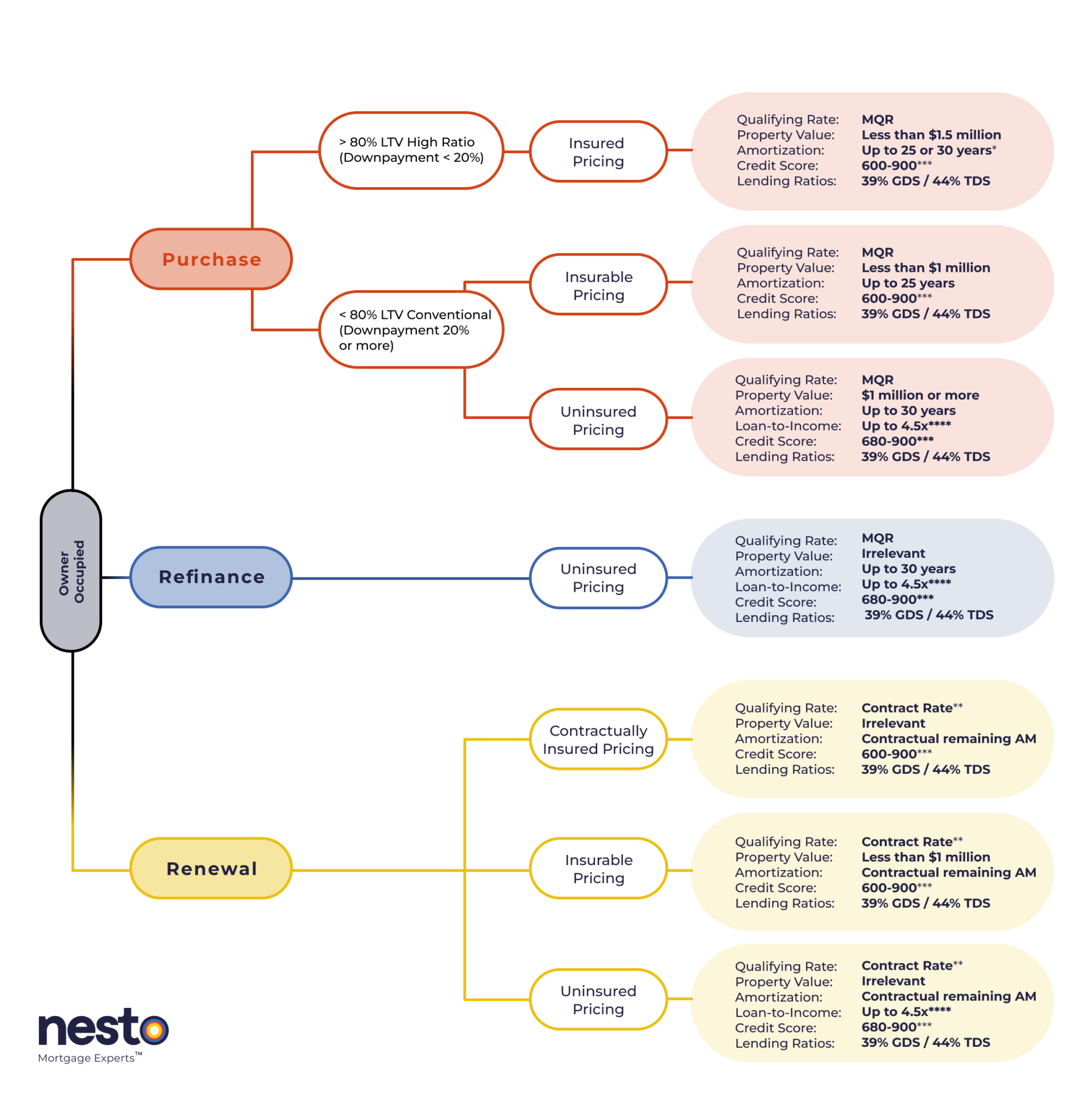
Insured, insurable, and uninsured mortgages differ in down payment, property value, amortization, and rate. Insured mortgages require less than 20% down and a borrower-paid premium from CMHC, Sagen, or Canada Guaranty. Insurable needs 20% or more on a property under $1 million with a 25-year amortization, and the lender pays the premium, which is why it prices close to insured. Uninsured covers everything else, including any refinance, and is the most expensive because the lender carries the full risk. Debt service limits are the same across all three: 39% GDS and 44% TDS. What differs is the minimum credit score, the amortization, and the rate.
Details
*30-year amortizations on insured purchases are limited to first-time homebuyers and buyers of newly built homes.
**The minimum qualifying rate applies to purchases and refinances, not to a renewal with your current lender or a straight switch where your balance and remaining amortization do not increase. Your contract rate plus 2% is the binding figure for almost every borrower today; the 5.25% floor only takes over if rates fall below 3.25%.
***nesto’s minimum credit score is 680 on uninsured mortgages and 600 on insured and insurable mortgages. Debt service ratios of 39% and 44% apply to all three insurability options, so a larger down payment no longer means tighter ratios. All criteria apply to an owner-occupied primary residence mortgage with nesto.
****Loan-to-income applies to uninsured mortgages only, effective 1 January 2025. A file above 4.5 times income is reviewed for an exception rather than declined.
How much can you borrow against your income?
On uninsured mortgages, nesto also checks your loan-to-income (LTI) ratio: everything borrowed against the property compared to your annual household income. If it’s above 4.5 times income, the file goes to an underwriter for an exception rather than being declined. It counts first and second mortgages, a home equity line of credit, and any other borrowing registered against the title, whether the lender is nesto or another institution, and whether you live there or rent it out.
A household earning $150,000 reaches the threshold at about $675,000 of total borrowing. A $100,000 line of credit behind a $600,000 mortgage puts them at 4.7, even though the mortgage alone would have cleared it. LTI applies only to uninsured mortgages, effective 1 January 2025, and reflects OSFI’s loan-to-income limits, which cap high-LTI lending across a lender’s entire book rather than setting a hard ceiling per borrower.
New purchase qualifying rates
Your qualifying rate is our lowest fixed or variable rate for your insurance type, plus 2%:
- Insured: 6.54% fixed or 5.41% variable
- Insurable: 6.54% fixed or 5.41% variable
- Uninsured: 7.09% fixed or 5.85% variable, plus the 4.5 times loan-to-income check
If rates fall below 3.25%, the OSFI floor of 5.25% becomes binding instead.
Renewal (switch or transfer) qualifying rates
A straight switch is exempt from the stress test, so you may renew at the contract rate on our lowest fixed or variable rate for your insurance type:
- Insured: 4.54% fixed or 3.41% variable
- Insurable: 4.54% fixed or 3.41% variable
- Uninsured: 5.09% fixed or 3.85% variable
Asking to increase your mortgage balance or to extend the amortization makes the transaction a refinance.
We're curious…
Mortgage Scenarios for Toronto
To better understand how borrowing needs impact affordability, the table below shows how monthly payments and income requirements scale by mortgage type, interest rate and amortization period in Toronto:
| Mortgage Type | Amortization | Mortgage Rate | Mortgage Payment | 5-Year Term Interest | Income Needed to Renew Mortgage | Qualifying Income Needed |
|---|---|---|---|---|---|---|
| Insured Fixed Rate | 25-year | 4.59% | $4,675 | $171,370 | $165,144 | $195,838 |
| Insured Variable Rate | 25-year | 3.41% | $4,318 | $139,770 | $154,159 | $184,354 |
| Insured Fixed Rate | 30-year | 4.59% | $4,242 | $174,244 | $152,077 | $184,349 |
| Insured Variable Rate | 30-year | 3.41% | $3,870 | $142,183 | $140,598 | $172,252 |
| Insurable Fixed Rate | 25-year | 4.54% | $4,051 | $149,535 | $145,947 | $172,470 |
| Insurable Variable Rate | 25-year | 3.41% | $3,743 | $122,304 | $136,461 | $162,564 |
| Uninsured Fixed Rate | 25-year | 5.09% | $4,197 | $162,064 | $167,606 | $197,612 |
| Uninsured Variable Rate | 25-year | 3.85% | $3,881 | $134,579 | $156,778 | $186,390 |
| Uninsured Fixed Rate | 30-year | 5.09% | $3,831 | $164,736 | $155,073 | $186,595 |
| Uninsured Variable Rate | 30-year | 3.85% | $3,501 | $136,870 | $143,754 | $174,789 |
Condos often require less income, but 50% of the condo maintenance fees must be included in your debt service ratio when applying, which can drive up the income required to qualify.
Can First-Time Buyers Still Buy in Toronto?
It’s no secret that buying a your first home in Toronto has become more difficult, especially for first-time buyers. For years, many were shut out of insured mortgage products, which previously only applied to homes priced under $1 million. But recent policy changes are opening up new opportunities to help first-time buyers get into the market:
- CMHC now insures homes up to $1.5 million, expanding the number of properties eligible for insured mortgages.
- 30-year amortizations are now available on insured mortgages for newly built homes and first-time buyers, helping reduce monthly payments.
- The RRSP Home Buyers’ Plan (HBP) allows borrowers to withdraw up to $60,000 from their RRSP for a down payment, tax-free.
- The First Home Savings Account (FHSA) allows up to $40,000 in tax-free savings for a down payment.
- Land transfer tax rebates of up to $8,475 (Toronto and Ontario combined) are available for qualifying FTHBs in Toronto.
These incentives and programs won’t solve Toronto’s affordability issues overnight. Still, they do offer real advantages to buyers who can combine them to offset their closing costs or increase their downpayment, especially those purchasing pre-construction, receiving gifted downpayments from family, or entering the market with a partner.
Mortgage Strategies to Boost Qualification Odds
If your income falls short of the mortgage you need, here are a few proven ways to strengthen your mortgage application:
- Increase your down payment to reduce your loan-to-value (LTV) ratio and unlock insurable options (requires 20% downpayment)
- Opt for a 30-year amortization to lower monthly debt service
- Buy a more affordable location or choose a different property type (e.g., condo instead of house)
- Add a co-applicant or guarantor with qualifying income and minimal debts
- Pay down other debts to improve your total debt service (TDS) ratio
Mortgage brokers and lenders can help tailor a qualification strategy around your financial goals and guide you through the options that best fit your situation.
Frequently Asked Questions (FAQ) About Toronto Income Requirements for Homeownership
What income is needed to buy a home in Toronto?
You’ll need an income between $162,564 and $197,612 in $657,500 to qualify for the average-priced home in Toronto with a 20% down payment.
Can I buy in Toronto with less than $100K income?
It’s possible to qualify for an insured mortgage on a lower-priced condo or with a co-borrower at that income level. However, you’re unlikely to qualify as a sole applicant for a detached home with an income of less than $100,000, unless you make up the difference with your downpayment.
What is the average monthly mortgage payment in Toronto?
The monthly payment for the average-priced home in Toronto is between $3,501 and $4,675 in $657,500 with a 20% downpayment.
Is buying a condo in Toronto more affordable?
Typically, yes, buying a condo in Toronto is more affordable than buying a house; however, you must account for monthly condo maintenance fees, which reduce the amount you can qualify to borrow.
Why are Toronto home prices so high?
Strong demand, limited supply, increased immigration, development delays, and high land transfer taxes all contribute to elevated housing costs in Toronto.
Make Your Mortgage Strategy Work in Toronto
Buying a home in Toronto is no small feat, but it’s not out of reach with the right strategy. If your income doesn’t quite meet today’s qualification thresholds, there are still ways to make the numbers work in your favour. Adjusting your amortization, exploring different property types, or making a larger down payment can help. New opportunities from changes to insured mortgage rules and pre-construction financing options also offer valuable pathways.
The key is finding a mortgage strategy that fits your situation, not someone else’s. Connect with a nesto mortgage expert to compare fixed and variable rates, insured and uninsured options, and to model your affordability across different amortization periods. With expert guidance and thoughtful planning, you can build a strategy that helps you enter the Toronto market with confidence.
Why Choose nesto
At nesto, our commission-free mortgage experts are salaried and regulated, with most licensed in multiple provinces. They are evaluated on client satisfaction and the quality of their advice, and they help you compare mortgage options and understand rates and qualification requirements. Once you’re ready to move forward, they work with you on a mortgage strategy that fits your situation.
nesto pairs expert advice with a 100% digital, transparent and seamless process, and a dedicated mortgage professional supports you throughout your purchase, renewal or refinance.
nesto is on a mission to offer a positive, empowering and transparent property financing experience – simplified from start to finish.
Contact our knowledgeable mortgage experts to find your best mortgage rate in Canada.
Let’s get started!
About the contributors