
Mortgage Rates Forecast Canada 2026-2030

Canada’s mortgage rate forecast for 2026 suggests borrowing costs will remain relatively stable. The Bank of Canada (BoC) is largely expected to hold the policy interest rate at 2.25% throughout the year. As a result, variable mortgage rates in Canada are expected to remain unchanged, while fixed rates may increase slightly in line with Government of Canada (GoC) bond yields.
Many Canadian borrowers are coming up for renewal for the first time since interest rates began to rise in 2022, and most are likely to see significant increases in their mortgage payments. Borrowers should not expect further rate cuts in 2026 unless trade tensions with the US or global economic conditions significantly affect Canada’s economy.
Key Takeaways
- The Bank of Canada is expected to hold the policy rate near 2.25% in 2026.
- Fixed mortgage rates will likely remain stable but may rise slightly if bond yields rise.
- Many borrowers renewing mortgages in 2026 will face higher monthly payments.
Best Mortgage Rates
Why Mortgage Renewals in 2026 Could Mean Higher Payments for 33% of Borrowers
By the end of 2026, approximately 33% of Canadian mortgage holders are expected to face higher monthly mortgage payments. Approximately 75% of borrowers facing a payment increase have 5-year fixed-rate mortgages. For those with fixed-rate mortgages renewing in 2026, payment increases are expected to average around 20%. This reflects the shift from ultra-low pandemic-era rates to today’s higher borrowing costs.
The experience will differ substantially for borrowers with variable mortgages. Those with adjustable-rate mortgages (ARM) have already absorbed most of the impact of past rate hikes and, based on current expectations for 2026 interest rates, many could begin to see some payment relief.
However, borrowers with variable-rate mortgages (VRM) may experience significant changes in their mortgage payments. 10% of borrowers renewing a variable-rate mortgage are projected to see payments rise by more than 40%. In comparison, roughly 25% could see their payments fall by at least 7%. This wide range largely reflects borrowers’ strategies for managing rising rates during the tightening cycle. Borrowers who increased their monthly payments to ensure principal and interest were covered are likely to face smaller adjustments at renewal. Meanwhile, borrowers experiencing negative amortization are likely to experience larger increases in their mortgage payments at renewal.
As of mid-2026, that stress is starting to show in the data. Equifax Canada’s first-quarter 2026 Market Pulse reported that mortgage delinquency balances were up about 32% from a year earlier nationally, and 52% higher in Ontario. However, the share of mortgages 90 or more days behind remains low at roughly 0.2%. Consumer insolvencies climbed to their highest level since 2009. Statistics Canada’s national balance sheet also shows the total dollar value of mortgage interest paid by households rising as renewals take hold, even though the mortgage interest costs (MIC) component of the Consumer Price Index has eased year over year. The two series measure different data, aggregate dollars paid versus the average annual price change, so both can move at once.
Canada Mortgage Rate Forecast for 2026 (Updated September 2026)
Canada’s mortgage rate outlook for 2026 depends largely on how quickly inflation stabilises and how the Bank of Canada responds to current economic conditions. Most economists at Canada’s largest banks expect borrowing costs to remain relatively stable over the year. However, mortgage rates could fluctuate throughout the year as economic data changes and financial markets adjust their expectations. Growth firmed sharply through the second quarter: Statistics Canada reported that real GDP grew 0.8% in the quarter, an annualised 3.3%, the fastest pace in more than 3 years. Exports rose 3.6% on a rebound in auto shipments, business capital investment rose 2.3% after 5 straight quarterly declines, and residential investment rose 2.5% as resale activity warmed in Ontario, Quebec and British Columbia. The agency also revised first-quarter growth up from a marginal contraction to an annualised 0.3%, which means Canada did not enter a technical recession.
Canada’s external position strengthened at the same time. The current account swung from a revised deficit of $8.3 billion in the first quarter to a surplus of $8.8 billion in the second, the first surplus since 2022 and the largest since 2005, as the trade in goods balance moved from a $6.4 billion deficit to a $12.2 billion surplus on record energy and auto exports. Foreign investors bought a record $80.8 billion of Canadian government bonds over the same period, which matters directly for fixed mortgage rates because those bonds are the benchmark lenders price against.
The quarter came in well ahead of the roughly 2.5% the Bank of Canada projected for the quarter in its July Monetary Policy Report. Even so, the Bank has left its full-year 2026 growth projection at 0.7%, reflecting the weak start to the year, while economists surveyed by Bloomberg have also kept their 2026 growth expectations near that level. Momentum has since faded: Statistics Canada’s advance estimate puts July output essentially unchanged from June, before the latest round of United States tariffs took effect on August 22.
Bank of Canada Policy Rate Forecast (Variable Rates)
Forecasts from the Big 6 Banks suggest that the overnight policy rate will remain stable at 2.25% for much of the year. By the end of 2026, most major banks predict rates will end the year at the same level as they began.
| Bank | Jun | Jul | Sep | Oct | Dec |
|---|---|---|---|---|---|
| BMO | 2.25% | 2.25% | 2.25% | 2.25% | 2.25% |
| CIBC | 2.25% | 2.25% | 2.25% | 2.25% | 2.25% |
| National Bank | 2.25% | 2.25% | 2.25% | 2.50% | 2.75% |
| RBC | 2.25% | 2.25% | 2.25% | 2.25% | 2.25% |
| Scotiabank | 2.25% | 2.25% | 2.25% | 2.50% | 2.75% |
| TD | 2.25% | 2.25% | 2.25% | 2.25% | 2.25% |
Government of Canada 5-Year Bond Yield Forecast (Fixed Rates)
Most forecasts from the Big 6 Banks expect bond yields to remain relatively stable through 2026. GoC 5-year bond yields are expected to rise from a low near 3% early in the year to around 3.25% by the end of 2026. As a result, fixed mortgage rates could gradually increase, although large increases are unlikely. Fixed mortgage rates in Canada may fluctuate modestly throughout the year as financial markets react to inflation and employment data, as well as shifts in global bond markets. Still, the overall trend is for rates to remain relatively stable. In early July, the 5-year GoC yield spiked to about 3.18%, a seven-week high, as renewed US-Iran tensions pushed oil and US Treasury yields up, before easing back to roughly 3.13% by July 10. That pressure returned in force through late July and into August, as the blockade of the Strait of Hormuz and the partial closure of Red Sea shipping routes lifted the yield back to around 3.18% to 3.23% in the first week of August. The main upward pressure on Canadian fixed rates continues to be imported rather than domestic, a dynamic explained further below.
| Bank | Q2 2026 | Q3 2026 | Q4 2026 |
|---|---|---|---|
| BMO | 3.15% | 3.05% | 2.95% |
| CIBC | 3.00% | 3.15% | 3.25% |
| National Bank | 3.20% | 3.15% | 3.15% |
| RBC | 3.10% | 3.20% | 3.30% |
| Scotiabank | 3.01% | 3.15% | 3.25% |
| TD | 3.10% | 3.00% | 2.95% |
Will Interest Rates Go Down in 2026?
The BoC Policy Rate decreased by 100 basis points (1 basis point equals 0.01%) in 2025. The Bank of Canada is expected only to consider further rate cuts if the economy shows significant weakness in 2026.
So far, most of the Big 6 Banks expect the policy rate to hold steady through 2026. Scotiabank and National Bank are the exceptions, with both projecting the rate rising to 2.75% by the end of 2026.
Changes in Government of Canada bond yields influence fixed mortgage rates, which respond to financial market expectations. Currently, market expectations suggest that rates, in particular the 5-year fixed rate, could increase slightly.
After the second-quarter data, economists broadly reaffirmed the hold. RBC expects the Bank of Canada to keep rates unchanged through the remainder of 2026, describing its base case as a gradual cyclical recovery and noting that the economy entered this period of trade disruption from a stronger starting point. Capital Economics cautioned that tariff headwinds make it unlikely the second-quarter pace continues, pointing to the flat July advance estimate as evidence growth was already losing momentum before the latest tariffs landed. Neither view supports a cut.
Will There Be a Bank of Canada Rate Hike in 2026?
Most rate analysts predict that rates will stabilise and remain constant throughout 2026. The Bank of Canada Governing Council considers the current policy rate adequate to keep inflation around the 2% target and to support the economy. However, uncertainty remains high, and the outlook could shift in response to global economic developments.
Bond markets currently price a hold at the September 2 decision, with the probability of a quarter-point hike in the low single digits, and the odds of an increase rising gradually through the October 28 and December 9 meetings. That path was not disturbed by the second-quarter growth data, because markets read a quarter that ended in June as backward-looking against a trade escalation that is not. The Bank of Canada last kept the policy rate at 2.25% on July 15 for a sixth consecutive time, alongside its quarterly Monetary Policy Report. In its June 10th Summary of Governing Council Deliberations, the Bank had signalled it would stay nimble, and its July 15 opening statement reaffirmed that stance: uncertainty remains elevated, with the re-escalation of the Middle East conflict and ongoing US trade discussions cited as the two main swing factors that could still move the Bank in either direction.
Fixed vs Variable Mortgage Rate Outlook in Canada
The outlook for fixed and variable mortgage rates in Canada can differ because each responds to economic forces at different times. Fixed mortgage rates tend to move first when financial markets anticipate changes in the economic outlook. Variable mortgage rates adjust after the Bank of Canada changes its policy rate.
Why Fixed and Variable Mortgage Rates Move Differently in Canada
Fixed mortgage rates are primarily influenced by the Government of Canada (GoC) bond yields of corresponding maturities. These bond yields move daily in response to global market conditions, US Treasury yields, economic growth outlooks, inflation expectations, and shifting expectations for policy rate decisions. If bond yields move in either direction, fixed mortgage rates follow.
Variable mortgage rates move more directly with the Bank of Canada’s overnight policy rate. The Bank reviews its policy rate at scheduled announcements 8 times a year, but can make unscheduled announcements at any time in response to a major or unexpected economic shock. When the policy rate changes, lenders typically adjust their prime lending rates within a day of the announcement.
As of late August 2026, that transmission remains the main upward risk to Canadian fixed rates. US headline inflation reached 4.2% in May. The US Federal Reserve held its benchmark rate at 3.50% to 3.75% again on July 29, its fifth consecutive hold, with three of twelve voting members dissenting in favour of a hike over persistent inflation, underscoring the hawkish pressure that has kept US Treasury yields, and by extension Canadian bond yields, elevated even though Canadian core inflation sits near the 2% target. By late August, that pressure had lifted the 5-year Government of Canada (GoC) bond yield above 3.25%, its highest level in several months.
Two forces are pulling Canadian fixed rates in opposite directions, which is why they have drifted rather than jumped. Pulling up, hawkish commentary from Federal Reserve officials has kept United States Treasury yields elevated, and Canadian yields tend to follow. Speaking from the Jackson Hole symposium on August 27, Cleveland Federal Reserve President Beth Hammack, one of the 3 dissenters who favoured a hike at the Fed’s July meeting, said she believes now is the time to act on raising rates, though market pricing still has the Fed on hold in September and October. Pulling down, foreign investors bought a record $80.8 billion of Canadian government bonds in the second quarter, and Canada posted its largest current account surplus since 2005. Strong demand for Canadian government debt supports bond prices and holds yields down. The net result of that tug of war has been a fixed rate environment that moves in small steps rather than large ones.
Top Economist’s Mortgage Predictions for 2026
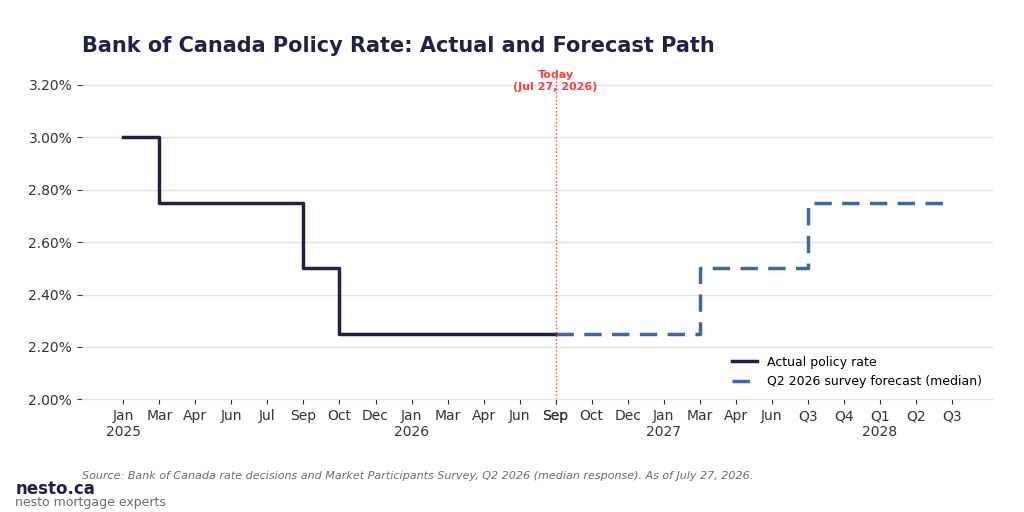
The Bank of Canada’s (BoC) latest Market Participant Survey, which gathers and publishes the views of senior economists and strategists in the Canadian financial market, indicates that rate cuts may have ended and will remain unchanged for the remainder of the year.
Results from the most recent Q2 2026 survey, released July 27, 2026, suggest we have seen the end of rate cuts. Rates are predicted to remain at 2.25% for 2026, with the first increase widely expected only in the second quarter of 2027. The same survey now points to a further increase, to 2.75%, as early as the third quarter of 2027, one quarter sooner than the previous survey indicated. This 2.25% rate falls within the lower end of the neutral rate range, where interest rates neither stimulate nor restrict the economy. The Bank’s next Market Participants Survey is expected in the fourth quarter of 2026, following the October rate announcement.
Policy Interest Rate Forecast
| 2026 | Policy Interest Rate (median response) |
|---|---|
| July | 2.25% |
| September | 2.25% |
| October | 2.25% |
| December | 2.25% |
5-Year Canadian Bond Yield Forecast
| 2026 | 5-Year Canadian Bond Yield (median response) |
|---|---|
| December | 3.15% |
nesto’s Policy Interest Rate Forecast for Canada 2026
| Policy Rate | |
|---|---|
| Q2 | 2.25% |
| Q3 | 2.25% |
| Q4 | 2.25% |
September 2026 Canada Mortgage Rates Forecast
On July 15, the Bank of Canada held its target for the overnight rate at 2.25% for the sixth consecutive decision, leaving the prime rate unchanged at 4.45%. The backdrop looks steadier than it did in the spring: growth firmed through the second quarter, with Statistics Canada’s preliminary estimate putting second-quarter growth at an annualised 3.4%, ahead of the Bank’s own 2.5% projection, and unemployment fell to 6.4% in July, dropping below the 6.5% to 7% range it had occupied since late 2024. Inflation, however, has ticked back up: headline inflation rose to 3.0% year-over-year in July from 2.8% in June, as the blockade of the Strait of Hormuz pushed gasoline prices higher, though core measures held near 2%. The Bank still expects inflation to average about 2.5% in the second half of 2026 and return to the 2% target by early 2027. Governor Tiff Macklem put it plainly:
We will not let higher oil prices become persistent inflation.
Unlike recent statements, the Bank dropped its explicit language on possible consecutive hikes or a trade-driven cut, a sign it now sees the risks as more balanced than pointed in either direction. Bond markets price a high probability of no change on September 2, with a 3% probability of a 25-basis-point hike. By October 28, markets imply a 19% chance of a cut. Read the full Opening Statement and our post-announcement mortgage strategy breakdown for what this means for Canada’s mortgage rates forecast.
Bank of Canada Interest Rate Expectations for 2026
On July 15, the Bank of Canada held the policy rate at 2.25% for a sixth consecutive time, exactly as every one of the 36 economists in a July Reuters poll had expected. The decision came alongside the Bank’s quarterly Monetary Policy Report, which showed a more constructive read of the economy than the April report. Statistics Canada has since confirmed that view and then some: second-quarter GDP grew at an annualised 3.3%, well ahead of the roughly 2.5% the Bank itself had projected for the quarter, and the first quarter was revised up from a marginal contraction to an annualised 0.3%. The Bank still held its full-year 2026 growth projection at 0.7%, rising to 1.8% in both 2027 and 2028, and has not revised that projection since. With July’s Labour Force Survey pointing to a labour market that is firming rather than deteriorating, and the Bank’s core inflation measures near the 2% target, the Bank is widely expected to keep the policy rate on hold for much of the rest of 2026.
A second Reuters poll, taken in late August after trade talks collapsed and United States tariffs took effect, found all 35 economists surveyed expecting a hold on September 2 and no change for the rest of 2026. The same poll put the first increase in the fourth quarter of 2027, with 47% of respondents expecting at least one increase by the end of the second quarter of 2027. Not one forecast a cut. Economists surveyed generally read the trade escalation as a drag on growth rather than a new source of inflation, which is why it reinforces a hold rather than pointing the Bank in either direction. For borrowers, the practical meaning of a seventh consecutive hold is that variable mortgage rates stay where they are and fixed mortgage rates keep taking their direction from bond markets rather than from the Bank of Canada.
As a result, any rate adjustments in 2026 are expected to be gradual and measured, aimed at fine-tuning rather than delivering broad-based relief or tightening. For mortgage borrowers, this indicates that while borrowing costs may edge lower for some over time, they are unlikely to return to pre-pandemic lows.
The Bank of Canada had also pushed back on recession fears throughout the spring, describing the economy as weak and in excess supply but not in recession, and the upward revision to the first quarter has since settled the question by removing the second of the 2 consecutive quarterly declines a technical recession requires. Among the big banks, RBC expects no policy rate moves in 2026, with the Bank beginning to raise rates in 2027.
Bank of Canada 2026 Rate Announcement Schedule
| Date | BoC Rate Decision (%) | Target Rate |
|---|---|---|
| January 28 | No Change | 2.25% |
| March 18 | No Change | 2.25% |
| April 29 | No Change | 2.25% |
| June 10 | No Change | 2.25% |
| July 15 | No Change | 2.25% |
| September 2 | TBD | TBD |
| October 28 | TBD | TBD |
| December 9 | TBD | TBD |
Bank of Canada 2025 Rate Announcement Schedule
| Date | BoC Rate Decision (%) | Target Rate |
|---|---|---|
| January 29 | -0.25 | 3.00% |
| March 12 | -0.25 | 2.75% |
| April 16 | No Change | 2.75% |
| June 4 | No Change | 2.75% |
| July 30 | No Change | 2.75% |
| September 17 | -0.25 | 2.50% |
| October 29 | -0.25 | 2.25% |
| December 10 | No Change | 2.25% |
What Affects the Bank of Canada’s Future Rate Decisions?
Inflation
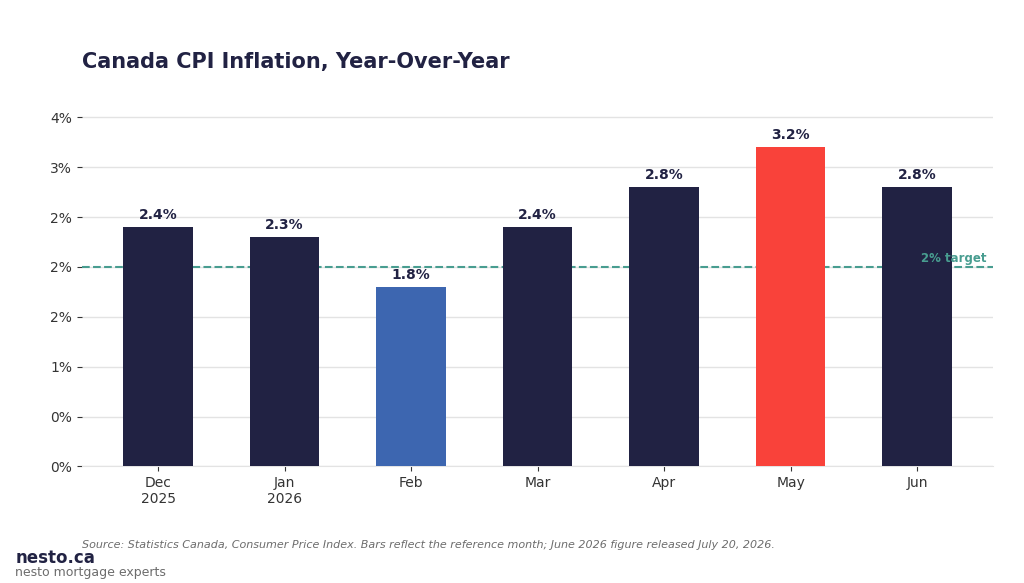
Inflation accelerated to 3.0% year-over-year in July, up from 2.8% in June. Gasoline drove the move, rising 25.7% from a year earlier compared with 20.5% in June, as the blockade of the Strait of Hormuz and the partial closure of Red Sea shipping routes in late July lifted global fuel costs. Excluding gasoline, the CPI held at 2.2% for a third consecutive month. Travel prices added to the acceleration, with travel tours up 15.2% and air transportation up 12.0%, both boosted by World Cup demand and costlier jet fuel. The Bank of Canada’s preferred core measures barely moved: CPI-trim held at 1.9% and CPI-median edged up to 2.0%, leaving their average at 2.0%. Shelter inflation eased again to 1.3%, the slowest pace since May 2020.
For rate watchers, the composition of the July print matters more than the headline. The pickup sits in energy and travel rather than in broad-based domestic price pressure, which is why the report reads as consistent with the Bank of Canada holding the policy rate through the rest of 2026. The headline rate now sits above the path in the Bank’s July Monetary Policy Report, although that Report already expected CPI inflation to stay elevated before easing gradually back to around 2% in early 2027.
Inflation is the most important driver of the BoC’s rate decisions. To achieve its 2% inflation target, the BoC must adjust its policy interest rates to control inflation.
When inflation rises above this target, the Bank of Canada (BoC) increases the policy rate. In turn, commercial banks and lenders raise their prime rates, which directly affect loan and mortgage rates. This discourages borrowing and spending, supporting the BoC’s efforts to return inflation to its 2% target.
If inflation falls below the 2% target, the BoC might lower the policy interest rate to stimulate the economy. Lenders, in turn, decrease their prime rates to encourage borrowing and spending.
Consumer Price Index (CPI) Release Dates 2026
| Date | CPI (Year-over-Year Change) |
|---|---|
| January 19 | +2.4% |
| February 26 | +2.3% |
| March 16 | +1.8% |
| April 20 | +2.4% |
| May 19 | +2.8% |
| June 22 | +3.2% |
| July 20 | +2.8% |
| August 17 | +3.0% |
| September 14 | TBD |
| October 19 | TBD |
| November 16 | TBD |
| December 14 | TBD |
Employment
Canada added 75,000 jobs in July 2026, well above most forecasters’ expectations, and the unemployment rate fell to 6.4% from 6.5% in June, according to Statistics Canada’s Labour Force Survey released August 7. It was the third straight monthly decline in the jobless rate and the lowest reading since July 2024. Since April, employment is up 181,000, the strongest three-month hiring stretch since before the US began imposing tariffs on Canadian goods, led by full-time work (+193,000). As the last Labour Force Survey before the Bank of Canada’s September 2 decision, this report carries real weight, and it points to a labour market that is firming rather than merely holding steady.
The gain was split fairly evenly between full-time and part-time work, and the employment rate rose 0.1 percentage points to 60.9%, its highest level in over a year. Private-sector hiring has led the recent trend: since April, employment growth has been concentrated among private-sector employees (+146,000) and the self-employed (+73,000), while public-sector employee counts have declined.
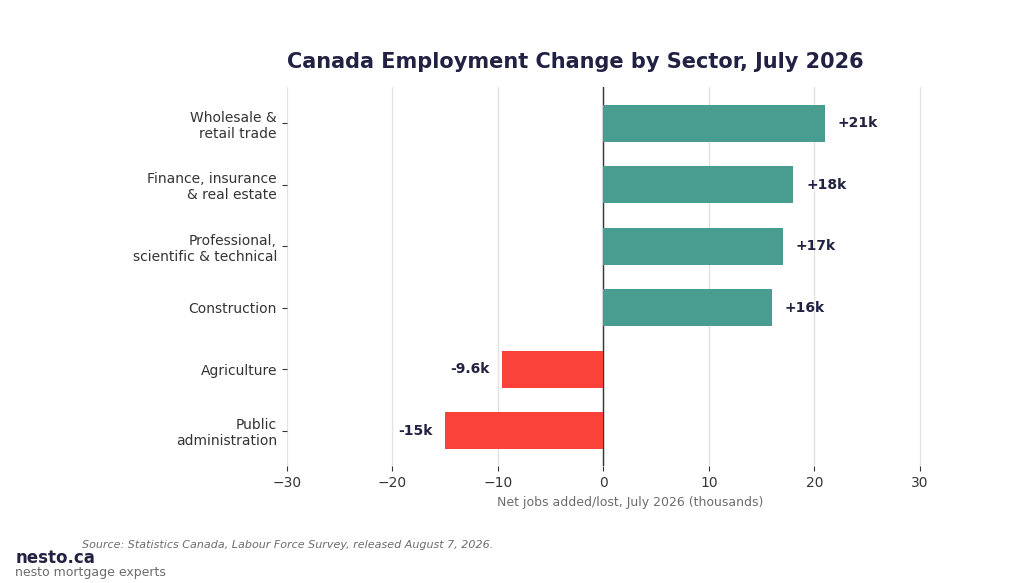
By industry, wholesale and retail trade led July’s gains (+21,000), followed by finance, insurance, and real estate (+18,000), professional, scientific, and technical services (+17,000), and construction (+16,000). Public administration (-15,000) and agriculture (-9,600) were the main areas of weakness.
Youth unemployment (ages 15 to 24) held roughly steady at 12.6%, well down from a recent peak of 14.3% in April, while the unemployment rate for returning students eased to 15.1%, its most favourable July reading in several years for those aged 20 to 24.
Regionally, employment gains were concentrated in Ontario (+52,000), where the unemployment rate fell to 6.8%, its lowest since July 2024, along with British Columbia (+18,000), Manitoba (+5,900), and Nova Scotia (+4,600). Alberta and Quebec were little changed on the month, though Alberta’s employment remains up 3.5% from a year earlier, the largest annual gain among the provinces.
Average hourly wages rose 2.8% from a year earlier to $37.17, easing from 3.3% growth in June (not seasonally adjusted).
Economists broadly read the report as a sign the economy is turning a corner. National Bank called it evidence of that improvement, tempered by fresh US tariff threats, while Servus Credit Union said the numbers support the Bank of Canada’s view of improving momentum, with trade-policy uncertainty as the main downside risk. For rates, a firming labour market gives the Bank of Canada less reason to consider a cut, while contained wage growth and ongoing trade uncertainty leave it in no rush to hike either, a combination consistent with a continued hold at the Bank’s September 2 decision.
BoC rate decisions aim to support maximum sustainable employment levels, maintain output growth, keep inflation predictable and stable, and stimulate the economy. For the economy to maintain inflation at the 2% target, it needs to maintain its maximum sustainable level of employment. This means the economy operates at its highest productive capacity and can sustain itself without triggering inflation.
When employment falls below the maximum sustainable level, people cannot find work and their earnings and savings decline. This affects spending habits, pushing inflation lower, possibly below the 2% target. When employment exceeds this level, employers struggle to find enough workers to meet demand, driving prices and wages higher and increasing inflation. Finding the right balance between inflation and the employment rate is challenging, as both are measured using data from the previous month rather than in real time.
Economic Growth (GDP)
Economic growth tells the Bank of Canada how much spare capacity the economy has. When output grows faster than the economy’s productive potential, that spare capacity closes and inflation pressure builds, which argues for a higher policy rate. When growth stalls, excess supply widens and inflation pressure eases, which argues for a lower one.
Real GDP grew 0.8% in the second quarter of 2026, an annualised 3.3%, the fastest quarterly pace in more than 3 years. Exports rose 3.6%, led by a 27.0% jump in passenger car and light truck shipments as auto production recovered from the semiconductor shortage and retooling shutdowns that disrupted the previous 2 quarters. Business capital investment rose 2.3%, ending 5 consecutive quarterly declines, and residential investment rose 2.5%. Measured by industry, output rose 0.9% with 17 of 20 sectors expanding.
Composition matters more than the headline. Imports rose only 0.3%, so net trade alone contributed roughly 4.4 percentage points to annualised growth, a one-time catch-up that will not repeat. The reference period also ended in June, and Statistics Canada’s advance estimate shows July output essentially unchanged. That combination is why a quarter strong enough to argue for tighter policy has not shifted expectations for the September 2 decision.
Growth reaches mortgage rates through 2 channels rather than one. Stronger growth reduces the Bank of Canada’s urgency to cut the policy rate, which sets prime and therefore variable mortgage rates. Separately, bond markets reprice Government of Canada yields on the data itself, months before the Bank would act, and those yields set fixed mortgage rates. For a fuller breakdown of the release and what it means for borrowing costs, read our guide to Canada’s GDP numbers.
Gross Domestic Product (GDP) Release Dates 2026
| Date | Reference Period | Real GDP Result |
|---|---|---|
| May 29 | First quarter 2026 | Reported unchanged, later revised to +0.1% (+0.3% annualised) |
| June 30 | April 2026 | +0.5%, later revised to +0.6% |
| July 31 | May 2026 | +0.3% |
| August 28 | June 2026 and second quarter | +0.3% monthly; +0.8% quarterly (+3.3% annualised) |
| September 29 | July 2026 | TBD |
| November 30 | Third quarter 2026 | TBD |
The US Economy
The latest data from the US Bureau of Labor Statistics show that US headline CPI rose 4.2% year over year in May, a multi-year high largely driven by energy costs, while core CPI, excluding food and energy, was 2.9%. The Federal Reserve held its benchmark rate at 3.50%-3.75% again on July 29, its fifth consecutive hold, but the 9-3 vote split, with three regional presidents dissenting in favour of a hike over persistent inflation, points to growing internal pressure for the Fed’s next move to be a hike rather than a cut. That stance has kept US Treasury yields elevated. Since Canadian bond yields tend to track US Treasury yields, this backdrop is a key reason Canadian fixed mortgage rates are facing upward pressure, even though domestic inflation remains near target. The Bank of Canada’s July Monetary Policy Report put US growth at about 2.5%, driven mainly by strong consumption and booming AI-related investment, and flagged that US bond yields have risen while Canadian yields have been little changed, a differential that has contributed to the Canadian dollar’s depreciation.
Tariffs and How They Influence Interest Rates in Canada
Trade tensions and tariff announcements may seem far removed from mortgage rates, but they play a direct role in shaping borrowing costs. Since early 2025, the US has imposed significantly higher tariffs on Canadian goods. Recent trade tensions between the US and Canada add a layer of complexity for inflation and monetary policy decisions. The Bank of Canada often responds by keeping policy rates higher for longer or delaying planned rate cuts to prevent consumer prices from climbing further.
The picture grew more uncertain over the summer. On July 1, the US declined to renew CUSMA (also known as USMCA) for a further 16-year term at its first joint review, leaving the agreement in force until 2036 but subject to annual reviews and a longer stretch of trade uncertainty for Canadian exporters. That annual-review timeline is separate from a faster-moving risk: under CUSMA’s Article 34.6, any party can withdraw from the agreement entirely on just six months’ written notice, a materially shorter path to disruption than the 2036 sunset date. No party has invoked it, but its existence is one reason trade uncertainty is expected to persist well beyond the 2026 review. Around the same time, renewed US-Iran tensions sent oil prices swinging, with benchmark crude jumping about 7% in the week of July 8 after a period of relative calm. Those tensions escalated further in late July, when the Strait of Hormuz was blockaded and Red Sea shipping routes were partly closed, keeping energy costs elevated into August. The Bank of Canada’s July 15 Monetary Policy Report noted that, despite the now-annual CUSMA reviews, more Canadian businesses report finding ways to navigate through the uncertainty, and that government spending is also contributing to higher economic activity over the projection.
Trade conditions then deteriorated sharply in late August. Negotiations with the United States broke down on August 22, and a 50% United States tariff took effect the same day on roughly $28 billion of Canadian goods under Section 338 of the Tariff Act of 1930. Canada announced counter-measures on about $20 billion of American products, scheduled to take effect on September 8, alongside support measures for affected businesses, and removed seafood and fish products from that list on August 26.
The measured exposure is narrower than the headline rate suggests. The affected goods represent roughly 5% of Canadian exports to the United States, and more than 80% of Canadian exports still enter the country duty-free under CUSMA. The concentration is regional and sectoral rather than national, falling hardest on producers of plastics, electrical machinery, furniture and wood products in Quebec, British Columbia and Ontario. For rates, most economists read the escalation as a drag on growth rather than a new source of inflation, which is why it reinforces a hold rather than pushing the Bank of Canada in either direction.
Here’s why tariffs matter for Canadian mortgage rates:
- These tariffs increase the costs of imported materials and intermediate goods (for example, metals, automotive parts, and machinery) used in Canadian production. Higher costs translate into stronger inflationary pressures, which in turn can make the Bank of Canada (BoC) more reluctant to cut its policy rate.
- Tariffs on Canadian exports to the US, such as steel, lumber, or manufactured goods, raise costs and slow demand for Canadian producers. This slowing demand for Canadian products can lead to weaker business investment, lower exports, and a hit to Canada’s overall economic growth, moderating the impact of retaliatory import tariffs on inflation.
- Uncertainty around trade and tariff threats can also increase the risk premium investors demand on Canadian-dollar assets. This tends to widen the gap between global interest rates, US yields, and Canadian yields, resulting in higher long-term mortgage rates in Canada.
- If trade talks progress and tariffs are eased, inflationary pressures may ease, and the BoC may gain more flexibility to reduce borrowing costs.
Impact on Canadian Mortgages
Tariff-related price pressures can ripple through the economy, affecting all types of borrowers. When tariffs increase the cost of imported goods and materials, they often feed into broader inflation, which could prompt the BoC to keep borrowing costs elevated for longer.
For first-time homebuyers, higher inflation can make it harder to qualify for a mortgage, increase the total cost of borrowing and push monthly payments higher. Lenders may tighten qualification ratios, further limiting how much buyers can borrow.
For renewers, elevated interest rates mean limited opportunities for meaningful rate relief at renewal. Many borrowers coming off historically low rates may see noticeable increases in monthly payments as fixed and variable rates remain elevated.
For refinancers, higher borrowing costs can reduce or eliminate the benefit of consolidating high-interest debt or tapping into home equity. Until inflation pressures linked to tariffs ease, homeowners may find fewer favourable options when restructuring their mortgage.
What Canada’s Mortgage Rate Forecast Means for Borrowers
Higher borrowing costs have already weighed on consumer demand, and mortgage rates are expected to remain relatively stable throughout 2026. Bond yields may still experience periodic upticks, especially if economic data remains better than expected. This could limit the speed at which lenders adjust their fixed mortgage rates.
Mortgage renewals will remain a significant source of pressure in 2026. A large share of borrowers will be renewing mortgages taken out when the Bank of Canada policy rate was at or below 1%. For these households, renewal rates will be materially higher than they have been, increasing the risk of a mortgage payment shock.
This adjustment is expected to place ongoing strain on household budgets and could continue to dampen housing demand, particularly among fixed-rate borrowers facing sharp payment resets. However, rising costs could also tame the inflation outlook as shelter and mortgage interest costs feed into Canada’s CPI.
Fresh data shows how this is playing out for Canadian mortgage holders and borrowers. The Bank of Canada’s Financial Stability Report estimates that a minority of borrowers, roughly 4% nationally and closer to 9% in the Toronto area, may not qualify to refinance at 2027 rates and prices. However, most can still renew with their existing lender. Being unable to refinance is not the same as defaulting; it will just leave households carrying on without a solution to their tight credit obligations. Household debt relative to disposable income also remained elevated at 179.6% in the first quarter, marking its sixth consecutive quarterly increase, leaving less room to absorb higher payments.
Mortgage Rate Predictions 2027 to 2030
While it’s nearly impossible to predict the exact path of interest rates, most economists broadly agree that interest rates are likely to stabilise as inflation remains under control and within the target range. Higher borrowing costs will touch more households, particularly as borrowers who locked in historically low rates continue to renew at much higher rates. This renewal wave is expected to weigh on household budgets and temper housing demand and inflation, as shelter and mortgage interest costs feed into the consumer price index (CPI).
Looking beyond 2026, the outlook is shaped by slower rate cuts and a gradual normalization of rates, with modest adjustments reflecting economic conditions rather than the emergency policy measures to which we have become accustomed. This sets the stage for a multi-year environment in which mortgage rates remain closer to historical norms, making long-term planning more essential than short-term rate timing. Consensus forecasts see the Bank holding the policy rate at 2.25% through 2026 before beginning to raise it in the second quarter of 2027, with RBC, for example, projecting a series of quarter-point increases through 2027.
Canada Policy Interest Rate Forecast 2027
| Bank | Q1 2027 | Q2 2027 | Q3 2027 | Q4 2027 |
|---|---|---|---|---|
| BMO | 2.25% | 2.25% | 2.25% | 2.25% |
| CIBC | 2.25% | 2.50% | 2.75% | 2.75% |
| National Bank | 2.50% | – | – | 2.75% |
| RBC | 2.50% | 2.75% | 3.00% | 3.25% |
| Scotiabank | 3.00% | 3.00% | 3.00% | 3.00% |
| TD | 2.25% | 2.25% | 2.25% | 2.25% |
Government of Canada 5-Year Bond Yield Forecast 2027
| Bank | Q1 2027 | Q2 2027 | Q3 2027 | Q4 2027 |
|---|---|---|---|---|
| BMO | 2.90% | 2.95% | 2.95% | 2.95% |
| CIBC | 3.30% | 3.35% | 3.40% | 3.45% |
| National Bank | 3.10% | – | – | 3.05% |
| RBC | 3.40% | 3.45% | 3.50% | 3.50% |
| Scotiabank | 3.35% | 3.35% | 3.35% | 3.35% |
| TD | 2.90% | 2.90% | 2.90% | 2.90% |
Bank of Canada Market Participants Survey Quarterly Forecast 2027 to 2028
The Bank of Canada’s Q2 2026 survey extends to 2027 and 2028, providing an outlook for future interest rates.
| 2027 | Policy Interest Rate (median response) |
|---|---|
| January | 2.25% |
| March | 2.50% |
| April | 2.50% |
| June | 2.50% |
| Q3 | 2.75% |
| Q4 | 2.75% |
| 2028 | |
| Q1 | 2.75% |
| Q2 | 2.75% |
| Q3 | 2.75% |
| 2027 | 5-Year Canadian Bond Yield (median response) |
|---|---|
| December | 3.10% |
nesto’s Policy Interest Rate Forecast for Canada 2027 to 2030
| Policy Rate | |
|---|---|
| Q1 2027 | 2.50% |
| Q2 2027 | 2.50% |
| Q3 2027 | 2.50% |
| Q4 2027 | 2.50% |
| Q1 2028 | 2.75% |
| Q2 2028 | 2.75% |
| Q3 2028 | 2.75% |
| Q4 2028 | 2.75% |
| Q1 2029 | 3.00% |
| Q2 2029 | 3.00% |
| Q3 2029 | 3.00% |
| Q4 2029 | 3.25% |
| Q1 2030 | 3.25% |
| Q2 2030 | 3.25% |
| Q3 2030 | 3.25% |
| Q4 2030 | 3.50% |
We’re curious…
Are you a first-time buyer?
Frequently Asked Questions (FAQ) About Mortgage Rate Forecasts in Canada
Will mortgage interest rates go down in 2026?
The Bank of Canada held its policy rate at 2.25% on July 15, 2026, for a sixth consecutive time, and mortgage rates are expected to remain stable for the rest of the year rather than decline.
How much will interest rates rise in the next 5 years?
Most forecasts indicate that interest rates will remain within a more normalized range rather than increase or decrease significantly. However, it is difficult to predict how rates will change over the next five years, as domestic and foreign inflationary pressures influence the BoC’s decisions to raise or lower rates. One of the most significant factors in the long-term inflation battle is the cost of living, which will continue to rise as our population grows and ages.
How will my mortgage payment be affected if it comes up for renewal in 2026?
For most borrowers renewing in 2026, mortgage payments are likely to be higher than they were at origination. Borrowers who locked in fixed rates in 2021 should expect noticeable increases in their payments. Those with fixed rates could see an increase of approximately 20%. In comparison, those with variable rates could see increases ranging from 7% to 40%, depending on whether they took an adjustable-rate mortgage (ARM) or a variable-rate mortgage (VRM).
When is the best time to get a mortgage?
The best time to get a mortgage is when your finances are stable, your credit is strong, and you have saved enough for a down payment and closing costs. Mortgage rates can change quickly and are difficult to predict accurately, so timing the market is rarely a reliable strategy.
Should I wait for rates to drop before buying?
Waiting for mortgage rates to drop can be risky because forecasts can change, and lower rates are not guaranteed. Lower rates can also increase buyer demand and push home prices higher. If you buy when you are financially ready, and mortgage rates decline, you may be able to switch from a variable rate to a fixed rate, choose a shorter-term fixed rate, blend your mortgage, or refinance to take advantage of lower borrowing costs.
How did Canada’s second-quarter GDP affect the mortgage rate forecast?
Canada’s second-quarter GDP growth of 3.3% annualised did not change the mortgage rate forecast for 2026. The strength came largely from a one-time rebound in auto exports during a period that ended in June, and Statistics Canada’s advance estimate shows July output flat, so markets continue to price a hold at the September 2 decision.
What is the Bank of Canada expected to do on September 2, 2026?
The Bank of Canada is expected to hold its policy rate at 2.25% on September 2, 2026, for a seventh consecutive decision. All 35 economists in a Reuters poll taken after the August tariff escalation forecast a hold, and market-implied pricing put the probability of an increase in the low single digits.
Will mortgage rates rise if the Canadian economy keeps growing?
Mortgage rates will not necessarily rise if the Canadian economy keeps growing. Fixed rates respond to Government of Canada bond yields, which price expectations rather than past results, and variable rates respond only when the Bank of Canada changes its policy rate. Sustained growth that closes excess supply would eventually argue for higher rates, but a single strong quarter does not.
Final Thoughts
Mortgage rates will fluctuate, as they have since the invention of mortgages. Ultimately, it’s not the rate that matters, but how much of your disposable income goes toward servicing this obligation. Your goal should be to keep your mortgage payments predictable, manageable within your budget, and feasible over the long term, aligning with your unique needs and long-term financial plans. In the market, rates are expected to stabilise and are unlikely to return to historic lows; flexibility, predictability, and long-term planning matter more than short-term timing of rates.
Mortgage decisions in today’s rate environment require more than guesswork. Reach out to nesto mortgage experts for transparent advice to help you navigate your rate options and long-term mortgage planning.
Why Choose nesto
At nesto, our commission-free mortgage experts, certified in multiple provinces, provide exceptional advice and service that exceeds industry standards. Our mortgage experts are salaried employees who provide impartial guidance on mortgage options tailored to your needs and are evaluated based on client satisfaction and the quality of their advice. nesto aims to transform the mortgage industry by providing honest advice and competitive rates through a 100% digital, transparent, and seamless process.
nesto is on a mission to offer a positive, empowering and transparent property financing experience – simplified from start to finish.
Contact our licensed and knowledgeable mortgage experts to find your best mortgage rate in Canada.
Let’s get started!
About the contributors