

Mortgage Pre-Approval vs. Pre-Qualification in Canada

Buying a home in Canada starts with knowing how much mortgage you can afford, which means getting either pre-qualified or pre-approved, and typically both. These two steps may sound similar, but they serve different purposes and happen at different stages of your home search.
If you’re exploring your budget or just starting to browse listings, pre-qualification provides a quick estimate with minimal effort. However, when you’re ready to make an offer, pre-approval shows sellers that you’re serious about a specific property. Understanding the differences, benefits, and timing of each process helps you move forward confidently.
Key Takeaways
- Pre-qualification is a fast and informal estimate that does not require a hard credit check.
- Pre-approval involves a thorough review and a credit check, making it a stronger indication of your homebuying intentions.
- Pre-approval strengthens your offer and can lock in your interest rate.
Best Mortgage Rates
What Is Mortgage Pre-Qualification?
Mortgage prequalification is typically the first step when you begin considering buying a home. It involves providing basic information about your income, assets, and debts to a lender, either online or over the phone. This information helps the lender quickly estimate how much mortgage you might be able to afford, based on your financial situation. More importantly, this process typically involves only a soft credit check, which doesn’t impact your credit score.
How Pre-Qualification Works
Getting pre-qualified involves a straightforward, informal assessment. You’ll share information about your income, employment, debts, and savings. With this information, the lender can quickly calculate an approximate loan amount you may qualify for. This estimate helps you set realistic expectations for your home search without committing you or the lender to a mortgage.
Benefits of Pre-Qualification
Before you dive into house hunting or comparing mortgage rates, getting pre-qualified can be a smart first step. It gives you a clearer picture of how much you may be able to borrow and helps set realistic expectations for your home search. Here are some of the key advantages of starting with a mortgage prequalification:
- It gives you a quick overview of your financial standing, helping you understand how much you may be able to borrow.
- The process requires minimal documentation and effort, making it an easy first step.
- Since it’s typically a soft credit check, it won’t impact your credit score.
- It helps you focus your home search on properties that realistically fit within your budget.
What Is Mortgage Pre-Approval?
Mortgage preapproval is a more detailed process where a lender thoroughly evaluates your financial position, including your income, debts, assets, and credit history. This evaluation involves a hard credit check, which can slightly affect your credit score, but provides a more concrete figure for how much mortgage you can afford.
A mortgage preapproval also requires specific property details, such as the address, square footage, listing price, property taxes, and condo fees (if applicable). Often, this includes locking in an interest rate for a set period to ensure the mortgage amount you qualify for remains unchanged. The rate hold period typically lasts 90 to 120 days, protecting you from potential rate hikes while you shop.
How Mortgage Pre-Approval Works
The mortgage preapproval process requires you to submit detailed financial documents, including recent pay stubs, employment verification, a summary of remuneration paid (T4S), and identification. The lender will review this information and perform a credit check to assess your financial risk. Upon successful review, you’ll receive a written commitment stating the maximum mortgage amount and the interest rate for which you’re qualified.
The interest rate you receive on a preapproval may be slightly higher than the rate advertised by the lender to protect against potential increases in their funding costs during the rate hold period.
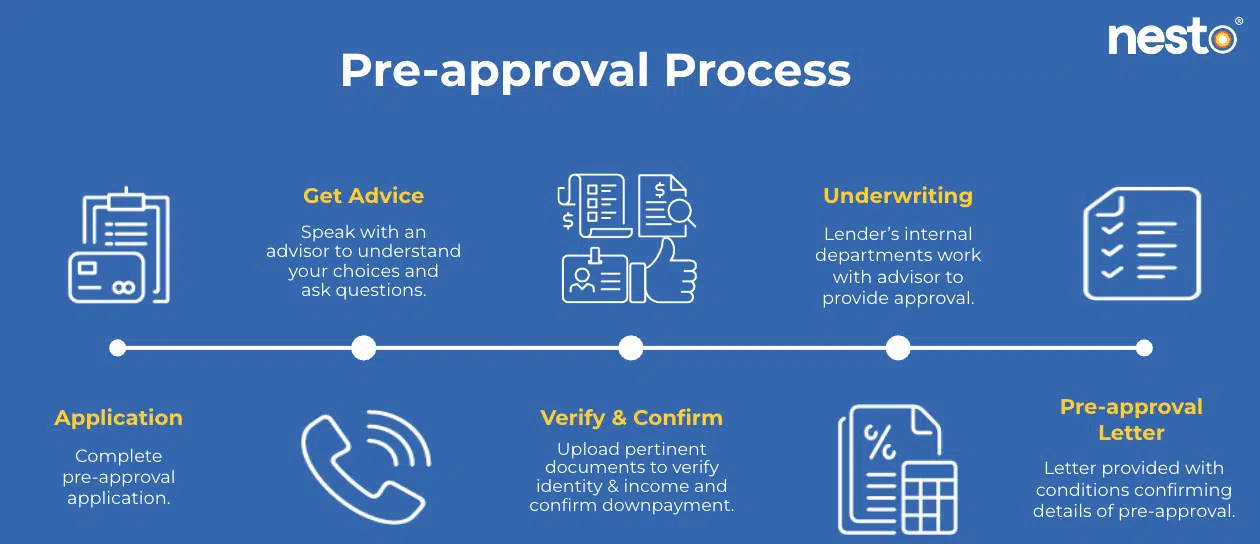
Benefits of Pre-Approval
Getting preapproved for a mortgage isn’t just a formality; it can give you a serious edge in today’s competitive housing market. Beyond helping you understand what you can afford, a preapproval demonstrates to sellers and real estate agents that you’re a serious buyer with financing already in place. Here are some of the key benefits of securing a mortgage pre-approval:
- Getting pre-approved strengthens your credibility as a serious buyer in the eyes of sellers and real estate agents.
- It locks in your interest rate, offering protection against potential rate hikes while you shop.
- Pre-approval provides a clear understanding of your budget, allowing you to make substantial, competitive offers with confidence.
- It also helps streamline the final mortgage approval process once your offer has been accepted, saving time and reducing stress.
Get approval on your low rate today
No big bank bias, just commission-free experts ready to help you.
Key Differences Between Pre-Qualification vs. Pre-Approval
Before you start house hunting or apply for a mortgage, it’s essential to understand the difference between prequalification and preapproval. These two steps may sound similar, but they serve distinctly different purposes, and understanding what sets them apart can help you approach the homebuying process with greater confidence and clarity. Grasping the differences between these two processes is crucial:
- Credit Check: Prequalification involves a soft check, while preapproval requires a hard credit check.
- Commitment: Prequalification offers an estimate, whereas preapproval provides a lender’s firm commitment.
- Property Specific: Prequalification is based solely on your financial profile, while preapproval also considers property details to confirm your eligibility.
- Duration and Effort: Prequalification is quick and easy, while pre-approval requires extensive documentation and takes longer.
- Rate Protection: Typically, only preapproval allows you to lock in interest rates. When qualifying for a variable-rate mortgage (VRM) or adjustable-rate mortgage (ARM), only your discount from the prime rate is locked in; the interest rate initially provided and used to qualify your mortgage is not.
When Should You Get Pre-Qualified or Pre-Approved?
It’s a good idea to get pre-qualified early, ideally when you’re first considering homeownership. Prequalification provides a rough estimate of what you might be able to afford based on your income and debts, helping you set a realistic budget and narrow your search. It’s a low-commitment approach that doesn’t require complete documentation, making it useful for early-stage planning.
Once you’re actively looking and ready to make offers, it’s time to get preapproved. Preapproval involves a more in-depth examination of your finances, including a credit check, which enables lenders to provide a more accurate estimate of your borrowing limit. At this stage, you’ll need information about the type of property you’re considering, as the approval can be tailored to specific property characteristics.
While many lenders require a specific address to issue a preapproval, most will allow you to change the address once your offer is accepted on a similar property. In competitive markets, a preapproval strengthens your position by demonstrating to sellers that you’re a serious, qualified buyer, often giving you an edge over others who haven’t taken that step yet.
Does Pre-Approval Guarantee a Mortgage?
Pre-approval is an essential first step, but it does not guarantee that your mortgage will be finalized. It’s essentially a conditional green light from the lender based on your current financial situation, credit history, and income. However, between pre-approval and closing, several things can change. If your employment status shifts, you take on new debt, miss payments, or your credit score drops, the lender may reassess or even withdraw the offer.
Additionally, final approval depends on the property meeting the lender’s criteria, including appraisal value and condition. To protect your pre-approval status, avoid significant financial changes and maintain a stable credit and income until your mortgage closes.
How to Get Pre-Qualified or Pre-Approved in Canada
If you’re considering buying a home, getting pre-qualified or pre-approved for a mortgage is one of the best ways to begin. It provides a clearer idea of what you can afford, helps you set a budget, and demonstrates to sellers that you’re serious. But these two options aren’t the same, and knowing the difference can save you time, stress, and potentially money down the road.
Pre-qualification is a quick estimate based on your financial snapshot. At the same time, pre-approval provides a more comprehensive assessment, examining your credit, income, and debts to offer a more accurate number. Here’s how to go through each process, step by step.
Step 1: Compare Lenders
Not all lenders offer the same mortgage rates, terms, or flexibility, so it’s worthwhile to conduct some research upfront. Compare different banks, credit unions, and mortgage brokers to find the best options for your needs. Pay attention to the kind of service they offer, their responsiveness, customer reviews and whether they seem focused on helping you, rather than just selling a product. If you’re unsure where to start, a mortgage broker can help you compare multiple options. However, going directly with a lender with transparent rates can also save you money.
Step 2: Decide What You Need
If you’re just getting started and want a rough estimate, pre-qualification may be sufficient. It’s quick, doesn’t require documents, and gives you a general idea of how much you could borrow. However, if you’re ready to start viewing homes or making an offer, pre-approval is the best way to proceed. It’s more official, and sellers will take you more seriously.
Step 3: Gather Your Documents
When you apply for a mortgage pre-approval, your mortgage broker or lender needs to obtain mortgage documents to ensure a clear picture of your finances, which helps determine if you can handle the mortgage. That usually means sharing some basic info about your income, debts, and credit history. You don’t need to have everything perfectly organized, but having your key financial details on hand will make things a lot smoother. It also helps speed up the process, which is crucial if you’re trying to move quickly in a busy market.
Step 4: Apply in a Way That Works for You
Many lenders now let you apply online, which is quick and easy, especially for pre-qualification. You can also choose to apply in person or over the phone if you prefer to discuss the details. Pre-approval may take a little longer, as your documents need to be reviewed, but you’ll usually hear back within a few days.
Step 5: Understand the Credit Check Window
When you apply for pre-approval, there’s a 45-day window where you can shop around with multiple lenders without damaging your credit score. That’s because Equifax, which provides the FICO scores used by most Canadian mortgage lenders, treats all mortgage-related credit checks within that period as one single inquiry. This leeway enables you to compare offers with confidence. Although your rate hold may last up to 120 days, your lender will still need to conduct another credit check once you’ve made an offer on a property and are ready to proceed with final approval.
Step 6: Understand What Your Mortgage Pre-approval Means
Getting pre-qualified or pre-approved is a significant milestone, but it’s essential to review the numbers closely before proceeding. Most lenders will show you an interest rate, and that’s what they’ll use to figure out how much you qualify for, but it doesn’t tell the whole story.
What affects how much your mortgage will cost you over time is how often interest is compounded. For example, a fixed-rate mortgage typically compounds semi-annually (twice a year), whereas a variable-rate mortgage often compounds monthly. Even if the posted rates look the same, monthly compounding means you’ll pay more in interest overall.
That’s why it’s worth asking your lender to confirm your effective rate, which includes compounding. Understanding the annual percentage rate (APR), which reflects your actual borrowing cost, can give you a clearer picture of what you’re signing up for. If any part of it feels confusing or you’d like a second opinion, don’t stress. Talk to a nesto mortgage expert who can walk you through the details and ensure you’re choosing a mortgage that truly fits your needs.
We're curious…
Tips to Protect Your Mortgage Pre-Approval
Getting pre-approved is a big step, but it doesn’t mean you’re fully in the clear just yet. Lenders will take one more look at your finances before officially giving you the green light, so it’s essential to keep things stable until your mortgage closes. Even small financial changes can disrupt or delay the process.
Here’s how to keep your pre-approval safe and on track:
- Try not to open new credit accounts. It may be tempting to finance a new car or apply for a store credit card, but taking on new credit can alter your debt load and negatively impact your credit score.
- Hold off on big purchases. Now’s not the time to buy furniture, book a vacation, or make large credit-based purchases. These can increase your debt levels and affect your approval, or reduce your savings at a time when cash flow management is critical.
- Stick with your job if you can. Lenders want to see stable, reliable income. Changing jobs or reducing your hours, even for a promotion, can raise questions and complicate your file. If you receive bonus income, the lender will use the average of the last two years; otherwise, they will not consider it if you don’t have two years’ T4s from the same employer.
- Stay on top of bills. Keep making payments on time for all your existing debts. A missed payment, even by a few days, could impact your credit at the worst time.
- Avoid co-signing loans. Even if you’re helping someone out, co-signing means taking on extra responsibility, and lenders will factor that into your total debt service (TDS) ratio to take on a mortgage.
What Happens After Mortgage Pre-Approval in Canada?
Once you’re pre-approved, your lender holds a rate for you (usually for 90 to 120 days) and issues a pre-approval letter stating your maximum mortgage amount. From there, the path to owning a home has five main steps.
1. Start house hunting with your pre-approval in hand. Share your pre-approval letter with your realtor so they can filter listings to homes you can actually afford. In competitive markets, pre-approved buyers are often taken more seriously than buyers who haven’t yet been qualified by their lender.
2. Protect your pre-approval while you shop. Lenders can re-check your finances before issuing final approval, so avoid anything that changes your debt ratios: don’t switch jobs, don’t apply for new credit cards or car loans, and don’t make large purchases on credit. Even small changes can shrink or void your pre-approval.
3. Make an offer and submit the full mortgage application. Once a seller accepts your offer, your lender needs the signed purchase agreement and the property details. They’ll refresh your financial documents, rerun your credit check, and pass the file to underwriting. This stage usually takes 2 to 5 business days.
4. Appraisal and conditional approval. The lender orders a property appraisal to confirm that the home’s value supports the loan. This takes anywhere from 3 to 10 business days. Once the appraisal clears, the lender issues a commitment letter listing any final conditions (such as proof of home insurance or updated employment verification).
5. Legal closing. Your lawyer or notary handles the title search, prepares the final paperwork, and coordinates the fund transfer on closing day. Between an accepted offer and closing day, expect roughly 30 to 60 days, depending on what you agreed to in the purchase contract.
A few things worth knowing. Your pre-approval isn’t a guaranteed mortgage. The lender can still decline if your finances change, if the property doesn’t appraise at the purchase price, or if something material comes up during underwriting. If your pre-approval expires before you find a home, you can usually renew it by refreshing your documents and rerunning your credit check.
We're curious…
Frequently Asked Questions (FAQ) About Mortgage Preapproval vs. Prequalification
What’s the difference between pre-qualification and pre-approval?
Pre-qualification provides a quick estimate of how much mortgage you might get, while pre-approval involves a detailed financial check and a lender’s commitment.
Does pre-qualification affect my credit score?
No, pre-qualification involves a soft credit check, which does not impact your credit score.
How long does a mortgage pre-approval last?
Mortgage pre-approval typically lasts between 90 and 120 days, depending on the lender’s rate hold policy.
Can I get pre-approved by multiple lenders?
Yes, you can. However, each lender conducts a separate hard credit check, which could affect your credit score if done outside the 45-day window.
Should I make an offer with just a pre-qualification?
You can, but sellers usually prefer offers backed by pre-approval, as it indicates serious intent and verified financing capacity. Additionally, the preapproval commitment letter is often tied to a specific property address and may offer a fixed rate or a variable discount guarantee.
What happens after mortgage pre-approval in Canada?
After pre-approval, your lender holds a rate for 90 to 120 days while you shop for a home. The path from pre-approval to closing has five steps: start house hunting, protect your finances (no new credit, no job changes, no large purchases), make an offer and submit the full mortgage application, complete the property appraisal and receive conditional approval, and close the deal with your lawyer or notary.
Pre-approval isn’t a guaranteed mortgage. The lender can still decline if your finances change, the property doesn’t appraise at the purchase price, or new issues arise during underwriting. Expect roughly 30 to 60 days between an accepted offer and closing day.
Final Thoughts
Mortgage pre-qualification and pre-approval both play crucial roles in preparing you for the homebuying process in Canada. Pre-qualification provides a quick estimate of what you can afford, helping you set realistic expectations from the outset.
Pre-approval, on the other hand, offers a more thorough financial review that strengthens your credibility with sellers and gives you a competitive edge when you’re ready to make an offer. Understanding the difference and the value each step brings can make your path to homeownership smoother and less stressful.
If you’re ready to take the next step or want expert guidance tailored to your financial situation, connect with a nesto mortgage expert today. We’ll help you navigate every stage with confidence, transparency, and the best mortgage rate.
Why Choose nesto
At nesto, our commission-free mortgage experts are salaried and regulated, with most licensed in multiple provinces. They are evaluated on client satisfaction and the quality of their advice, and they help you compare mortgage options and understand rates and qualification requirements. Once you’re ready to move forward, they work with you on a mortgage strategy that fits your situation.
nesto pairs expert advice with a 100% digital, transparent and seamless process, and a dedicated mortgage professional supports you throughout your purchase, renewal or refinance.
nesto is on a mission to offer a positive, empowering and transparent property financing experience – simplified from start to finish.
Contact our knowledgeable mortgage experts to find your best mortgage rate in Canada.
Let’s get started!
About the contributors