
Income Needed to Buy a Home in the Atlantic Provinces

Buying a home in Atlantic Canada may appear more affordable than in larger provinces, but mortgage approval is subject to the same federal rules nationwide. Lenders approve mortgages based on stress tested qualifying income, mortgage balance, downpayment structure, property taxes, and debt service ratios. Lower home prices do not improve mortgage affordability, as they depend on the borrower’s qualifying income, while total carrying costs depend on after-tax income and the actual monthly payment.
We’ll explain how mortgage affordability and qualification work across New Brunswick, Nova Scotia, Prince Edward Island, and Newfoundland and Labrador, and compare income requirements across provinces and key Atlantic cities using the latest CREA data.
Key Takeaways
- Mortgage approvals in Atlantic Canada are stress tested at the minimum qualifying rate, not the contract rate.
- Income requirements vary across NB, NS, PEI, and NL due to differences in home prices and property tax rates.
- The downpayment structure and mortgage default insurability materially affect the maximum approval.
Best Mortgage Rates
Qualifying for a Mortgage in Atlantic Canada
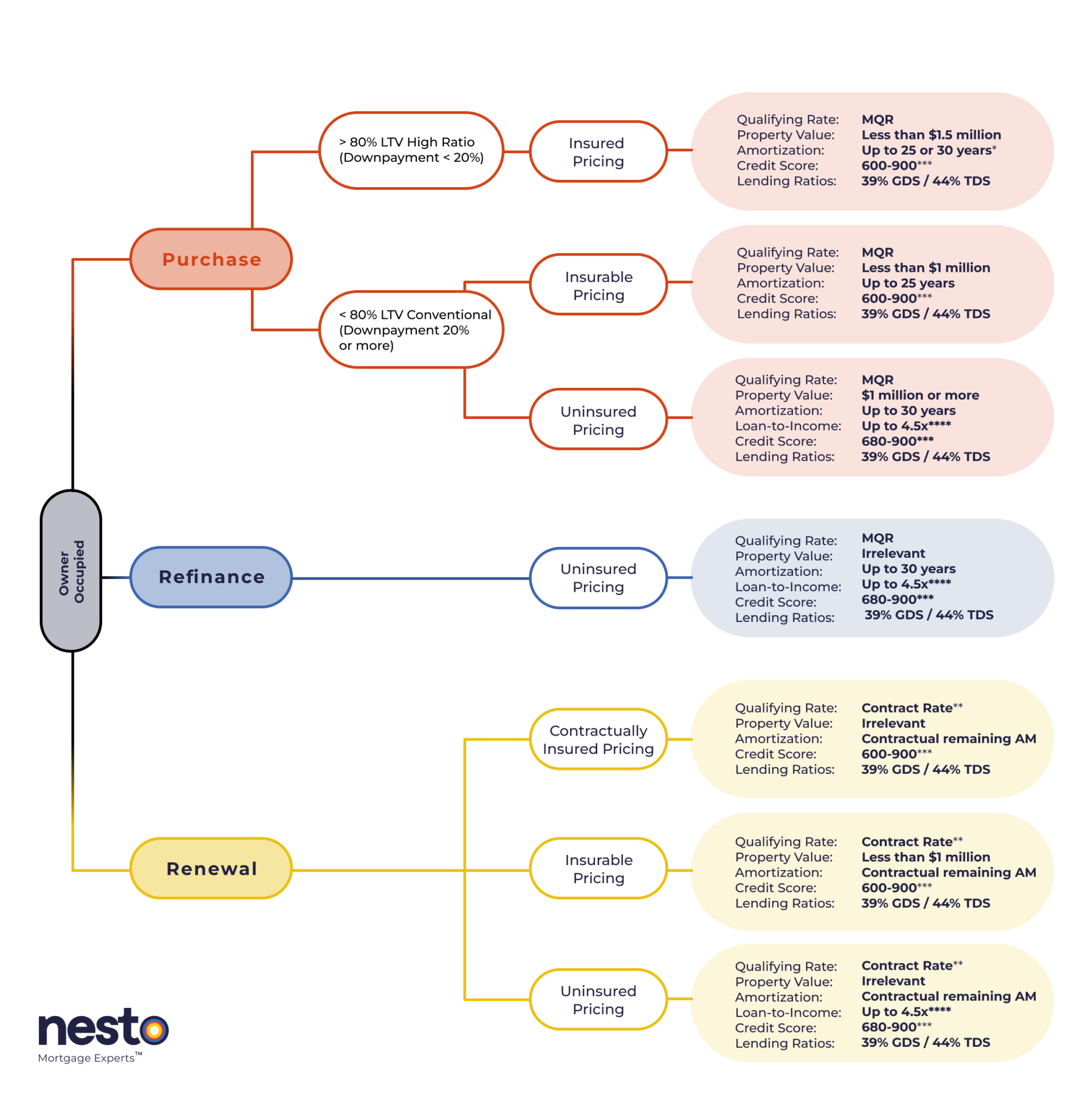
Insured, insurable, and uninsured mortgages differ in down payment, property value, amortization, and rate. Insured mortgages require less than 20% down and a borrower-paid premium from CMHC, Sagen, or Canada Guaranty. Insurable needs 20% or more on a property under $1 million with a 25-year amortization, and the lender pays the premium, which is why it prices close to insured. Uninsured covers everything else, including any refinance, and is the most expensive because the lender carries the full risk. Debt service limits are the same across all three: 39% GDS and 44% TDS. What differs is the minimum credit score, the amortization, and the rate.
Details
*30-year amortizations on insured purchases are limited to first-time homebuyers and buyers of newly built homes.
**The minimum qualifying rate applies to purchases and refinances, not to a renewal with your current lender or a straight switch where your balance and remaining amortization do not increase. Your contract rate plus 2% is the binding figure for almost every borrower today; the 5.25% floor only takes over if rates fall below 3.25%.
***nesto’s minimum credit score is 680 on uninsured mortgages and 600 on insured and insurable mortgages. Debt service ratios of 39% and 44% apply to all three insurability options, so a larger down payment no longer means tighter ratios. All criteria apply to an owner-occupied primary residence mortgage with nesto.
****Loan-to-income applies to uninsured mortgages only, effective 1 January 2025. A file above 4.5 times income is reviewed for an exception rather than declined.
How much can you borrow against your income?
On uninsured mortgages, nesto also checks your loan-to-income (LTI) ratio: everything borrowed against the property compared to your annual household income. If it’s above 4.5 times income, the file goes to an underwriter for an exception rather than being declined. It counts first and second mortgages, a home equity line of credit, and any other borrowing registered against the title, whether the lender is nesto or another institution, and whether you live there or rent it out.
A household earning $150,000 reaches the threshold at about $675,000 of total borrowing. A $100,000 line of credit behind a $600,000 mortgage puts them at 4.7, even though the mortgage alone would have cleared it. LTI applies only to uninsured mortgages, effective 1 January 2025, and reflects OSFI’s loan-to-income limits, which cap high-LTI lending across a lender’s entire book rather than setting a hard ceiling per borrower.
New purchase qualifying rates
Your qualifying rate is our lowest fixed or variable rate for your insurance type, plus 2%:
- Insured: 6.54% fixed or 5.41% variable
- Insurable: 6.54% fixed or 5.41% variable
- Uninsured: 7.09% fixed or 5.85% variable, plus the 4.5 times loan-to-income check
If rates fall below 3.25%, the OSFI floor of 5.25% becomes binding instead.
Renewal (switch or transfer) qualifying rates
A straight switch is exempt from the stress test, so you may renew at the contract rate on our lowest fixed or variable rate for your insurance type:
- Insured: 4.54% fixed or 3.41% variable
- Insurable: 4.54% fixed or 3.41% variable
- Uninsured: 5.09% fixed or 3.85% variable
Asking to increase your mortgage balance or to extend the amortization makes the transaction a refinance.
How Mortgage Qualification Works in Atlantic Canada
All new mortgage purchases and refinances in Atlantic Canada must pass the federal stress test. Borrowers qualify at the higher of 5.25% or their contract rate plus 2%. This minimum qualifying rate (MQR) is used strictly for approval purposes and does not determine the borrower’s actual monthly payment.
Lenders apply gross debt service (GDS) and total debt service (TDS) ratios to ensure housing costs and existing debts remain within federally approved thresholds. Debt service ratio flexibility depends on the mortgage structure you choose, which affects your qualifying income requirement.
| Transaction Type & Limitation | Minimum GDS | Minimum TDS |
|---|---|---|
| Credit score (FICO) for the lowest-score borrower (between 650 and 680) | 32 | 40 |
| Uninsured refinance or uninsured purchase of a property valued at $1.5 million or more | 35 | 42 |
| Insured purchase with a down payment of less than 20% (also applies to insurable mortgages for new purchases and renewals) | 39 | 44 |
Insured, Insurable, and Uninsured Mortgages in the Atlantic Provinces
Mortgage structure, particularly the loan-to-value (LTV) ratio based on the borrower’s downpayment, plays a major role in affordability.
Insured mortgages apply when the downpayment is under 20% and generally allow higher qualifying ratios. Insurable mortgages meet insurer standards with a 20% downpayment and are typically limited to properties under $1M. Uninsured mortgages avoid insurance premiums but are subject to tighter debt service limits, allowing purchases of homes valued at over $1.5 million.
Choosing the right mortgage structure in the Atlantic Provinces can affect both the income required to qualify and the affordability of the carrying costs.
Mortgage Default Insurance Requirements
Mortgage default insurance is mandatory for downpayments under 20%, impacting your mortgage qualifying amount and monthly costs. Default insurance often applies to higher-LTV loans, making high-ratio mortgages more affordable. Due to limitations on amortization periods, these mortgages require a smaller downpayment despite having a higher monthly payment.
| Loan-to-Value | Premium (25-year Amortization) | Premium (30-year amortization) |
|---|---|---|
| 80.01% to 85% | 2.80% | 3.00% |
| 85.01% to 90% | 3.10% | 3.30% |
| 90.01% to 95% | 4.00% | 4.20% |
Atlantic Canada Housing Affordability Snapshot
While the Atlantic provinces generally have lower benchmark rates than Ontario and BC, approval is still based on income under the federal stress test rules.
New Brunswick’s average home price is $344,000, with qualifying income ranging from $69,012 to $82,962.
Nova Scotia’s average home price is $429,100, with qualifying income between $85,544 and $102,882.
Prince Edward Island’s average home price is $389,900, with qualifying income between $77,910 and $93,685.
Newfoundland and Labrador’s average home price is $359,300, with qualifying income between $67,247 and $81,263.
Income Needed Across Atlantic Cities
City-level affordability reflects local home pricing differences within each province. Mortgage qualifying rules are consistent. Home prices and property tax rates differences create qualifying income differences
Income Needed to Buy an Average-Priced Home in Atlantic Canada
| Cities | Average Home Price | Lowest Income Needed | Highest Income Needed |
|---|---|---|---|
| Fredericton | $363,800 | $75,513 | $90,553 |
| Moncton | $384,300 | $74,569 | $89,863 |
| Saint John | $357,700 | $76,591 | $91,648 |
| Halifax | $557,300 | $96,035 | $116,831 |
| St.John’s | $427,800 | $77,725 | $94,147 |
Income Needed by Mortgage Amount in Atlantic Canada
Some borrowers think in terms of mortgage balance rather than purchase price. You’ll need slightly more income to qualify for each $100K mortgage in Atlantic Canada, as the above figures are based on Canada’s 1% average property tax rate. In comparison, the Atlantic provinces have average property tax rates above 1%.
| Province | Property Tax rate |
|---|---|
| New Brunswick | 1.58% |
| Nova Scotia | 1.6% |
| Prince Edward Island | 1.59% |
| Newfoundland and Labrador | 1.07% |
The income required to qualify for a mortgage is based on stress tested monthly payments, not actual contract rate payments.
For every $100,000 of mortgage balance, qualifying income typically ranges from $23,873 to $30,257, depending on mortgage structure and amortization.
For a $200,000 mortgage, qualifying income ranges from $44,670 to $57,086.
For a $300,000 mortgage, qualifying income ranges from $65,466 to $83,914.
How Downpayment Scenarios Affect Mortgage Amounts in Atlantic Canada
Your downpayment size directly affects the mortgage amount you need and the default insurance status of your loan. A 20% downpayment avoids mortgage default insurance premiums but is qualified under stricter uninsured lending guidelines. Minimum downpayments increase your mortgage amount but fall under insured or insurable lending guidelines, allowing more flexibility with debt service ratios.
Home Financing Scenarios Affecting Downpayment and Mortgage Amounts
| Province | Scenario | Downpayment Needed | Mortgage Needed |
|---|---|---|---|
| New Brunswick | Minimum Downpayment | $17,200 | $326,800 |
| 10% Downpayment | $34,400 | $309,600 | |
| 20% Downpayment | $68,800 | $275,200 | |
| Nova Scotia | Minimum Downpayment | $21,455 | $407,645 |
| 10% Downpayment | $42,910 | $386,190 | |
| 20% Downpayment | $85,820 | $343,280 | |
| Prince Edward Island | Minimum Downpayment | $19,495 | $370,405 |
| 10% Downpayment | $38,990 | $350,910 | |
| 20% Downpayment | $77,980 | $311,920 | |
| Newfoundland and Labrador | Minimum Downpayment | $17,965 | $341,335 |
| 10% Downpayment | $35,930 | $323,370 | |
| 20% Downpayment | $71,860 | $287,440 |
We're curious…
Frequently Asked Questions (FAQ) About Mortgage Affordability in Atlantic Canada
How much income do I need to buy a home in Atlantic Canada?
Across Canada’s Atlantic region and within each province, home prices and mortgage qualification requirements vary widely. Income requirements depend not only on the province alone but also on the city or municipality, mortgage balance, and downpayment structure.
How does the mortgage stress test apply in Atlantic Canada?
The mortgage stress test is a federal requirement for prime lending and applies the same across all provinces and territories. All borrowers must meet the minimum qualifying rate (MQR), which is the higher of 5.25% (the benchmark rate) or their contract rate plus 2%. This qualifying rate is used only for approval and does not determine the borrower’s actual payment.
How much income do I need for a $400,000 mortgage in Atlantic Canada?
Under current stress-test rules, qualifying income for a $400,000 mortgage ranges from $86,262 to $110,743, depending on amortization and insurance classification. Typically, you’ll need slightly more income to qualify for a $400K mortgage in Atlantic Canada, as the above figures are based on the nationally averaged 1% property tax rate; however, each of the 4 Atlantic provinces has a higher average property tax rate.
How much mortgage can I afford with 20% down in Atlantic Canada?
A 20% downpayment reduces the mortgage balance and avoids insurance premiums. Final approval depends on the stress tested qualifying rate, the applicant’s household income, the debt service ratios used by the applicant’s mortgage lender, and the property taxes in the province/municipality where the subject property is located.
Typically, you’ll qualify for a mortgage amount of 3.5 to 4.5 times your household income. We’ll use Nova Scotia as an example since it has the highest property prices and property tax rates among the Atlantic provinces. The average home price in Nova Scotia is $429,100.
Currently, a 20% downpayment would set you back $85,820. You’ll need to qualify for a mortgage balance of $343,280 if you’d like to buy the average-priced home in Nova Scotia.
How much house can I afford on a $100,000 salary in Atlantic Canada?
Your mortgage approval depends on your debts, downpayment compared to the home purchase price. Under federal stress test rules, many borrowers qualify for mortgage balances between 4 and 5 times gross household income, provided their debt service ratios remain within lender limits.
As a reference point, each $100,000 of mortgage balance typically requires qualifying income between $23,873 and $30,257 under current stress test rules.
However, these numbers assume a 1% property tax rate; the qualifying income required will vary by province. With Nova Scotia’s 1.6% property tax rate, the income needed to qualify for each $100K mortgage balance should be slightly higher, whereas New Brunswick, PEI and Newfoundland will require more income to qualify with their property tax at 1.58%,1.59% and1.07%, respectively.
Final Thoughts
Mortgage affordability in Atlantic Canada is determined by provincial average home prices, down payments, qualifying interest rates, and federal debt service rules. Although benchmark home prices in NB, NS, PEI, and NL are often lower than in larger provinces, lenders apply the same qualifying criteria nationwide.
Comparing provincial averages, city-level affordability, and mortgage balance scenarios provides a clearer view of realistic approval outcomes. Adjusting your downpayment approach, amortization length, and insurance type can materially influence both qualifying income and long-term affordability.
If you are planning to buy in Atlantic Canada, speak with a nesto mortgage expert to review your income, compare insured and uninsured options, and structure a mortgage strategy that aligns with your goals and regional market realities.
Why Choose nesto
At nesto, our commission-free mortgage experts are salaried and regulated, with most licensed in multiple provinces. They are evaluated on client satisfaction and the quality of their advice, and they help you compare mortgage options and understand rates and qualification requirements. Once you’re ready to move forward, they work with you on a mortgage strategy that fits your situation.
nesto pairs expert advice with a 100% digital, transparent and seamless process, and a dedicated mortgage professional supports you throughout your purchase, renewal or refinance.
nesto is on a mission to offer a positive, empowering and transparent property financing experience – simplified from start to finish.
Contact our knowledgeable mortgage experts to find your best mortgage rate in Canada.
Let’s get started!
About the contributors