
Income Needed to Buy a Home in Montreal
Thinking of buying a home in Montreal? You might have more breathing room than in Toronto or Vancouver, but that doesn’t mean affordability isn’t a challenge. The gap between housing costs and household earnings has widened, even with recent interest rate relief. As property values continue to rise and stress test rules remain in place, homebuyers need to be better prepared than ever.
Let’s break down how much income you need to qualify for an average home in Montreal using today’s best mortgage rates, amortization options, and down payment scenarios. Whether you’re shopping for a condo, an owner-occupied multiplex, or a detached property, we’ll help you budget realistically.
Key Highlights
- The income required to buy a home in Montreal is now well above six figures, mainly due to stress test rules and price growth.
- The average monthly payment in Montréal ranges between $2,211 and $2,952.
- The income required to qualify for a mortgage in Montréal ranges between $105,912 and $128,416.
Best Mortgage Rates
Average Home Price in Montreal
The average home price in Montreal is currently $596,300. That puts homeownership within reach of more people than in Vancouver or Toronto, but rising values are shrinking the gap. With a 20% down payment, buyers who need to qualify using an uninsured mortgage and pass the stress test at the higher of 5.25% or their rate plus 2%. To buy at this price point, the income required to qualify is $128,416.
Monthly Mortgage Payments in Montreal
While lenders test your finances against a higher qualifying rate, your actual monthly mortgage payment will be lower if approved. For a fixed insurable mortgage in Montreal, the actual monthly payment works out to $95,418 when amortized over 25 years. In contrast, you’ll have to qualify with a higher mortgage payment $112,167 if you choose to purchase with a 20% or more downpayment, or transfer/switch your mortgage to a federally regulated lender.
If you choose a 25-year variable mortgage on an insured rate, the monthly payment comes to $2,727, but the qualifying mortgage payment becomes $2,899 as the stress test rate is higher than your contract rate. However, these same monthly payments drop down to $99,289 and $119,669 if you extend your amortization to 30 years, respectively. Extending your amortization increases your borrowing costs, but accelerating your payment frequency can reduce these interest-carrying costs and reduce the time it takes to repay your mortgage.
Even with this flexibility, rate shifts can cause big swings in qualification thresholds from month to month, especially with amortization or rate type changes.
Want to save thousands of
dollars on your renewal?
Renew with nesto and you can.
Mortgage Type and Down Payment Impact
Here’s how down payment and mortgage type affect your income requirements:
- Insured: Less than 20% down, only available on homes priced under $1.5M.
- Insurable: Requires a 20% or higher down payment on eligible properties valued up to $1M, with a 25-year amortization limit for borrowers.
- Uninsured: Any home over $1.5M, refinances, or longer amortizations come with higher rates and lender qualification rules.
In Montreal, most average-priced homes still fall within insured or insurable categories, but even those require careful income planning.
How Much Income Is Needed to Afford a Home in Montreal
To pass the stress test for a new mortgage, your gross debt service (GDS) ratio typically must stay below 35% of your household’s gross income for uninsured mortgage products. In $657,500, the income required to qualify for a home in Montreal ranges between $105,912 and $128,416 when using nesto’s lowest available mortgage rates.
To qualify for the average home in Montreal with a 20% down payment, here’s what’s required based on current fixed mortgage rates:
- Required household income: $128,416
- With a 30-year amortization: $121,459
- Last year’s income needed: $119,906 (30-year amortization)
Using today’s variable mortgage rates, here’s how those figures shift:
- Required household income: $121,330
- With a 30-year amortization: $114,004
- Last year’s income needed: $121,460 (30-year amortization)
While there has been some year-over-year improvement, housing affordability in Montreal is still under pressure due to rising prices. Even with lower rates, many households continue to fall short of the income required to qualify under current lending rules.
How Much Income Do You Need to Afford vs Qualify
To simply afford your monthly payments on a typical Montreal home, you’d need an annual income of $95,418 with a 20% or more downpayment. But to qualify under Canada’s mortgage stress test, lenders want to see that borrowers can handle a higher payment, which increases the required income to $112,167.
This income gap continues to widen as home prices outpace incomes, even in cities like Montreal, which used to be considered relatively affordable.
How Montreal Compares to Other Canadian Cities
Montreal’s affordability gap is growing, even if it remains more manageable than in Toronto or Vancouver. According to the National Bank’s most recent housing affordability report, the median household income in Montreal is approximately $84,000. In contrast, the average income, as tracked by Teranet-National Bank HPI, is closer to $102,000.
Both figures fall short of the $128,416 required to qualify for an average home in the city today. Without a sizable down payment amount or a co-borrower, many prospective buyers would need well above the median income to qualify under current mortgage rules.
Here’s how Montreal home prices and income required to qualify compare to other major markets for $657,500:
- Montreal – $596,300
Income needed: $128,416 - Toronto – $940,800
Income needed: $197,612 - Vancouver – $1,099,100
Income needed: $215,340 - Calgary – $572,500
Income needed: $120,066 - Ottawa – $632,200
Income needed: $143,669
Affordability Trends and Rate Pressures in Montreal
Despite being more affordable than Toronto and Vancouver, Montreal’s required income gap is expanding quickly due to a surge in prices. According to the National Bank’s most recent housing affordability report, “In the first quarter of 2025, affordability in Montreal as measured by the mortgage payment as a percentage of income deteriorated for the second straight quarter. The MPPI* rose 0.2 pp to 43.4%, which was above the average level since 2000 (31.8%). While the quarterly deterioration was worse than the improvement of the urban composite (-0.7 pp), the housing market still remained more affordable in Montreal than in the urban average, as the MPPI* of the latter stood at 55.4%. “
According to the Canada Mortgage and Housing Corporation (CMHC). “For example, the loss of affordability since 2019 in Montréal, Ottawa-Gatineau, the rest of Ontario and Nova Scotia leads to more housing being needed there.”
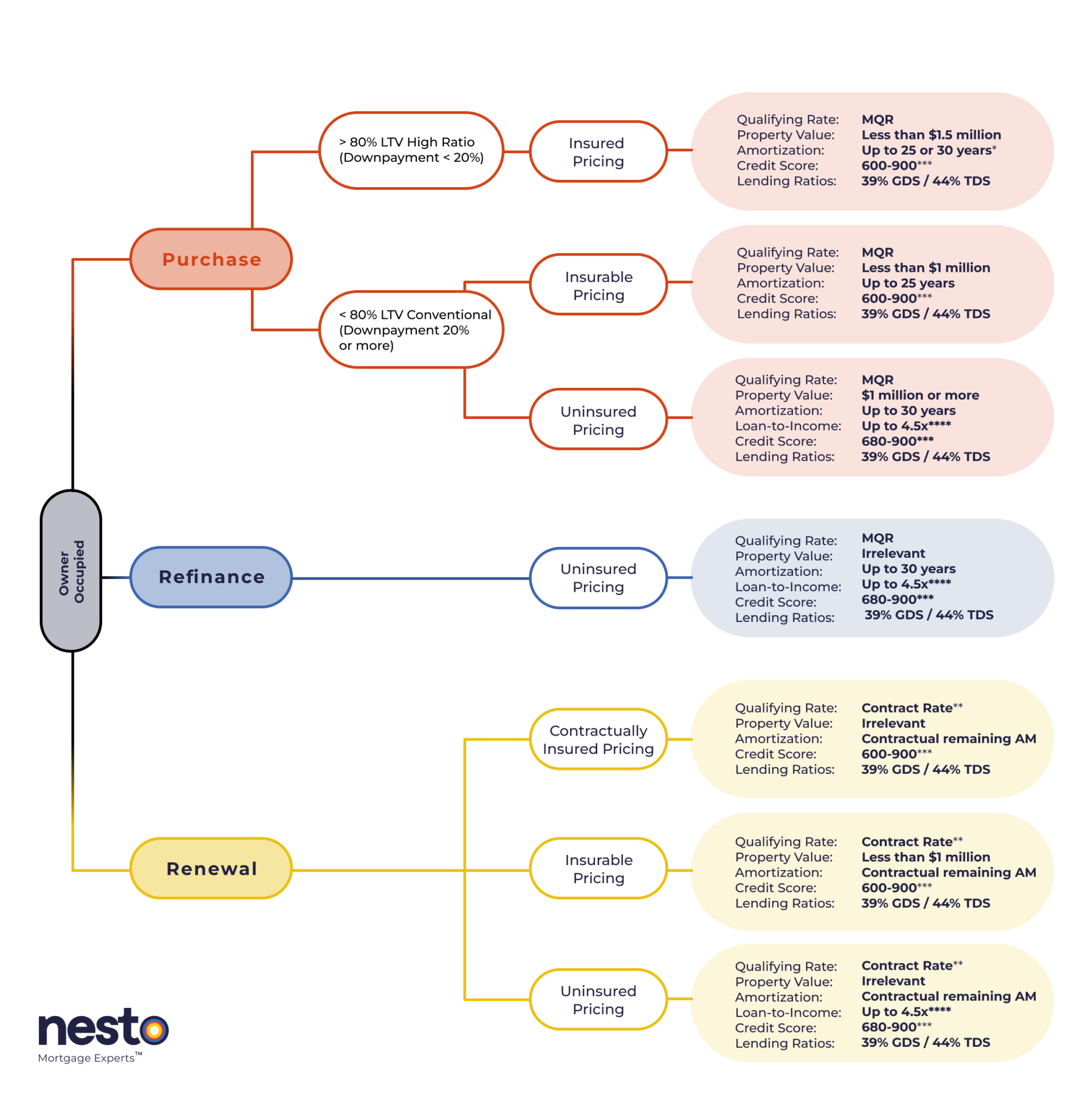
Insured, insurable, and uninsured mortgages differ in down payment, property value, amortization, and rate. Insured mortgages require less than 20% down and a borrower-paid premium from CMHC, Sagen, or Canada Guaranty. Insurable needs 20% or more on a property under $1 million with a 25-year amortization, and the lender pays the premium, which is why it prices close to insured. Uninsured covers everything else, including any refinance, and is the most expensive because the lender carries the full risk. Debt service limits are the same across all three: 39% GDS and 44% TDS. What differs is the minimum credit score, the amortization, and the rate.
Details
*30-year amortizations on insured purchases are limited to first-time homebuyers and buyers of newly built homes.
**The minimum qualifying rate applies to purchases and refinances, not to a renewal with your current lender or a straight switch where your balance and remaining amortization do not increase. Your contract rate plus 2% is the binding figure for almost every borrower today; the 5.25% floor only takes over if rates fall below 3.25%.
***nesto’s minimum credit score is 680 on uninsured mortgages and 600 on insured and insurable mortgages. Debt service ratios of 39% and 44% apply to all three insurability options, so a larger down payment no longer means tighter ratios. All criteria apply to an owner-occupied primary residence mortgage with nesto.
****Loan-to-income applies to uninsured mortgages only, effective 1 January 2025. A file above 4.5 times income is reviewed for an exception rather than declined.
How much can you borrow against your income?
On uninsured mortgages, nesto also checks your loan-to-income (LTI) ratio: everything borrowed against the property compared to your annual household income. If it’s above 4.5 times income, the file goes to an underwriter for an exception rather than being declined. It counts first and second mortgages, a home equity line of credit, and any other borrowing registered against the title, whether the lender is nesto or another institution, and whether you live there or rent it out.
A household earning $150,000 reaches the threshold at about $675,000 of total borrowing. A $100,000 line of credit behind a $600,000 mortgage puts them at 4.7, even though the mortgage alone would have cleared it. LTI applies only to uninsured mortgages, effective 1 January 2025, and reflects OSFI’s loan-to-income limits, which cap high-LTI lending across a lender’s entire book rather than setting a hard ceiling per borrower.
New purchase qualifying rates
Your qualifying rate is our lowest fixed or variable rate for your insurance type, plus 2%:
- Insured: 6.59% fixed or 5.41% variable
- Insurable: 6.59% fixed or 5.41% variable
- Uninsured: 7.09% fixed or 5.85% variable, plus the 4.5 times loan-to-income check
If rates fall below 3.25%, the OSFI floor of 5.25% becomes binding instead.
Renewal (switch or transfer) qualifying rates
A straight switch is exempt from the stress test, so you may renew at the contract rate on our lowest fixed or variable rate for your insurance type:
- Insured: 4.59% fixed or 3.41% variable
- Insurable: 4.59% fixed or 3.41% variable
- Uninsured: 5.09% fixed or 3.85% variable
Asking to increase your mortgage balance or to extend the amortization makes the transaction a refinance.
We're curious…
Mortgage Scenarios for Montreal
To better understand how borrowing needs impact affordability, the table below shows how monthly payments and income requirements scale by mortgage type, interest rate and amortization period in Montreal:
| Mortgage Type | Amortization | Mortgage Rate | Mortgage Payment | 5-Year Term Interest | Income Needed to Renew Mortgage | Qualifying Income Needed |
|---|---|---|---|---|---|---|
| Insured Fixed Rate | 25-year | 4.59% | $2,952 | $108,220 | $107,541 | $126,924 |
| Insured Variable Rate | 25-year | 3.41% | $2,727 | $88,264 | $100,604 | $119,672 |
| Insured Fixed Rate | 30-year | 4.59% | $2,679 | $110,035 | $99,289 | $119,669 |
| Insured Variable Rate | 30-year | 3.41% | $2,444 | $89,788 | $92,040 | $112,030 |
| Insurable Fixed Rate | 25-year | 4.59% | $2,558 | $94,432 | $95,418 | $112,167 |
| Insurable Variable Rate | 25-year | 3.41% | $2,364 | $77,235 | $89,428 | $105,912 |
| Uninsured Fixed Rate | 25-year | 5.09% | $2,650 | $102,344 | $109,468 | $128,416 |
| Uninsured Variable Rate | 25-year | 3.85% | $2,451 | $84,987 | $102,630 | $121,330 |
| Uninsured Fixed Rate | 30-year | 5.09% | $2,419 | $104,031 | $101,553 | $121,459 |
| Uninsured Variable Rate | 30-year | 3.85% | $2,211 | $86,434 | $94,405 | $114,004 |
Condos often require less income, but 50% of the condo maintenance fees must be included in your debt service ratio when applying, which can drive up the income required to qualify.
Strategies to Improve Your Buying Power
If you’re struggling to qualify for your desired property, consider:
- Increasing your down payment to lower your loan-to-value ratio
- Extending your amortization period to 30 years
- Paying down high-interest debt to improve your debt service ratio
- Adding a co-borrower with stable income
- Exploring pre-construction options with longer possession timelines
Mortgage brokers or lenders can help run scenarios based on different rate types, terms, and property types to find your qualifying ceiling.
First-Time Buyer Programs in Montreal
First-time home buyers should look into programs that could help improve their overall purchasing capacity. These supports can help reduce upfront costs, such as:
- RRSP Home Buyers’ Plan (HBP): Withdraw up to $60,000 from your RRSP for a down payment, tax-free.
- First Home Savings Account (FHSA): FTHBs can withdraw up to $40,000 in tax-free savings for a down payment.
- Home Purchase Assistance Program (City of Montreal): FTHB can access up to $15,000 in financial aid and rebates depending on family size and property type.
Frequently Asked Questions (FAQ) About Income Requirements for Homeownership in Montreal
What income is needed to buy a home in Montreal?
To qualify for the average-priced home in Montreal with a 20% down payment, you will need a household income between $105,912 and $128,416 as of $657,500.
Can I purchase a home in Montreal with an income under $100,000?
It may be possible to qualify for an insured mortgage on a lower-priced property, such as a condo, particularly if you apply with a co-borrower. However, qualifying on your own for a detached home is generally not feasible with an income below $100,000, unless you have a downpayment available that makes up the difference.
What is the average monthly mortgage payment in Montreal?
For $657,500, the monthly mortgage payment for the average-priced home in Montreal with a 20% down payment falls between $2,211 and $2,952.
Is buying a condo in Montreal typically more affordable than buying a house?
Yes, condos usually cost less than single-family homes. However, buyers must consider monthly condo fees, which are factored into their debt servicing ratios and can reduce the amount of money they can borrow.
Why are home prices rising in Montreal?
Home prices in Montreal have been driven up by a combination of strong local demand, relatively limited resale inventory, sustained immigration to the region, and continued upward pressure on construction costs.
Make Your Mortgage Strategy Work in Montreal
With home prices rising in Montreal and the income gap widening, qualifying for a mortgage takes more than just strong credit. From down payment strategy to amortization planning, every detail counts. Whether you’re a first-time buyer or upgrading your space, our licensed and qualified mortgage experts will help you find the lowest rate and the best path to affordability.
Connect with a nesto mortgage expert today to secure a mortgage strategy that fits your income and helps you afford the home you want in Montreal.
Why Choose nesto
At nesto, our commission-free mortgage experts are salaried and regulated, with most licensed in multiple provinces. They are evaluated on client satisfaction and the quality of their advice, and they help you compare mortgage options and understand rates and qualification requirements. Once you’re ready to move forward, they work with you on a mortgage strategy that fits your situation.
nesto pairs expert advice with a 100% digital, transparent and seamless process, and a dedicated mortgage professional supports you throughout your purchase, renewal or refinance.
nesto is on a mission to offer a positive, empowering and transparent property financing experience – simplified from start to finish.
Contact our knowledgeable mortgage experts to find your best mortgage rate in Canada.
Let’s get started!
About the contributors