

Income Needed to Buy a Home in Ontario

Mortgage affordability in Ontario depends on more than just a home’s purchase price and your household income. Lenders approve mortgages based on qualifying income, mortgage amount, downpayment, and debt service ratios, not simply the advertised mortgage rate. That means two homebuyers in the same Ontario city can face different approval limits depending on the mortgage amount and structure.
We’ll explain how mortgage qualification works in Ontario and show how income requirements vary across the province. Home prices are updated monthly using the latest market data from OREA and CREA, and all qualifying figures reflect nesto’s current rates, lending standards, and federal stress test rules.
Key Takeaways
- Mortgage approval in Ontario is based on qualifying income calculated at stress tested interest rates, not contract mortgage rates.
- The income required for the same mortgage amount can vary across Ontario municipalities due to property taxes and home values.
- Downpayment size and mortgage insurability can materially change approval outcomes for the same loan amount.
Best Mortgage Rates
Qualifying for a Mortgage in Ontario
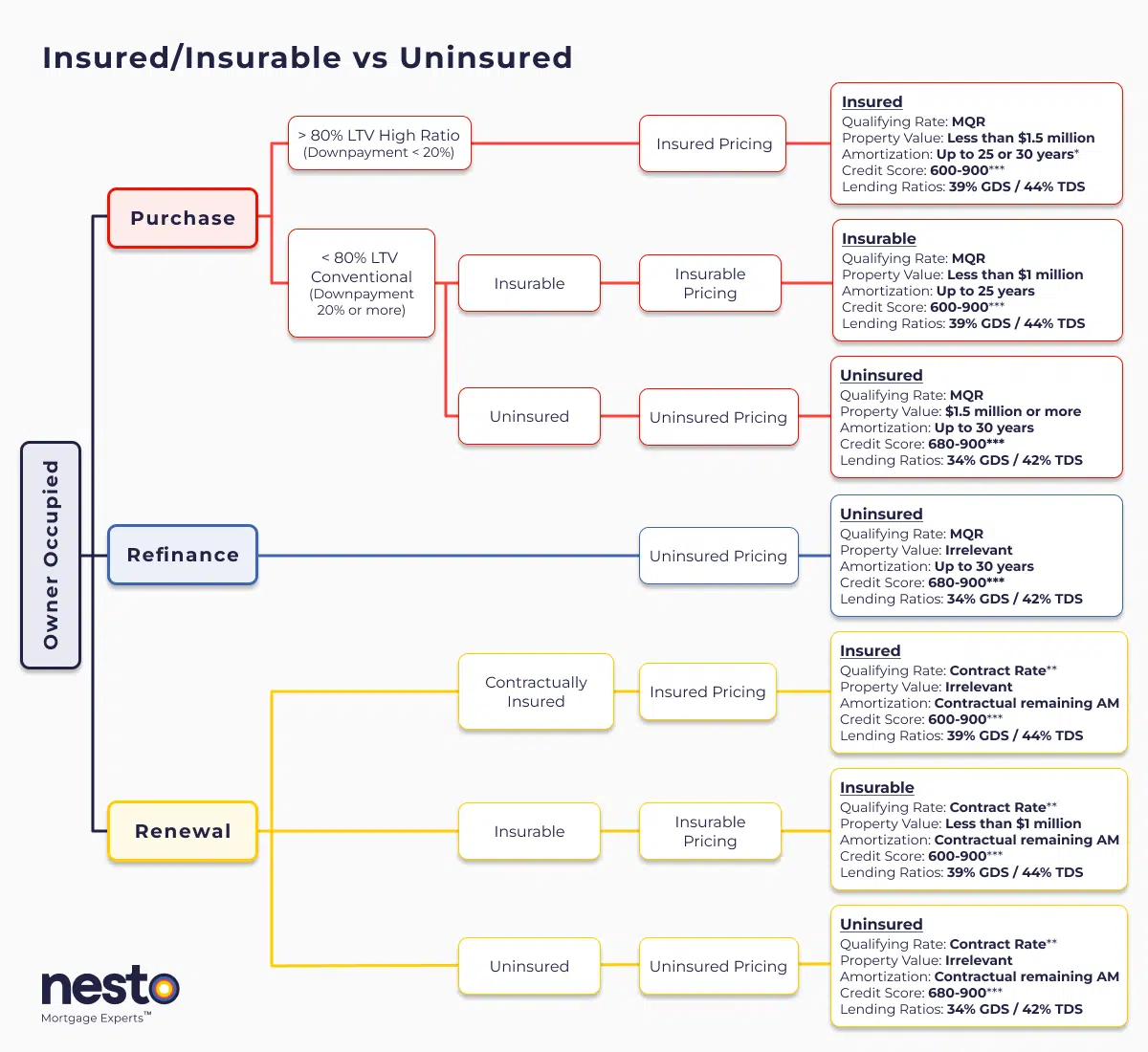
Details
*30-year amortizations on insured purchases are limited to first-time homebuyers (FTHBs) or anyone purchasing newly built homes.
**Qualified at contract rate at renewal only if there are no increases to contractually remaining amortization or remaining balance, and the mortgage is being transferred from a federally regulated lender as outlined by the Department of Finance (DOF) as a straight switch. The Minimum Qualifying Rate (MQR) requirements have been amended by the Office of the Superintendent for Financial Institutions (OSFI). It will be used to qualify all mortgages used for purchases and refinances. The MQR does not apply to renewals if the mortgage is renewed with the current lender or switched from a federally regulated lender.
***A credit score of 600 or 650 is allowable based on the mortgage insurer, and if there is a secondary applicant with a credit score of 680 or above. Lenders may scale debt service ratios (GDS/TDS) based on applicant(s) credit score(s) or reason for purchase/renewal (primary residence vs rental property). If one applicant on a joint mortgage has a credit score below 680, the lender may apply lending ratios as low as 32% GDS and 40% TDS. All criteria in the chart above apply to an owner-occupied primary residence mortgage with nesto.
Contractually insured mortgages are initially mortgage default insured by the borrower at the time of purchase and have not been refinanced or changed in any way that increases their remaining contractual amortization or mortgage balance. These insured mortgages are also known as high-ratio mortgages. In contrast, insurable and uninsured terms apply to conventional mortgages that are back-end bulk portfolio insured (typically lender-paid) or not.
New Purchase Qualifying Rates
Insured home purchases may be qualified using our lowest fixed rate, which will be the greater of 5.25% or 6.04%.
Insured home purchases may be qualified using our lowest variable rate, which will be the greater of 5.25% or 5.40%.
Insurable home purchases may be qualified using our lowest fixed rate, which will be the greater of 5.25% or 6.09%.
Insurable home purchases may be qualified using our lowest variable rate, which will be the greater of 5.25% or 5.40%.
Uninsured home purchases may be qualified using our lowest fixed rate, which will be the greater of 5.25% or 6.44%.
Uninsured home purchases may be qualified using our lowest variable rate, which will the greater of 5.25% or 5.85%.
Renewal (Switch or Transfer) Qualifying Rates
An insured mortgage may be qualified for renewal using the contract rate, which could be on our lowest fixed or variable insured rates, currently at 4.04% and 3.40%, respectively.
An insurable mortgage may be qualified for renewal using the contract rate, which could be on our lowest fixed or variable insurable rates, currently at 4.09% and 3.40%, respectively.
An uninsured mortgage may be qualified for renewal using the contract rate, which could be on our lowest fixed or variable uninsured rates, currently at 4.44% and 3.85%, respectively.
How Mortgage Qualification Works in Ontario
All new mortgage purchases and refinances in Ontario must pass the federal mortgage stress test. Borrowers are qualified at the minimum qualifying rate, which is the higher of 5.25% (benchmark rate) or their contract rate plus 2%, regardless of whether they choose a fixed or variable mortgage. The qualifying rate is used solely for qualifying mortgage approvals and does not reflect the actual interest rate used to calculate monthly payments.
Lenders then apply gross debt service (GDS) and total debt service (TDS) ratios to determine whether a borrower’s income can support their housing costs and other debts. These debt service ratios differ depending on whether the mortgage is insured, insurable, or uninsured.
| Transaction Type & Limitation | Minimum GDS | Minimum TDS |
|---|---|---|
| Credit score (FICO) for the lowest-score borrower (between 650 and 680) | 32 | 40 |
| Uninsured refinance or uninsured purchase of a property valued at $1.5 million or more | 35 | 42 |
| Insured purchase with a down payment of less than 20% (also applies to insurable mortgages for new purchases and renewals) | 39 | 44 |
Insured, Insurable, and Uninsured Mortgages in Ontario
Mortgage structure, particularly the loan-to-value (LTV) ratio based on the downpayment, plays a significant role in affordability.
Insured mortgages apply when the downpayment is under 20% and generally allow higher qualifying ratios. Insurable mortgages available for new purchases and renewals meet insurer standards with a 20% downpayment on amortizations up to 25 years, and are limited to properties under $1M. Uninsured mortgages avoid mortgage insurance premiums but are subject to tighter debt service limits, allowing 30-year amortizations and financing for homes valued at $1.5 million or more.
Understanding which default mortgage insurance category applies to your purchase in Ontario can significantly affect the income you need to qualify.
In Ontario, mortgage default insurance premiums are subject to the provincial sales tax (PST), which must be paid upfront and cannot be added to the mortgage balance, affecting the total required for closing costs.
Mortgage Default Insurance Requirements
Mortgage default insurance is mandatory for downpayments under 20%, impacting your mortgage qualifying amount and monthly costs. Default insurance often applies to higher-LTV loans, making high-ratio mortgages more affordable. Due to limitations on amortization periods, these mortgages require a smaller downpayment despite having a higher monthly payment.
| Loan-to-Value | Premium (25-year Amortization) | Premium (30-year amortization) |
|---|---|---|
| 80.01% to 85% | 2.80% | 3.00% |
| 85.01% to 90% | 3.10% | 3.30% |
| 90.01% to 95% | 4.00% | 4.20% |
Ontario Housing Affordability Snapshot
The average home price in Ontario is currently $746,900. Based on lender qualifying rules, the income needed to buy an average-priced home in the province ranges from $137,381 to $163,713, depending on downpayment and mortgage structure.
Monthly mortgage payments for an average-priced Ontario home range between $2,801 and $3,604, reflecting insured, insurable, and uninsured scenarios on both fixed and variable options.
Income Needed for Common Mortgage Amounts in Ontario
Looking at affordability by mortgage balance helps answer common borrower questions more directly.
The qualifying income for each $100,000 mortgage balance in Ontario typically ranges from $23,478 to $29,325, highlighting that the mortgage amount is just as important as location and insurability when assessing affordability.
For example, the qualifying income required for a $300,000 mortgage in Ontario ranges from $64,279 to $81,118, depending on insurability and amortization.
For a $700,000 mortgage, qualifying monthly payments under the stress test range between $4,570 and $3,865, depending on mortgage type and amortization period.
Income Needed Across Ontario Cities
Mortgage qualification rules are consistent across Ontario, but home prices and property tax rates vary by municipality. These differences affect income requirements across the province even when the mortgage amount is similar.
Income Needed to Buy an Average-Priced Home in Ontario
| Region | Average Home Price | Lowest Income Needed | Highest Income Needed |
|---|---|---|---|
| Toronto | $938,800 | $159,851 | $191,483 |
| Ottawa | $615,400 | $113,262 | $134,966 |
| Hamilton | $736,500 | $138,721 | $165,058 |
| London | $561,600 | $110,109 | $130,687 |
| Kitchener | $646,400 | $120,967 | $143,993 |
| Mississauga | $965,900 | $171,311 | $204,639 |
| Guelph | $721,300 | $135,367 | $161,104 |
| Kingston | $522,900 | $100,991 | $119,975 |
| Windsor | $575,700 | $118,996 | $140,790 |
How Downpayment Scenarios Affect Mortgage Amounts in Ontario
Downpayment size directly determines the mortgage amount you need to borrow. A higher downpayment reduces the loan balance, while a lower downpayment increases the loan balance and may require mortgage insurance.
Home Financing Scenarios Affecting Downpayment and Mortgage Amounts
| Scenario | Downpayment Needed | Mortgage Needed |
|---|---|---|
| Minimum Downpayment | $49,690 | $697,210 |
| 10% Downpayment | $74,690 | $672,210 |
| 20% Downpayment | $149,380 | $597,520 |
We’re curious…
Are you a first-time buyer?
Frequently Asked Questions (FAQ) on Mortgage Affordability in Ontario
How much income do I need to buy a house in Ontario?
The income needed to buy a home in Ontario depends on the mortgage amount, downpayment, property taxes, and the mortgage stress test. For an average-priced home in Ontario, qualifying income currently ranges from $137,381 to $163,713, depending on the mortgage structure.
How does the mortgage stress test work in Ontario?
Borrowers must qualify at the minimum qualifying rate (MQR), which is the higher of 5.25% (federal benchmark rate) or their contract rate plus 2%. This qualifying rate is used solely for mortgage approval and does not affect the actual monthly payment.
How much house can I afford on a $100k salary in Ontario?
Affordability depends on other debts, downpayment size, and local home prices. In lower-priced Ontario cities, a $100k household income may support a larger purchase than in higher-priced markets such as Toronto, but approval is always based on stress-tested ratios.
For example, the income requirement to qualify for a $100,000 mortgage balance typically ranges from $23,478 to $29,325. You can use this as a factor to assess how much you’ll qualify for a $100,000 income.
How much income do I need for a $500k mortgage in Ontario?
Under current stress test rules, the qualifying income required for a $500k mortgage in Ontario ranges from $105,080 to $132,910, depending on mortgage type and amortization. Typically, you’ll need slightly more income to qualify for a $500K mortgage in Ontario, as the above figures are based on Canada’s 1% average property tax rates, while Ontario has a slightly higher average property tax rate of 1.26%.
How much mortgage can I afford with a 20% down payment in Ontario?
A 20% downpayment reduces the mortgage amount and avoids mortgage insurance premiums. However, uninsured mortgages are subject to tighter debt service limits, which can reduce the maximum mortgage approval amount compared with insured or insurable mortgages.
Typically, you’ll qualify for a mortgage amount of 4 to 5 times your household income. Based on Ontario’s average home price of $746,900 currently, a 20% downpayment would set you back $149,380. You’ll need to qualify for a mortgage balance of $597,520 if you’d like to buy the average-priced home in the province.
Final Thoughts
Mortgage affordability in Ontario depends on how income, mortgage balance, downpayment structure, and property tax rates interact under the federal stress test rules. Looking only at home prices or mortgage rates does not provide a complete picture of what lenders will approve.
Understanding how these variables interact enables borrowers to make more suitable decisions. Adjusting the downpayment amount, selecting a suitable amortization period, or structuring the mortgage correctly can meaningfully change qualifying income and long-term affordability.
Working with a mortgage expert can help translate these numbers into a clear, tailored strategy for your financial situation. Nesto mortgage experts take the time to understand your income, debts, and goals so you can move forward with a mortgage structure that fits your needs and Ontario’s lending environment.
Why Choose nesto
At nesto, our commission-free mortgage experts, certified in multiple provinces, provide exceptional advice and service that exceeds industry standards. Our mortgage experts are salaried employees who provide impartial guidance on mortgage options tailored to your needs and are evaluated based on client satisfaction and the quality of their advice. nesto aims to transform the mortgage industry by providing honest advice and competitive rates through a 100% digital, transparent, and seamless process.
nesto is on a mission to offer a positive, empowering and transparent property financing experience – simplified from start to finish.
Contact our licensed and knowledgeable mortgage experts to find your best mortgage rate in Canada.
Ready to get started?
In just a few clicks, you can see our current rates. Then apply for your mortgage online in minutes!