Bank of Canada Maintains the Policy Rate at 2.25%


Find the Best Mortgage
Rates in Canada
5-year fixed*
4.39%
5-year variable*
3.45%
(Prime –1.00%)*Insured mortgage rates. Other conditions apply. Rate in effect as of September 17, 2026.
Compare current mortgage rates across Canada
As of Thursday, September 17, 2026, the Bank of Canada’s policy rate sits at 2.25% and nesto’s prime rate at 4.45%, which together set every variable mortgage rate on this page. The next Bank of Canada decision is expected October 28. Fixed rates move on a different beat, tracking Government of Canada (GoC) bond yields rather than the policy rate, so the two can move in opposite directions in the same week.
Mortgage rate options
There are many mortgage rate options available in Canada, making it essential to find the one that best matches your unique financial circumstances and long-term goals. To make things easier, we’ve compiled a simple table highlighting the most common rate terms and their associated risk levels.
Our lowest advertised rates apply to insured mortgage balances between $700,000 and $1,375,000 for properties valued less than $1.5 million. Discounted rates also apply to insurable mortgages (LTV of 80% or less) on properties valued at less than $1 million. (Conditions may apply)
Uninsured rates apply to all other mortgages that do not meet the above criteria.
The loan-to-value (LTV) ratio compares your base mortgage amount (excluding insurance premiums) to the appraised value of the subject property.
*Applicable only with an accepted offer to purchase, or for switch/transfer of an existing mortgage to nesto at renewal (not applicable for prequalifications, preapprovals or refinances).
Top Big
Bank Rates
The top Big Bank rates in one easy-to-view table. Compare and save with the lowest mortgage rates from nesto.
Are you a first-time buyer?
Province
Find the right home
for your budget
Not sure where to start? Check out our tools to get started
Mortgage
payment calculator

Mortgage
refinance
calculator

Mortgage
affordability
calculator

Today’s Mortgage Interest Rates in Canada

Mortgage rates in Canada move whenever pricing shifts in the capital markets, so the table below shows what nesto would quote you right now, as of Thursday, September 17, 2026. Every term nesto offers appears with insured and uninsured pricing side by side. The rate you personally qualify for depends on your down payment, the property, the term you choose, and which insurance tier your transaction falls into, and each of the sections below explains one of those inputs.
What are the average mortgage rates in Canada today?
The average mortgage rates in Canada today are best represented by the advertised pricing of the six largest lenders: TD, RBC, BMO, Scotiabank, CIBC, and National Bank. Below are the current Big 6 Bank average mortgage rates by term, which serve as a useful benchmark for determining whether an offer in front of you is competitive.
- 2-year fixed mortgage rate:
4.87% - 3-year fixed mortgage rate:
4.98% - 3-year variable mortgage rate:
5.00% - 4-year fixed mortgage rate:
5.44% - 5-year fixed mortgage rate:
5.02% - 5-year variable mortgage rate:
4.16% - 7-year fixed mortgage rate:
5.79% - 10-year fixed mortgage rate:
6.78%
Over the past week, the Big 6 Bank average 5-year fixed moved
Canada’s average uninsured 5-year fixed rate is 5.12%, and the 3-year is 4.93% . The lowest fixed rates go to files carrying default insurance, whether you pay the premium yourself with less than 20% down or the lender covers it. On a 5-year fixed, that is 4.39% at nesto against a Big 6 Bank average of
Variable and adjustable-rate pricing works differently: your rate is set at a fixed discount or premium from the lender’s prime rate, currently 4.45%, and that spread holds for the full term even as the prime rate moves. Insured files earn the deepest discounts, putting nesto at 3.45% against a Big 6 Bank average of
What are the lowest mortgage rates in Canada today?
The best mortgage rates in Canada right now, as of Thursday, September 17, 2026, are the lowest insured rates nesto offers on each term. Every rate below updates automatically when nesto’s pricing moves.:
- 2-year fixed insured mortgage rate: 4.89%
- 3-year fixed insured mortgage rate: 4.44%
- 3-year variable insured mortgage rate: 3.60%
- 4-year fixed insured mortgage rate: 4.59%
- 5-year fixed insured mortgage rate: 4.39%
- 5-year variable insured mortgage rate: 3.45%
- 7-year fixed insured mortgage rate: 6.49%
- 10-year fixed insured mortgage rate: 8.04%
How often are nesto’s mortgage rates updated?
nesto’s dynamic pricing updates your available mortgage rates in real time whenever pricing moves in the capital markets—the part of the financial system where lenders, investors, and institutions trade investments and debt. A dedicated capital markets division continuously sources the most competitive mortgage funding across Canada, so the rate you see on this page is the rate you are offered, with no negotiation step and no posted number held artificially high to leave room for haggling.
How often do Canadian mortgage rates change?
Canadian fixed mortgage rates change whenever Government of Canada bond yields move, which can happen daily. However, once you lock in a fixed rate, you pay the same interest for the whole term. Variable-rate pricing changes on a different clock: the discount from prime is set when you sign, and the prime rate underneath it typically moves when the Bank of Canada adjusts its key overnight policy rate at one of its 8 scheduled announcements each year. nesto and most chartered banks adjust their prime lending rates within a day of a Bank of Canada change.
How to Compare Mortgage Rates in Canada
A mortgage rate comparison is only meaningful when the two numbers describe the same product. Compare a fixed rate against another fixed rate, a 5-year term against another 5-year term, and an insured offer against another insured offer. A posted rate from a bank branch and a discounted rate from a direct lender are not the same number, even when both carry the label 5-year fixed, because posted rates tracked by the Bank of Canada are the standard advertised figures most borrowers never actually pay.
Why is my mortgage rate different from the posted rate?
Your mortgage rate differs from the posted rate because lenders price each file based on risk, then discount from the posted figure according to your credit profile, down payment, transaction type, and whether you are purchasing, renewing, or switching lenders. The best rates you see on nesto reflect the discounted pricing directly, which is why the number quoted here is often well below a branch quote for the same borrower.
A difference of a few basis points can look trivial until you express it in dollars over a full term, so it is worth converting the gap into a monthly payment on your own mortgage amount before deciding it does not matter. Beyond the rate itself, weigh the features, penalties, and restrictions attached to each offer, since many rock-bottom offers carry pre-emptive qualifying criteria or prepayment limits that cost more than the savings if you break the mortgage early. A licensed mortgage broker can run a like-for-like comparison across lenders on your behalf.
Which bank has the best mortgage rates in Canada?
No single bank or lender consistently offers the best mortgage rate in Canada, because each lender prices based on its own funding costs and reprices at different times. The Big 6 Bank average on this page shows where Canada’s biggest chartered banks sit as a group, and a direct lender or broker channel will often undercut it, since branch pricing has to carry the cost of commissioned salespeople and brick-and-mortar overhead. Compare the Big 6 rates against the discounted pricing offered for the same term and default insurance tier, while also considering the lender’s penalty and prepayment terms you could actually live with.
Mortgage Rate Options by Term and Type
What is a mortgage?
A mortgage is a loan used to purchase property, with the property serving as security for the loan. A mortgage typically involves a large sum, is usually repaid over 25 or 30 years, and the borrower retains ownership of the home while paying it off. Canada offers several types of mortgages, from standard charges to collateral charge mortgages that make it easier to borrow against home equity later.
What is a mortgage rate?
A mortgage rate is the percentage of interest you pay on the amount you borrowed over the life of the loan. Canadian mortgage rates are either fixed, staying the same for the full term, or variable, fluctuating as a set discount from the lender’s prime rate, which itself follows the Bank of Canada’s key policy rate.
What is the most common mortgage term length in Canada?
The 5-year term is still the most common among mortgages already outstanding in Canada, but it is no longer what most borrowers are choosing. CMHC reports that variable-rate mortgages became the most popular option in late 2025 and early 2026, and that in the first quarter of 2026 only 14.9% of new uninsured mortgages carried a fixed term of 5 years or longer, down from 22.8% 4 years earlier.
Popularity is not the same as suitability, though. Mortgage terms in Canada run from 6 months to 10 years, and the right one depends on your plans, since breaking a term early triggers a penalty.
Should I choose a 5-year term or a 3-year term in Canada?
Choose a 3-year term when you expect Canadian interest rates to decline, because the shorter commitment lets you renew sooner at lower pricing. Choose a 5-year term when you value payment certainty or expect borrowing costs to rise, since the longer commitment protects you for 2 extra years.
If your plans involve moving, an inheritance, or leaving Canada before the term ends, a shorter term or a lender with generous porting terms limits your penalty exposure. Risk-averse borrowers who want one predictable number for half a decade are usually best served locking a 5-year fixed, while borrowers comfortable with movement can use a 3-year fixed as a bridge until variable pricing improves.
Insured, Insurable, and Uninsured Mortgage Rates
Counterintuitively, the lowest advertised rates in Canada go to borrowers with the smallest down payments. A purchase with less than 20% down must carry mortgage default insurance from CMHC, Sagen, or Canada Guaranty, which transfers the risk of loss away from the lender, and the lender prices that reduced risk back to you. These high-ratio insured mortgages apply to owner-occupied properties valued under $1.5 million, and the provincial sales tax on the default insurance premium is collected at closing rather than added to the loan. First-time buyers also qualify for a 30-year amortization on an insured purchase, new build or resale
Insurable mortgages carry 20% or more down on a property under $1 million, with amortization capped at 25 years; the lender buys the insurance on the back end, and at many lenders, including within nesto’s pricing, rates improve as the loan-to-value ratio falls because lender-paid default insurance costs less. Uninsured mortgages cover everything else: a property purchase for $1.5 million or more, an amortization beyond 25 years on a file that does not qualify for the insured 30-year exception, or any refinance. No insurance is available on an uninsured file; the lender carries the full risk, and pricing is highest. Pricing at 80% loan-to-value can therefore be higher than at lower tiers, so if you are near the boundary, calculate both scenarios before committing.
Fixed vs. Variable Mortgage Rates
The fixed versus variable decision is the widest single choice you make about your mortgage rate, and it is not primarily a forecasting question. It is a question about how much payment uncertainty you can carry without it affecting how you live. The table below puts the two structures side by side.
| Consideration | Fixed rate | Variable rate |
|---|---|---|
| What sets the rate | Government of Canada bond yields plus a lender spread | Lender prime rate minus a set discount |
| Payment during the term | Unchanged for the full term | Changes with prime on an ARM; static on a VRM, with the principal and interest split moving instead |
| What a rate hold locks | The rate itself | The discount from prime, not the absolute rate |
| Penalty for breaking early | Greater of 3 months’ interest or the interest rate differential | Typically 3 months’ interest |
| Suits you if | You want budget certainty, or a rate rise would genuinely strain your finances | You can absorb payment movement and want the lower penalty and the historical cost advantage |
What do nesto borrowers actually choose, fixed or variable?
Across all nesto mortgage applications in August 2026, 72.5% of applicants were pursuing a variable rate — up from just 41.2% a year earlier, when fixed still held a 62% majority. That’s not the highest variable share in nesto’s own data (June 2026 hit 75.5%), but it confirms the shift has held for months, not just spiked once. The wider shift is not unique to nesto: CMHC reported that variable-rate mortgages became the most popular option among Canadian borrowers in late 2025 and early 2026, after variable pricing fell below fixed for the first time since 2022.
Is a variable rate better than a fixed rate?
A variable rate has historically cost Canadian borrowers less than a fixed rate on average over long periods, and it remains substantially cheaper to break, so on pure economics the variable side has the edge. An average conceals individual outcomes that were considerably worse, and an average is cold comfort to a household whose payment jumped in a year when money was already tight. For a first-time buyer absorbing property taxes, condo fees, and maintenance for the first time, a fixed rate buys a stable footing while the rest of the budget settles. Whether the trade is worth it comes down to your risk appetite and cash flow—exactly the conversation to have with a commission-free mortgage expert before you sign. Our guide on whether fixed or variable is the way to go walks through the current case for each.
What is the difference between a VRM and an ARM?
A variable-rate mortgage (VRM) keeps your payment static when prime moves, shifting the split between principal and interest inside each payment instead, while an adjustable-rate mortgage (ARM) changes the payment itself whenever prime changes. Both are commonly called variable mortgages, but the mechanics matter. On a VRM, sustained rate increases can push you toward your trigger rate, the point where your static payment no longer covers the interest owing, and eventually your trigger point, where the balance exceeds the lender’s allowed limit and the payment must be reset. An ARM never reaches a trigger rate because its payment adjusts automatically. Investors financing a rental property sometimes prefer a VRM to keep the deductible interest portion higher, while owners of a principal residence who want to pay the loan down faster typically fare better on an ARM.
How do I lock my mortgage rate?
You lock a variable mortgage rate through convertibility, a standard feature that lets you convert a VRM or ARM into a fixed rate at any point in your term without penalty, provided you stay with your current lender. Depending on the lender, the converted term must usually be at least as long as the time remaining. Before converting, run a cost-savings comparison, since the fixed rate offered on conversion carries no new-business discount, and confirm that any premium you accept for certainty is worth surrendering the cheaper exit a variable mortgage gives you.
Variable Rates Follow the Policy Rate Through Prime
Fixed and variable mortgage rates in Canada are priced off different benchmarks, which is why they can move in opposite directions in the same week. Knowing which benchmark drives your rate tells you what to watch and what to ignore.
The Bank of Canada sets a target for the overnight rate, known as the policy rate, currently 2.25%, and reviews it at 8 scheduled announcements per year, with the next decision expected October 28. When the policy rate moves, lenders adjust their prime rates by the same amount, usually within a day. nesto’s prime rate is currently 4.45%.
Your variable rate is expressed as prime minus a discount. The discount stays constant for your term; the prime rate underneath it does not. When a variable rate is held for you, the discount is being held rather than the rate, so if prime moves during your hold, your effective rate moves with it while the discount stays where it was locked. The Bank of Canada does not set mortgage rates directly, but lenders typically adjust their prime rates within a day of a policy rate change, and prime-linked products such as variable mortgages and home equity lines of credit reprice with it.
Illustrative. A variable rate moves with your lender’s prime rate, so the discount stays fixed for your term while the rate itself does not. Your own discount depends on the mortgage you qualify for.
On September 2, the Bank of Canada held its target for the overnight rate at 2.25% for its seventh consecutive decision, leaving the prime rate unchanged at 4.45%. The recovery has broadened since the spring: second-quarter growth came in at an annualised 3.3%, ahead of the Bank’s own 2.5% projection, with gains across consumption, housing, exports and business investment. The labour market has since cooled, with employment down 42,000 in August while the unemployment rate held at 6.4%, still below the 6.5% to 7% range it had occupied since late 2024. Labour demand is subdued, and the economy is running with excess supply. Inflation held at 3.0% year-over-year in August, kept there by gasoline as the blockade of the Strait of Hormuz drags on, although gasoline price growth itself slowed to 22.8% from 25.7%. Excluding gasoline, inflation rose to 2.4% after 3 consecutive months at 2.2%, while core measures stayed near target with CPI-trim at 1.9% and CPI-median at 2.0%. Financial conditions have tightened as well, with long-term bond yields moving up globally and in Canada. The Bank still expects inflation to average about 2.5% in the second half of 2026 and return to the 2% target by early 2027. Governor Tiff Macklem was direct about where the balance now sits:
Unlike in July, when the Bank read the risks as broadly balanced, this decision was framed around two risks pulling in opposite directions: persistently high oil prices and spillover into other goods and services, while new US tariffs and Canadian countermeasures make growth prospects less certain. The Governing Council offered no forward guidance beyond a readiness to move if conditions change. The August inflation report did little to settle it, since the headline held steady while price pressure broadened beneath it. Bond markets put the odds of a 25-basis-point hike on October 28 at 60%, against 40% for a hold. The odds shift by December 9, which falls after another inflation report and the Bank’s October Monetary Policy Report, and markets imply 99% for a hike by then. Read the full Opening Statement and our post-announcement mortgage strategy breakdown for what this means for Canada’s mortgage rates forecast.
Fixed Rates Follow Government Bond Yields
How do bonds affect mortgage rates?
Bonds affect mortgage rates because Government of Canada (GoC) bond yields, particularly yields at maturities close to the mortgage term, are the main benchmark for fixed mortgage pricing. Lenders then add a spread reflecting funding cost, credit risk, operating cost and market conditions, commonly 1 to 2 percentage points on a 5-year fixed.
Bonds are debt securities issued by governments to fund growth and projects, and Canada Mortgage Bonds (CMBs) specifically function as mortgage-backed securities that channel investor money into home lending. When interest rates rise, existing bond prices fall, and yields climb; when rates fall, prices rise, and yields drop, as the Bank of Canada explains in its primer on what sits behind your mortgage rate.
Bond yields respond to inflation data, employment figures, and global capital flows rather than to any single Canadian policy decision, which is why a fixed rate can rise in a month when the Bank of Canada does nothing at all. Decisions by the US Federal Reserve ripple into Canadian yields too—a dynamic covered in our piece on how the US Fed impacts Canadian mortgages. If you are already locked into a fixed term, yield movements change the price of new mortgages, not yours, although falling bond yields do shape the offer waiting at your renewal.
Where Are Mortgage Rates Headed?
Are mortgage rates going down in Canada?
Nobody can promise that mortgage rates are going down in Canada, and any lender claiming certainty is selling something. What can be said with confidence is what the market is pricing, what the Bank of Canada has signalled, and where economists disagree. Bond markets currently imply a narrow range of outcomes centred on stability, with some economists pointing to inflation near the 2% target as grounds to hold and others warning that renewed price pressure would skew the risk toward a hike rather than a cut. Both are reasonable readings of the same data, and the disagreement itself is the useful signal: the credible range is narrow. For the full outlook by term, see nesto’s mortgage rates forecast for Canada.
Should I wait for rates to drop before buying?
Waiting for rates to drop before buying is a bet that pricing improves faster than home values and rents rise, and that bet has historically been unreliable. A lower rate on a more expensive home can cost more than a higher rate on a cheaper one, and every month of waiting is a month of rent with no equity. A sounder approach is to buy when your finances support it, qualify at today’s pricing through the purchase process, and choose a term structure that leaves you free to renew into lower rates if they arrive.
Payment Shock and the Great Renewal
What is the Great Renewal?
The Great Renewal is a term coined by nesto to describe the wave of Canadian mortgages renewing between 2025 and 2029, most of them originated at record-low pandemic pricing in 2020 and 2021. CMHC estimated that roughly 2.2 million mortgages, about 45% of all outstanding loans, came up for renewal across 2024 and 2025 alone, and its residential mortgage industry dashboard shows total residential mortgage debt passing $2.4 trillion in December 2025, up 4.8% year-over-year. The renewal wave has now peaked, with volumes expected to ease through 2026, but borrowers coming off 5-year terms still face materially higher pricing than they signed up for.
How many Canadian mortgages are at risk of payment shock?
The number of Canadian mortgages facing payment shock is falling, but the size of the shock is not. CMHC estimated that more than 1.2 million fixed-rate mortgages came up for renewal in 2025, and reports that renewal pressures peaked that year, with roughly 13% fewer borrowers renewing in 2026 and volumes easing further into 2027. Rates have come down over the same stretch, from about 4.8% in January 2025 to about 4.2% in January 2026, but a household rolling off a 5-year term signed at pandemic pricing still faces an increase close to what 2025 renewers absorbed.
CMHC warned as early as 2023 that the greatest shocks lay ahead for homeowners renewing off pandemic-era pricing. Most borrowers who renewed in 2025 managed the increase, which CMHC attributes in part to the stress test having qualified them well above their contract rate, though industry commentary continues to flag the risk for the households still to come. To see what your own renewal could cost, run the numbers through nesto’s payment shock calculator.
Posted & Prime Rate History
Here’s a historical overview of changes in the posted and prime rates at Canada’s chartered banks since 1980.
Source: bankofcanada.ca
What Factors Affect Your Mortgage Rate in Canada?
Canadian mortgage rates are priced on risk, and a handful of inputs do most of the work: the term you pick, the rate type, your down payment, the property’s use, the transaction type, your amortization, your credit history, and your income stability. The down payment has the largest single effect because it determines which insurance tier your file falls into, but every input below affects your pricing.
Mortgage Term
Your mortgage term is the length of time your agreement and pricing stay in effect, anywhere from 6 months to 10 years. Lenders price each term differently based on their funding costs at that maturity, so comparing offers only makes sense once you have settled on the term that fits your plans.
Mortgage Type
Open mortgages cost more than closed ones because they let you repay the full balance at any time without penalty, a flexibility most borrowers never use. Closed mortgages carry lower pricing in exchange for prepayment limits, and they represent the overwhelming majority of Canadian home loans.
Down Payment and Loan-to-Value
The size of your down payment sets your loan-to-value (LTV) ratio, the single most influential number in rate pricing. The LTV compares your base mortgage amount, excluding any insurance premium, against the appraised value of the property, and it determines whether your file is insured, insurable, or uninsured under the tiers described earlier on this page.
Property Use
A home you live in prices better than a home you rent out. Lenders add a risk premium on investment properties because a borrower under financial strain pays the mortgage on their own residence first. An owner-occupied home with a legally registered secondary suite still qualifies for primary-residence pricing.
Transaction Type
Purchases and straight renewals price similarly. A refinance is always priced as an uninsured transaction, so pulling equity, extending the amortization period, adding a HELOC, or moving from a private lender to a prime lender each carries a rate premium over an equivalent purchase. Porting a mortgage to a new home keeps your existing rate, blended with current pricing on any new money through a weighted average.
Amortization
A longer amortization period lowers each payment and raises the lifetime interest cost. Insured and insurable files cap at 25 years, with insured purchases stretching to 30 years for first-time buyers and newly built homes, while uninsured files can run to 30 years in exchange for slightly higher pricing.
Credit Score
The best pricing, including nesto’s, is reserved for borrowers with a FICO score of 680 or higher and no missed mortgage payments. Canada’s 2 credit agencies, Equifax and TransUnion, score files out of 900, and lenders rely on the hard FICO pull rather than the soft scores in consumer apps.
FICO, the most-used credit scoring model for mortgage applications, ignores mortgage inquiries made in the 30 days before it scores your file, and counts the rest of a rate-shopping period as one inquiry rather than several, so shopping around does not damage your credit score the way many borrowers fear. FICO’s Canadian guidance is to finish shopping and close within 45 days to keep the impact as small as possible. Where missed payments have a genuine explanation, such as a separation, nesto experts can build a case for an underwriting exception.
Income Proof
Income stability shows your capacity to carry the debt. Salaried applicants supply pay stubs, an employment letter, and T4 slips, while self-employed borrowers need notices of assessment, T1 Generals, business registration, and at least 3 months of bank statements.
Lenders commonly use a 2-year history to assess variable or non-guaranteed income such as bonuses, overtime, contract work and self-employed earnings. Treatment of non-taxable income varies by lender and program, and some lenders will gross up eligible non-taxable income for qualification.
The Canada Mortgage Stress Test
What is the current stress test in Canada?
The current mortgage stress test in Canada requires most new mortgages and refinances at a federally regulated lender to qualify at the higher of 5.25% or the contract rate plus 2 percentage points. Renewals with your existing lender and straight switches to a new lender are exempt. For uninsured mortgages, the qualifying rate is set by the Office of the Superintendent of Financial Institutions (OSFI) under its B-20 underwriting guideline. For insured mortgages, it is set by the Department of Finance. Because contract rates have sat above 3.25% for several years, the contract-plus-2% side of the test is almost always the binding one, and the 5.25% minimum qualifying rate now matters mainly as a backstop. You can check your own qualifying rate with the FCAC mortgage qualifier tool. Provincially regulated credit unions are exempt from the federal test, although they apply their own higher qualifying rates instead.
| Requirement | Insured | Insurable | Uninsured |
|---|---|---|---|
| Minimum down payment | 5% | 20% | 20% |
| Maximum property value | Under $1.5 million | Under $1 million | No limit |
| Maximum amortization | 25 years* | 25 years | 30 years |
| GDS / TDS limits | 39% / 44% | 39% / 44% | Set by lender policy |
| Qualifying rate | Higher of 5.25% or contract + 2% | Higher of 5.25% or contract + 2% | Higher of 5.25% or contract + 2% |
*Insured purchases can carry a 30-year amortization for first-time homebuyers and buyers of newly built homes. All criteria in the chart apply to an owner-occupied primary residence mortgage with nesto.
Insured, insurable, and uninsured mortgages differ in down payment, property value, amortization, and rate. Insured mortgages require less than 20% down and a borrower-paid premium from CMHC, Sagen, or Canada Guaranty. Insurable needs 20% or more on a property under $1 million with a 25-year amortization, and the lender pays the premium, which is why it prices close to insured. Uninsured covers everything else, including any refinance, and is the most expensive because the lender carries the full risk. Debt service limits are the same across all three: 39% GDS and 44% TDS. What differs is the minimum credit score, the amortization, and the rate.
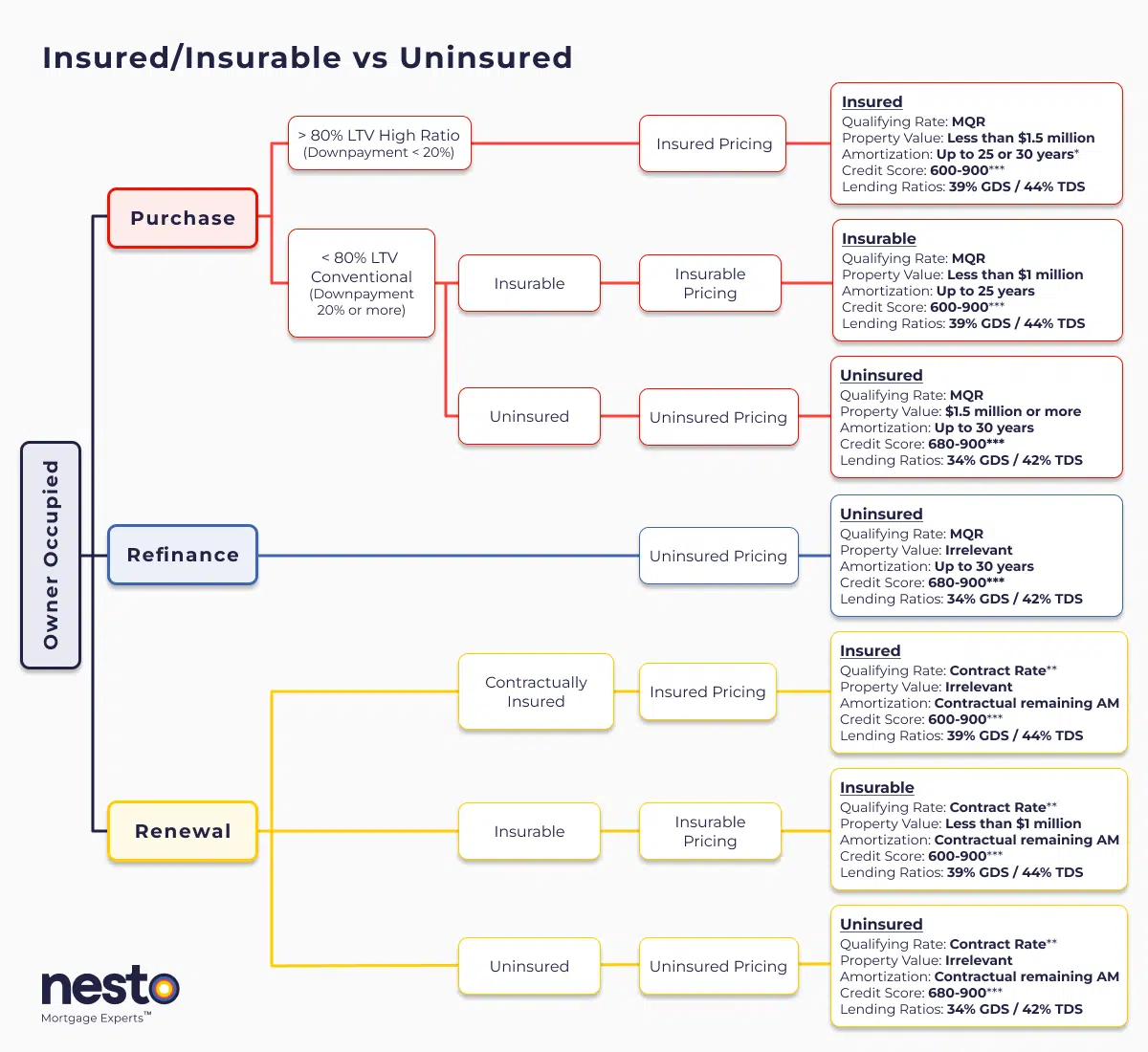
Details
*30-year amortizations on insured purchases are limited to first-time homebuyers and buyers of newly built homes.
**The minimum qualifying rate applies to purchases and refinances, not to a renewal with your current lender or a straight switch where your balance and remaining amortization do not increase. Your contract rate plus 2% is the binding figure for almost every borrower today; the 5.25% floor only takes over if rates fall below 3.25%.
***nesto’s minimum credit score is 680 on uninsured mortgages and 600 on insured and insurable mortgages. Debt service ratios of 39% and 44% apply to all three insurability options, so a larger down payment no longer means tighter ratios. All criteria apply to an owner-occupied primary residence mortgage with nesto.
****Loan-to-income applies to uninsured mortgages only, effective 1 January 2025. A file above 4.5 times income is reviewed for an exception rather than declined.
How much can you borrow against your income?
On uninsured mortgages, nesto also checks your loan-to-income (LTI) ratio: everything borrowed against the property compared to your annual household income. If it’s above 4.5 times income, the file goes to an underwriter for an exception rather than being declined. It counts first and second mortgages, a home equity line of credit, and any other borrowing registered against the title, whether the lender is nesto or another institution, and whether you live there or rent it out.
A household earning $150,000 reaches the threshold at about $675,000 of total borrowing. A $100,000 line of credit behind a $600,000 mortgage puts them at 4.7, even though the mortgage alone would have cleared it. LTI applies only to uninsured mortgages, effective 1 January 2025, and reflects OSFI’s loan-to-income limits, which cap high-LTI lending across a lender’s entire book rather than setting a hard ceiling per borrower.
New purchase qualifying rates
Your qualifying rate is our lowest fixed or variable rate for your insurance type, plus 2%:
- Insured: 6.39% fixed or 5.45% variable
- Insurable: 6.39% fixed or 5.46% variable
- Uninsured: 6.79% fixed or 5.84% variable, plus the 4.5 times loan-to-income check
If rates fall below 3.25%, the OSFI floor of 5.25% becomes binding instead.
Renewal (switch or transfer) qualifying rates
A straight switch is exempt from the stress test, so you may renew at the contract rate on our lowest fixed or variable rate for your insurance type:
- Insured: 4.39% fixed or 3.45% variable
- Insurable: 4.39% fixed or 3.46% variable
- Uninsured: 4.79% fixed or 3.84% variable
Asking to increase your mortgage balance or to extend the amortization makes the transaction a refinance.
Do I have to pass the stress test when I renew?
You do not have to pass the stress test when you renew with your current lender, and a straight switch to a new lender at renewal, where neither the loan amount nor the remaining amortization increases, is also exempt from the prescribed stress test. OSFI stopped prescribing a minimum qualifying rate for uninsured straight switches on 21 November 2024, and insured and portfolio-insured switches were already exempt. The new lender still underwrites the file and can set its own qualification standards. That single rule change removed the main obstacle keeping borrowers tied to an uncompetitive renewal offer, and CMHC data shows uninsured switches rose 34% between the second half of 2024 and the second half of 2025 as homeowners caught on. A refinance is different: taking out equity, extending the amortization, or adding a home equity line of credit always triggers a full stress-tested requalification.
What are the GDS and TDS lending ratios?
The GDS and TDS ratios are the 2 affordability limits inside the stress test. The Gross Debt Service (GDS) ratio divides your housing costs — meaning the stress-tested mortgage payment, property taxes, heat, and half of any condo fees — by your gross income, and must stay at or below 39% on insured files. The Total Debt Service (TDS) ratio adds up all other debt payments on your credit file and must stay at or below 44%. CMHC applies a standard threshold of 35% GDS and 42% TDS and reserves the 39% and 44% maximums for applicants with a strong credit history, with a recommended minimum credit score of 680. Uninsured limits are not prescribed and vary by lender.
How to Lock In the Best Mortgage Rate
Should I complete a pre-approval or a pre-qualification?
A pre-qualification assesses your borrowing capacity from your income, credit, savings, and down payment before you have a property in view, and a pre-qualification is not a rate hold offered with a pre-approval. The distinction is deliberate at nesto. Lenders that attach a rate hold to a pre-approval incur a real cost for reserving money at a set price, and they recover that cost by adding a premium to the rate, which then follows you even if pricing falls. nesto prices live instead, which is how the rate stays as low as it does, and your best rate or discount locks only once you have an accepted offer to purchase, or an approved switch or transfer at renewal. It never locks on a pre-qualification, a pre-approval, or a refinance.
What is a mortgage rate hold, and how long does it last?
A mortgage rate hold protects your pricing while you finish the transaction. At nesto, the hold on a 5-year fixed or 5-year variable runs up to 150 days, among the longest in the Canadian market, while every other term carries a hold of up to 120 days. On a 5-year variable specifically, the hold locks your discount from prime rather than the absolute rate, so your effective rate still moves if prime moves during the hold period, while the discount stays exactly where it was secured.
Does comparing mortgage rates hurt my credit score?
Comparing mortgage rates does not hurt your credit score in any meaningful way. FICO, the credit scoring model used in mortgage applications, ignores mortgage inquiries from the 30 days before it scores your file and de-duplicates the rest of a rate-shopping period into a single inquiry, and its Canadian guidance is to complete your shopping and close within 45 days. Soft checks used for planning have no effect at all, so shop as widely as you like before a lender pulls your full FICO file to underwrite the application.
Renewing or Switching Your Mortgage
Most Canadian mortgage rate shopping is done by homeowners reaching the end of a term rather than by buyers, and the majority still sign the renewal letter their existing lender sends without comparing it to anything. A renewal offer is very rarely the best pricing available to you, because your incumbent lender is counting on inertia. The mortgage renewal process rewards borrowers who start shopping 4 to 6 months before maturity, which lines up neatly with nesto’s 150-day hold on 5-year terms.
What is the difference between a switch and a refinance?
A switch, also called a transfer, moves your existing balance and remaining amortization to a new lender at renewal, usually at no cost to you and, since the recent rule change, generally without a new stress test. A refinance changes the loan itself: borrowing more, extending the amortization, or restructuring the charge. Refinances are always priced as uninsured transactions and always require requalification, and the costs of refinancing in Canada include legal and appraisal fees a straight switch avoids. For a deeper library on both paths, browse nesto’s renewal and refinancing advice hub.
Beyond the Rate: Features, Penalties, and Total Cost
The lowest rate is not always the cheapest mortgage. About 60% of outstanding Canadian mortgages are scheduled to renew by the end of 2026, and many borrowers also pay out their mortgage before the term ends: through a sale, a move, a refinance, or a change in circumstances. At that moment, the prepayment penalty and the feature set matter far more than the few basis points that decided the original choice. Breaking a variable or adjustable mortgage normally costs three months’ interest, while breaking a fixed-rate mortgage costs the greater of three months’ interest or the interest rate differential (IRD), which can be substantial when mortgage rates have fallen since you originally signed.
Should I choose the lender with the lowest rate?
The lender with the lowest rate is not automatically the best choice, because restricted or limited-feature mortgages buy their pricing by removing something: prepayment privileges, portability, or, in some cases, the right to break the mortgage at all except through a bona fide sale to an unrelated party. Penalties on restricted products can be calculated as a percentage of the outstanding balance rather than the usual 3 months’ interest. Review the main types of mortgage lenders in Canada and the restrictions attached to each offer before deciding that a few basis points are worth it.
What are mortgage prepayment options?
Mortgage prepayment privileges let you pay down principal directly and become mortgage-free faster. The standard menu includes annual lump sums of 10% to 20% of the original balance, doubled-up payments, an annual increase to your regular payment, and accelerated weekly or biweekly payment frequencies that quietly shave years off an amortization schedule. nesto keeps the feature set simple by offering all of them on its full-featured mortgages, including a minimum lump-sum prepayment of $100 with any regularly scheduled payment, and prices its limited-feature option identically for every client who qualifies.
What other mortgage features should I compare?
Portability lets you transfer your mortgage to a new property mid-term without penalty, typically within 30 to 90 days of paying out the old loan, and it is the feature that saves you when a restricted mortgage would have charged a punishing exit fee. Assumability allows a qualified buyer to take over your existing loan when they purchase your home, which can be a genuine selling point if your contract rate is below the market rate. Convertibility, covered above, rounds out the set. Not every lender offers every feature on every product, so confirm what is attached before the pricing conversation starts, or ask one of nesto’s mortgage advisors to walk you through the full comparison; the nesto FAQ also answers the questions our experts hear most often.
Choosing Between a Mortgage Broker and a Mortgage Lender
Who arranges your loan changes how much you pay, how smooth the process feels, and even how much you qualify for. Lenders sell through different channels: some fund through branches and broker networks, while direct lenders sell straight to consumers and pass along the savings from skipping commissioned salespeople. Pricing genuinely varies by channel because someone has to be paid in each one, so understanding how your salesperson is compensated tells you a great deal about the rate you’re seeing.
A qualified mortgage broker specialises in mortgages rather than general banking, shops multiple lenders on your behalf, and is typically paid by the lender rather than by you on a standard residential file. Titles vary by province, from mortgage agent in Ontario to mortgage associate in Alberta and sub-mortgage broker in British Columbia, but the licensing, education, and provincial regulation behind the title are equivalent, with Quebec applying some of the most rigorous consumer-protection requirements in the country. At nesto, salaried, commission-free experts concurrently hold designations in every province we lend in, so nobody earns more by selling you a higher rate. Whoever you work with, confirm your mortgage professional is licensed before sharing your documents.
Why Choose nesto
At nesto, our commission-free mortgage experts, certified in multiple provinces, provide exceptional advice and service that exceeds industry standards. Our mortgage experts are salaried employees who provide impartial guidance on mortgage options tailored to your needs and are evaluated based on client satisfaction and the quality of their advice. nesto aims to transform the mortgage industry by providing honest advice and competitive rates through a 100% digital, transparent, and seamless process.
nesto is on a mission to offer a positive, empowering and transparent property financing experience – simplified from start to finish.
Contact our licensed and knowledgeable mortgage experts to find your best mortgage rate in Canada.
Save up to $18,542 in your first term*
See current provinces rates
See current local rates
*Interest rates displayed, posted, or discussed verbally and in writing are subject to change at any time and without notice. The interest rate is not guaranteed until it is provided as a mortgage commitment or loan agreement produced by the lending authority. Interest rates may change if the transaction type changes or evolves outside of the criteria of the originally secured interest rate. To secure your interest rate promptly, all requested information and documents must be provided and deemed satisfactory by the lending authority.
The average rates are calculated from the advertised rates of the six largest mortgage lenders in Canada. The six biggest lenders are the chartered banks: Toronto-Dominion Bank (TD), Royal Bank of Canada (RBC), Bank of Montréal (BMO), Bank of Nova Scotia (BNS), Canadian Imperial Bank of Commerce (CIBC), and National Bank of Canada (NBC). We may also display a similar average, including Desjardins, Tangerine, First National Financial (FN), and nesto, to round out Canada’s 10 biggest mortgage lenders. The averages shown may be further broken down between insured/insurable and uninsured rates.