
Income Needed to Buy a Home in the Prairie Provinces

Buying a home in the Prairie provinces can feel more affordable than in BC or Ontario, but mortgage approval is subject to the same federal rules nationwide. Lenders approve mortgages based on stress tested qualifying income, mortgage balance, downpayment structure, property taxes, and debt service ratios. Lower home prices reduce the required mortgage amount, but qualification still depends on income under the federal stress test.
We’ll explain how mortgage affordability and qualification work across Alberta, Saskatchewan, and Manitoba, and compare income requirements across the Prairie provinces and their major cities using the latest CREA data.
Key Takeaways
- Mortgage approvals in the Prairie provinces are qualified using the federal minimum qualifying rate, not the contract rate.
- Income requirements vary across Alberta, Saskatchewan, and Manitoba due to differences in home prices and property tax rates.
- Downpayment structure and mortgage default insurability materially affect maximum approval amounts.
Best Mortgage Rates
Qualifying for a Mortgage in the Prairie Provinces
Details
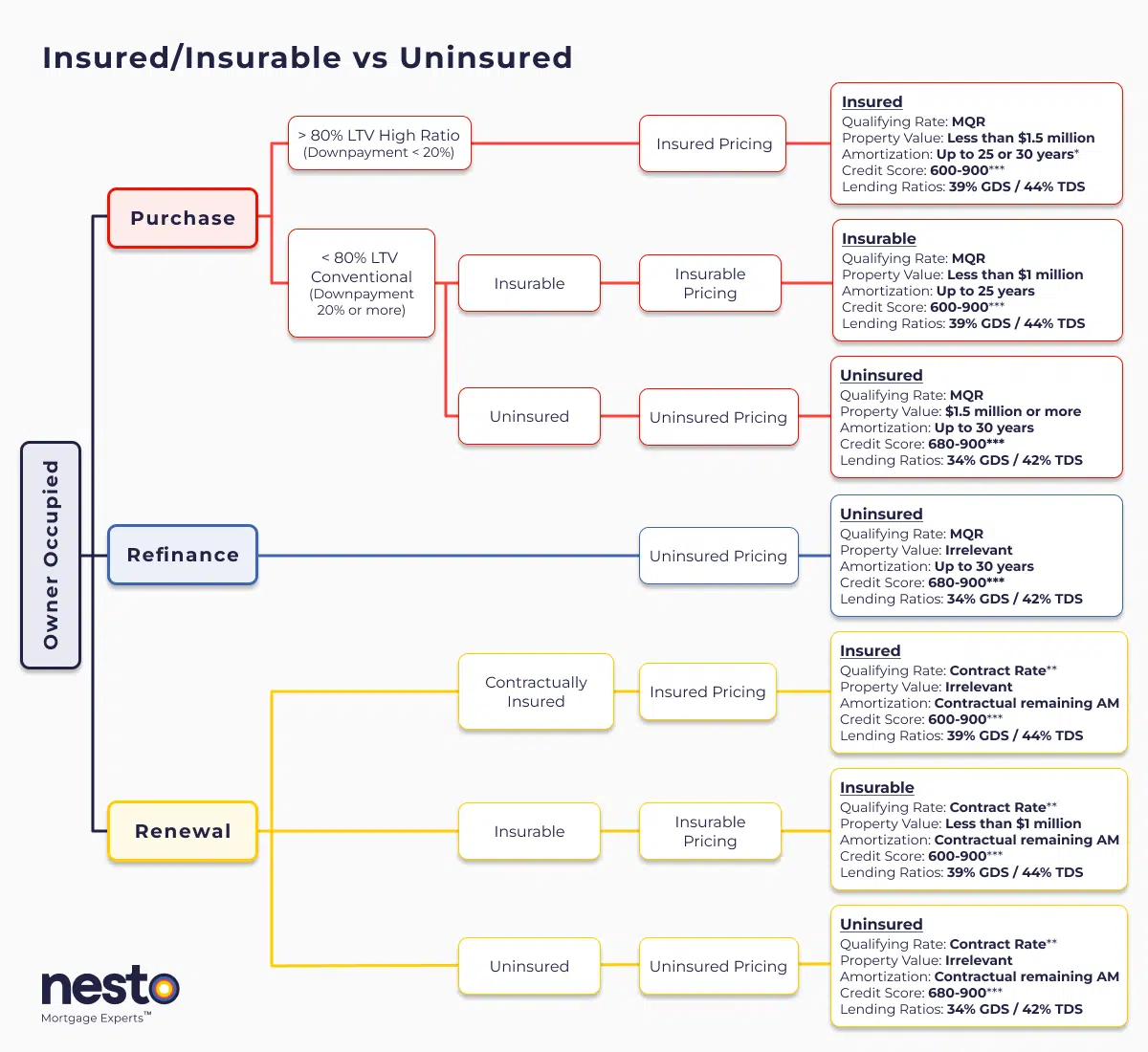
*30-year amortizations on insured purchases are limited to first-time homebuyers (FTHBs) or anyone purchasing newly built homes.
**Qualified at contract rate at renewal only if there are no increases to contractually remaining amortization or remaining balance, and the mortgage is being transferred from a federally regulated lender as outlined by the Department of Finance (DOF) as a straight switch. The Minimum Qualifying Rate (MQR) requirements have been amended by the Office of the Superintendent for Financial Institutions (OSFI). It will be used to qualify all mortgages used for purchases and refinances. The MQR does not apply to renewals if the mortgage is renewed with the current lender or switched from a federally regulated lender.
***A credit score of 600 or 650 is allowable based on the mortgage insurer, and if there is a secondary applicant with a credit score of 680 or above. Lenders may scale debt service ratios (GDS/TDS) based on applicant(s) credit score(s) or reason for purchase/renewal (primary residence vs rental property). If one applicant on a joint mortgage has a credit score below 680, the lender may apply lending ratios as low as 32% GDS and 40% TDS. All criteria in the chart above apply to an owner-occupied primary residence mortgage with nesto.
Contractually insured mortgages are initially mortgage default insured by the borrower at the time of purchase and have not been refinanced or changed in any way that increases their remaining contractual amortization or mortgage balance. These insured mortgages are also known as high-ratio mortgages. In contrast, insurable and uninsured terms apply to conventional mortgages that are back-end bulk portfolio insured (typically lender-paid) or not.
New Purchase Qualifying Rates
Insured home purchases may be qualified using our lowest fixed rate, which will be the greater of 5.25% or 6.04%.
Insured home purchases may be qualified using our lowest variable rate, which will be the greater of 5.25% or 5.40%.
Insurable home purchases may be qualified using our lowest fixed rate, which will be the greater of 5.25% or 6.09%.
Insurable home purchases may be qualified using our lowest variable rate, which will be the greater of 5.25% or 5.40%.
Uninsured home purchases may be qualified using our lowest fixed rate, which will be the greater of 5.25% or 6.44%.
Uninsured home purchases may be qualified using our lowest variable rate, which will the greater of 5.25% or 5.85%.
Renewal (Switch or Transfer) Qualifying Rates
An insured mortgage may be qualified for renewal using the contract rate, which could be on our lowest fixed or variable insured rates, currently at 4.04% and 3.40%, respectively.
An insurable mortgage may be qualified for renewal using the contract rate, which could be on our lowest fixed or variable insurable rates, currently at 4.09% and 3.40%, respectively.
An uninsured mortgage may be qualified for renewal using the contract rate, which could be on our lowest fixed or variable uninsured rates, currently at 4.44% and 3.85%, respectively.
How Mortgage Qualification Works in the Canadian Prairies
All new mortgage purchases and refinances in Alberta, Saskatchewan, and Manitoba must pass the federal stress test. Borrowers are qualified at the minimum qualifying rate (MQR), which is the higher of 5.25% (the benchmark rate) or their contract rate plus 2%. The minimum qualifying rate is used strictly for approval and does not determine the borrower’s actual monthly payment.
Lenders apply gross debt service (GDS) and total debt service (TDS) ratios to ensure housing costs and existing debts remain within federal lending guidelines. Debt service ratio flexibility depends on mortgage insurability and directly affects the income you’ll need to qualify.
- Insured mortgages generally allow higher debt service ratios.
- Insurable mortgages requiring a 20% downpayment are limited to a 25-year amortization on properties priced less than $1 million, and allow insured debt service ratios.
- Uninsured mortgages may face tighter ratio caps even though they avoid insurance premiums.
| Transaction Type & Limitation | Minimum GDS | Minimum TDS |
|---|---|---|
| Credit score (FICO) for the lowest-score borrower (between 650 and 680) | 32 | 40 |
| Uninsured refinance or uninsured purchase of a property valued at $1.5 million or more | 35 | 42 |
| Insured purchase with a down payment of less than 20% (also applies to insurable mortgages for new purchases and renewals) | 39 | 44 |
Insured, Insurable, and Uninsured Mortgages in the Prairies
Mortgage structure, particularly the loan-to-value (LTV) ratio based on the borrower’s downpayment, plays a major role in affordability.
Insured mortgages apply when the downpayment is under 20% and generally allow higher qualifying ratios. Insurable mortgages meet insurer standards with a 20% downpayment and are typically limited to properties under $1M. Uninsured mortgages avoid insurance premiums but are subject to tighter debt service limits, allowing purchases of homes valued at over $1.5 million.
Choosing the right mortgage structure in the Prairies can affect both the income required to qualify and the affordability of the carrying costs.
In Saskatchewan, mortgage default insurance premiums are subject to the provincial sales tax (PST), which must be paid upfront and cannot be added to the mortgage balance, affecting the total required for closing costs.
Mortgage Default Insurance Requirements
Mortgage default insurance is mandatory for downpayments under 20%, impacting your mortgage qualifying amount and monthly costs. Default insurance often applies to higher-LTV loans, making high-ratio mortgages more affordable. Due to limitations on amortization periods, these mortgages require a smaller downpayment despite having a higher monthly payment.
| Loan-to-Value | Premium (25-year Amortization) | Premium (30-year amortization) |
|---|---|---|
| 80.01% to 85% | 2.80% | 3.00% |
| 85.01% to 90% | 3.10% | 3.30% |
| 90.01% to 95% | 4.00% | 4.20% |
Prairie Provinces Housing Affordability Snapshot
While benchmark home prices in the Prairies are generally lower than the national average, federal stress test rules still require income-driven approvals.
Alberta’s average home price is $504,500, with qualifying income ranging from $86,679 to $103,766.
Saskatchewan’s average home price is $363,800, with qualifying income between $69,147 and $82,227.
Manitoba’s average home price is $379,400, with qualifying income between $72,466 and $86,149.
Income Needed for Major Cities in the Prairie Provinces
Affordability at the city level is shaped by local home values within each province. While mortgage qualification rules remain the same across Canada, variations in home prices and property tax rates lead to different income requirements from one city to another.
Income Needed To Buy An Average-Priced Home In Prairie Cities
| Cities | Average Home Price | Lowest Income Needed | Highest Income Needed |
|---|---|---|---|
| Calgary | $562,000 | $95,487 | $114,399 |
| Edmonton | $412,300 | $74,572 | $88,963 |
| Saskatoon | $421,600 | $79,752 | $94,867 |
| Regina | $336,400 | $66,068 | $78,407 |
| Winnipeg | $383,800 | $73,271 | $87,108 |
Income Needed by Mortgage Amount in Prairie Provinces
In the Prairie Provinces, the income required to qualify for each $100,000 of mortgage may differ from national benchmarks because property taxes are included in debt service calculations. For the examples below, the national estimates assume a 1% average property tax rate. In contrast, effective tax rates in Alberta, Saskatchewan, and Manitoba can vary by municipality, slightly increasing or decreasing the income required to qualify.
| Province | Property Tax rate |
|---|---|
| Alberta | 0.71% |
| Saskatchewan | 1.33% |
| Manitoba | 1.38% |
For every $100,000 of mortgage balance, qualifying income typically ranges from $23,478 to $29,325, depending on mortgage structure and amortization.
For a $200,000 mortgage, qualifying income ranges from $43,878 to $55,221.
For a $300,000 mortgage, qualifying income ranges from $64,279 to $81,118.
How Downpayment Scenarios Affect Mortgage Amounts in the Prairie Provinces
A 20% downpayment eliminates mortgage default insurance premiums but places the loan under uninsured lending rules, which may apply stricter debt service limits. Smaller downpayments increase the mortgage balance and insurance cost, but insured and insurable mortgages often benefit from more flexible ratio thresholds.
Home Financing Scenarios Affecting Downpayment And Mortgage Amounts
| Province | Scenario | Downpayment Needed | Mortgage Needed |
|---|---|---|---|
| Alberta | Minimum Downpayment | $25,450 | $479,050 |
| 10% Downpayment | $50,450 | $454,050 | |
| 20% Downpayment | $100,900 | $403,600 | |
| Saskachewan | Minimum Downpayment | $18,190 | $345,610 |
| 10% Downpayment | $36,380 | $327,420 | |
| 20% Downpayment | $72,760 | $291,040 | |
| Manitoba | Minimum Downpayment | $18,970 | $360,430 |
| 10% Downpayment | $37,940 | $341,460 | |
| 20% Downpayment | $75,880 | $303,520 |
We’re curious…
Are you a first-time buyer?
Frequently Asked Questions (FAQ) About Mortgage Affordability in the Prairie Provinces
How much income do I need to buy a home in the Prairie Provinces?
Income requirements vary by province and city. Alberta, Saskatchewan, and Manitoba each reflect their own benchmark home prices and property tax rates. Qualifying income depends on mortgage balance, downpayment structure, and debt levels.
How does the mortgage stress test apply in Alberta, Saskatchewan, and Manitoba?
The mortgage stress test is a federal requirement for prime lending and applies the same across all provinces and territories. All borrowers must qualify at the higher of 5.25% or their contract rate plus 2%. This qualifying rate is used only for approval and does not determine the actual payment.
How much income do I need for a $400,000 mortgage in the Prairie Provinces?
Under current stress-test rules, qualifying income for a $400,000 mortgage ranges from $84,679 to $107,014, depending on the mortgage amortization and insurability.
How much mortgage can I afford with 20% down in the Prairie Provinces?
With 20% down, you avoid mortgage default insurance premiums and reduce your loan balance, but your application is assessed under uninsured lending guidelines, which may apply stricter debt service limits. Approval depends on your stress tested income, total debts, and municipal property taxes.
For example, Saskatchewan’s average home price is $363,800. A 20% downpayment equals $72,760, resulting in a mortgage balance of $291,040. Final approval depends on whether your income qualifies for this amount under federal stress test rules.
How much house can I afford on a $100,000 salary in the Prairie Provinces?
At a $100,000 household income, many borrowers qualify for a mortgage at 4 to 5 times income, provided debt service ratios remain within lender limits. Final approval depends on your existing debts, downpayment size, and municipal property taxes where the subject property is located.
As a reference point, each $100,000 of mortgage balance typically requires qualifying income between $23,478 and $29,325 under current stress test rules.
However, these numbers assume a 1% property tax rate; the qualifying income required will vary by province. With Alberta’s 0.71% property tax rate, the income needed to qualify for each $100K mortgage balance should be slightly lower, whereas Saskatchewan and Manitoba will require more income to qualify with their higher property tax at 1.33% and1.38%, respectively.
Final Thoughts
Mortgage affordability in the Canadian Prairie provinces is influenced by provincial benchmark home prices, downpayment strategies, qualifying interest rates, and federal lending rules. Although home prices in Alberta, Saskatchewan, and Manitoba are often lower than in larger provinces, lenders apply the same approval framework nationwide.
Comparing provincial averages, city-level affordability, and mortgage balance scenarios provides a clearer view of realistic approval outcomes. Adjusting your downpayment approach, amortization length, and insurance classification can materially influence both qualifying income and long-term affordability.
If you are planning to buy in the Prairies, speak with a nesto mortgage expert to review your income, compare insured and uninsured options, and structure a mortgage strategy aligned with your goals and regional market realities.
Why Choose nesto
At nesto, our commission-free mortgage experts, certified in multiple provinces, provide exceptional advice and service that exceeds industry standards. Our mortgage experts are salaried employees who provide impartial guidance on mortgage options tailored to your needs and are evaluated based on client satisfaction and the quality of their advice. nesto aims to transform the mortgage industry by providing honest advice and competitive rates through a 100% digital, transparent, and seamless process.
nesto is on a mission to offer a positive, empowering and transparent property financing experience – simplified from start to finish.
Contact our licensed and knowledgeable mortgage experts to find your best mortgage rate in Canada.
Ready to get started?
In just a few clicks, you can see our current rates. Then apply for your mortgage online in minutes!